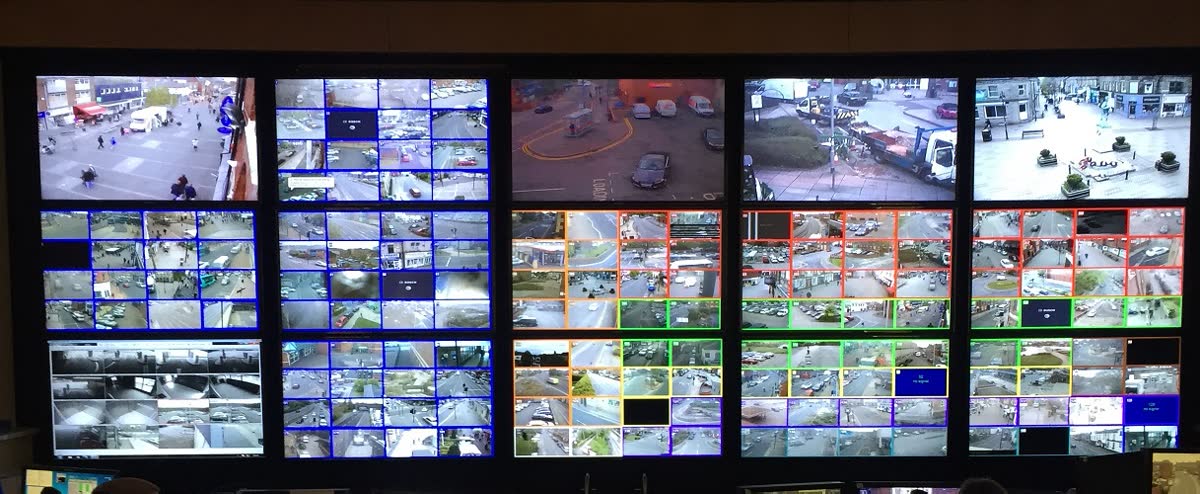
A perimeter system is ordered last in almost every ELV package, and it is the one system whose mistakes are measured in nights, not in test reports. The sensors go up along 1.2 km of boundary, the first windy night produces eleven alarms, the guard stops walking out, and six months later the system is set to “monitor only” — which in practice means it is off.
This is not a design guide. It is the list of decisions a buyer has to make before a supplier can quote, because a quotation answers price and almost never answers grade, zone length, environmental class or what happens on a wet night.
The grade is the specification, not the brand
Every European-spec intrusion system is graded by the intruder it has to stop. EN 50131-1 defines four grades, and the grade drives the whole bill of materials.
| Grade | Risk | The intruder it assumes | Where it appears |
|---|---|---|---|
| 1 | Low | Little knowledge of alarm systems, a few easily available tools | Rarely specified for a real site |
| 2 | Low to medium | Limited knowledge, a general tool kit including a multimeter | Small shops, offices, houses |
| 3 | Medium to high | Knows alarm systems, carries a full tool kit and portable electronics | Commercial sites, hotels, warehouses with stock |
| 4 | High | Plans in detail, has equipment to substitute system components | Sites where security outranks everything else |
Two rules follow, and both are written into the standard: the environmental class and the grade are independent of each other, and the grade of the system is the grade of its lowest-graded component. A Grade 3 panel with Grade 2 beam pairs is a Grade 2 system. This matters commercially because insurers and specification writers quote the grade, and after an incident the first document anyone asks for is the label.
So the RFQ line is not “Grade 3 compatible”. It is “grade marked on each component, certificate number listed per item, and any component below the site grade named explicitly with a reason”. In a hotel or campus project these sensors are one line in a wider ELV package, which is exactly why the grade slips: the package is assembled from three suppliers and nobody owns the weakest part.
Environmental class decides where a detector may be mounted
The second standard, EN 50130-5, classes every device by the conditions it survives. It has nothing to do with grade, and mixing the two is the most common specification error on a perimeter.
| Class | Where the device may sit | Working temperature |
|---|---|---|
| I | Indoor, temperature maintained (offices, living rooms) | +5 to +40 °C |
| II | Indoor in general (corridors, shops, stairways, stores) | −10 to +40 °C |
| III | Outdoor but sheltered, or indoor with extreme conditions (garages, loading bays) | −25 to +50 °C |
| IV | Outdoor in general | −25 to +60 °C |
A detector on a fence post, a sounder on an outside wall and a control panel in a plant room are three different classes on the same drawing. Buy a Class II passive infrared unit for an outside wall and it works for one summer: the first cold snap puts it outside its rated band, the housing takes water, and the alarm it produces at 03:00 is indistinguishable from a real one. Class IV units cost more because of the housing, gaskets, heaters and surge protection — a line item that is easy to delete during value engineering and impossible to add back later.
Six technologies and what each one fails at
There is no best sensor. There are six families, each with a footprint, a power need and a characteristic failure.
| Technology | Principle | Practical zone length | Power at the field | Characteristic failure |
|---|---|---|---|---|
| Electric fence | High voltage pulse on wires; contact completes the circuit | 50–200 m per zone, one energizer per site | Energizer at the fence, mains or 12 V | Vegetation shorting the wires; insulation breakdown; legal and liability questions |
| Tension fence | Mechanical load on taut wires; cutting or spreading drops the tension | 50–100 m per zone | None at the fence, sensor at the end post | Slow drift in tension; wind load; installation quality |
| Vibration fibre | Interference in a fibre optic cable fixed to the fence | 50–500 m per channel | None; one processor in the plant room | Wind and rain on the fence fabric; loose fixings |
| Active infrared beams | Interrupted beam between a transmitter and receiver | 50–200 m per pair | Both ends need power | Fog, rain, snow, birds; misalignment after ground movement |
| Microwave barrier | Disturbance of a microwave field between two units | 100–200 m per pair | Both ends need power | Moving vegetation, reflecting metal surfaces, adjacent units interfering |
| Outdoor dual-technology PIR | Passive infrared plus microwave, both must trigger | 12–30 m per unit | Every unit needs power | Spiders and insects on the lens; animals; heat sources |
Two facts decide most projects. The technologies with the longest zones need power at the field, and the ones with no field power have the shortest zones or the most maintenance. The cheapest unit per metre — usually the outdoor PIR — needs three times as many devices on the same boundary, each with a power drop and its own false alarm rate.
The electric fence comes with a hard safety envelope: IEC 60335-2-76 limits an energizer to 5 J per pulse into a 500 Ω load, a pulse no longer than 10 ms, a repetition rate no higher than 1 Hz, and a peak current of 20 A for no more than 200 µs cumulative per pulse. Those numbers are what makes an electric fence legal next to a public path, and they belong in the certificate request, not in a datasheet footnote.
Three geometry numbers before a single unit is quoted
Take a site with a 1,200 m boundary, a hotel or a plant, and six detection zones of 200 m each. Three numbers have to be fixed first.
Zone length. Six zones of 200 m means every alarm points to a 200 m stretch, which a guard can walk in a few minutes and a PTZ camera can be aimed at. One zone for all 1,200 m means every alarm becomes a full patrol.
Crossing time. The gap between the fence and the building or the car park is what the sensor has to buy. An intruder walking at 1.5 m/s crosses 30 m of open ground in 20 seconds; a slow crawl at 0.3 m/s takes 100 seconds. The alarm chain is longer: 5 seconds to detect, 20 seconds for the operator to verify on camera, around 300 seconds for a guard to reach the zone — about 325 seconds in total, measured with a stopwatch on a real site rather than taken from a brochure. Detection therefore has to happen at the fence line; a sensor that watches the yard instead of the boundary is decorative.
Blind zones. Corners, gates, drainage culverts and the 2 m either side of a gate pier are where every technology loses coverage. Beam pairs on a corner leave a triangular gap, fence-mounted fibre stops at the gate hinges, and a microwave pair will not straddle a vehicle gate. Ask for the coverage drawing with the gaps marked, then count the gaps: a 1,200 m boundary in six zones typically carries four to six, and each one is either a camera task or an extra sensor.
False alarms are labour, and labour is the biggest line
Suppliers quote detection probability and rarely quote a nuisance alarm rate. The number that decides whether the system survives its first year is events per zone per night.
| Events per zone per night | Events per night (6 zones) | Events per year | Guard-hours at 30 min each |
|---|---|---|---|
| 0.20 | 1.2 | 438 | 219 |
| 0.10 | 0.6 | 219 | 110 |
| 0.05 | 0.3 | 110 | 55 |
0.2 per zone per night does not sound like much until it is multiplied out. It is 438 call-outs a year, roughly one every 20 hours, and the practical result is a guard who stops treating alarms as events.
Three design answers, all of which can be written into the purchase order:
- Confirmation by a second technology. If one layer detects with 90% probability and a second, independent layer with 85%, requiring both gives 77% detection and cuts simultaneous nuisance alarms from 0.20 to about 0.04 per zone per night. Layering costs less than a guard patrol and is the only answer insurers accept on a Grade 3 site.
- Time and sensitivity profiles. A profile that reduces sensitivity between 22:00 and 06:00, or ignores a zone while a scheduled gate movement happens, removes most of the avoidable events without removing detection.
- Verification by camera. Analytics on an existing camera at the gate turns a 20 second walk to the monitor into a 5 second glance, and it gives the operator something to decide with. Video analytics on its own is not a perimeter layer; it is what makes a perimeter layer usable. The video analytics guide covers the licensing and false positive side of that decision.
How the alarm leaves the site
A perimeter that alarms into a plant room is a local system. If anyone is to respond, the signal has to reach a receiving centre under a defined performance category, which is EN 50136-1: single path categories SP1 to SP6 and dual path categories DP1 to DP4, with a maximum reporting time per category.
| Category | Maximum primary path reporting time |
|---|---|
| SP4 | 3 minutes |
| SP5 | 90 seconds |
| SP6 | 20 seconds |
| DP3 | 3 minutes (two paths) |
| DP4 | 90 seconds (two paths) |
Two things are worth knowing before signing. From SP4 and DP3 upward the standard requires substitution and information security, which in practice means encryption with keys of at least 128 bits — a plain unencrypted IP dialler does not meet it. And on the IP side the open protocol to ask for is SIA DC-09, an ANSI-approved standard for supervised IP alarm transmission supported by most panel and communicator makers; it is what lets you change the receiving centre without changing the panel.
Ask for the category in writing per path, and for the path-failure reporting time. A dual path transmitter whose second path is a SIM in the same cabinet is a second path on paper only.
Ten lines the RFQ must carry
- Security grade of the whole system, and the grade of every component in the bill.
- Environmental class per device, and the mounting location it is bought for.
- Technology, zone length and total zone count, with the coverage drawing.
- Detection performance figures as measured on a test target walking and crawling.
- Nuisance alarm figures: events per zone per night in the supplier’s reference installation.
- Power: what is fed at the field, PoE class or 12/24 V, and the standby requirement.
- Alarm transmission: category per path, protocol (SIA DC-09 or proprietary), encryption key length.
- Integration: relay outputs for the CCTV system, VMS alarm input count, and whether the panel exposes events over IP.
- Mechanicals: post spacing, fence height covered, mounting kit for the actual fence type, and the corrosion class.
- Spares and service: spare detector ratio, splice kits, energizer or PSU spare, response time, and software licence terms.
A quotation that answers price per metre and nothing else cannot be compared with a second one. The free RFQ template on this site has these columns laid out.
Inspect on arrival, then test in the rain
Five checks at goods-in, three on site:
- Grade and class printed on the label, matching the certificate number on the packing list.
- Tamper switch present on detectors and sounders, and it reports — test it on the bench, not on the post.
- Beam stacks aligned with the alignment indicator working at both ends; housings sealed, gaskets intact.
- Fibre processor channel count and splice loss, with the OTDR trace per channel rather than a summary.
- Power supply: battery date code inside rated life, output voltage under load, surge protection on an outdoor feed.
On site: a walk test at two speeds (about 1.5 m/s and a slow crawl) across every zone boundary and corner; a three-night nuisance log with wind or irrigation running where the season allows; and a timed end-to-end test from intrusion to operator screen to receiving centre, measured against the category’s reporting time.
Six traps
- Buying the grade on the panel only. One Grade 2 component drops the site to Grade 2, and the certificate will not save the claim.
- Using indoor detectors outdoors. Class II on a fence line is a one-season device, and its failures look exactly like intrusions.
- One zone for the whole boundary. The system detects and nobody can act on it, so it is switched to monitor mode within a year.
- Skipping the vegetation strip. The cheapest false alarm reduction on any fence sensor is 1 m of cleared ground under the fence, and it is a civil works line nobody puts in the budget.
- Accepting an unencrypted IP dialler. Below SP4/DP3 the transmission path is not required to be secured, and a perimeter alarm on a plain IP path can be replayed or blocked.
- No nuisance alarm figure in the contract. Without events per zone per night and a remedy, the first windy week is an argument, not a warranty claim.
Where this sits among the other guides
Detection on the fence is the first layer. The camera layer behind it is covered in CCTV camera sourcing and the lens maths in DORI pixel density; where the perimeter meets a gate or a staff door, the credential side is in access control and video intercom. Power and cabling along the boundary follow structured cabling, cable tray and UPS and standby power, and the paperwork that decides whether the site accepts the system is in ELV package handover.
The ELV systems page groups these subsystems by hotel and campus package, and the Bassam Hotel CCTV case shows the drawings and device counts from a delivered site.
Need a perimeter package priced against your site plan? Send the boundary length, the fence type, the number of gates and the site photos, and you get a 48-hour response with zone layout, technology comparison on your own geometry and an RFQ list ready to send to three suppliers. Contact us here.