Structured cabling is the part of an ELV package that most easily gets treated as “just some cable”. It is at project acceptance that the truth arrives: three factories quote the same list with a spread above 40%, all three can hand you a sample, and the difference is not in the negotiating - it is in four things: whether the conductor is actually solid copper, whether the gauge is 23 AWG or 24 AWG, whether the sheath passes EU CPR, and whether the factory dares to issue a permanent link test report. Cable is the material that sits inside walls and cable trays for twenty years without moving; buy it wrong once and the rework costs many times the material itself.
This article does not explain “what a network cable is”. It covers the buying actions you can verify: which material groups the passive layer actually contains, how to tell solid copper from copper-clad aluminium, how to choose between Cat5e / Cat6 / Cat6A / fiber, how the PoE and conductor-gauge arithmetic works, what to look for in a test report, the 8 questions to nail down with the supplier, the 5 sampling checks at goods-in, and the 12-point quotation checklist. Structured cabling is the base layer that carries CCTV, access control, public address, IPTV and wireless APs in hotel low-voltage system integration, and it is the only system that cannot be fixed once the slabs and partitions are closed up.
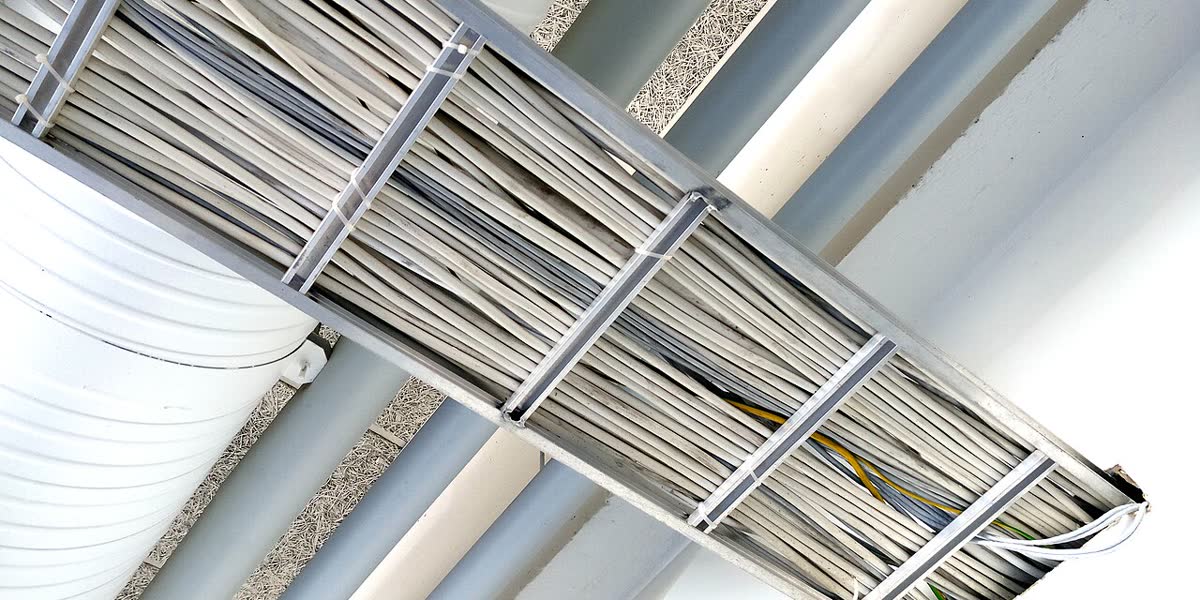
Photo: Santeri Viinamäki, CC BY-SA 4.0, via Wikimedia Commons.
Fix the Scope First: the Passive Layer Is Six Material Groups, Not Just Cable
Treat structured cabling as “buying network cable” and the quotation will never line up. In a complete project, cable is only part of the value; the rest is accessory material, and it usually comes from different factories.
| Material group | Typical spec | What it decides | Most common buying mistake |
|---|---|---|---|
| Horizontal cable | Cat6/Cat6A UTP or F/UTP, 305 m per box | Bandwidth, PoE current capacity, service life | Copper-clad aluminium (CCA) passed off as solid copper; PoE heat above limits |
| Patch panels and modules | 24/48-port patch panel, keystone modules, faceplates | Termination quality, repair difficulty | Modules from a different factory than the cable; return loss fails after termination |
| Patch cords | Cat6/Cat6A cords 0.5-5 m | Channel compliance, on-site loss | 26 AWG slim cords feeding PoE++ devices |
| Fiber and optical distribution | OM4/OS2 cable, pre-terminated MPO, ODF, pigtails | Backbone distance, comms room consolidation | Multimode backbone planned as if it could reach 10 km |
| Cable tray and trunking | Metal tray, PVC trunking, conduit, firestop | Route, fire acceptance | Tray cross-section filled to the line count; no room to add cable later |
| Racks and cable management | 42U rack, cable managers, jumper rings, labelling system | Maintainability, heat removal | No labelling scheme; six months later nobody dares touch it |
One practical rule: count the points to get cable length and port count first, then decide copper or fiber, and only then talk price. For a hotel project with 500 guest rooms and roughly 3,000 data points, at an average permanent link of 55 m per point: 3,000 x 55 m = 165 km, add 10% installation slack for about 181.5 km, which at 305 m per box is about 595 boxes; ports including 20% spare come to 3,600, so about 75 units of 48-port patch panels. At that scale the difference in conductor material is amplified into a six-figure amount.
The First Thing to Nail Down: Solid Copper or Copper-Clad Aluminium (CCA)
This is the one product parameter in structured cabling procurement that cannot be compromised. The TIA-568 series requires a solid annealed copper conductor for horizontal cable; CCA does not comply, but because it is cheap and looks identical, it is the most common way to build a low quotation.
| Item | Solid bare copper | Copper-clad aluminium (CCA) | How to verify |
|---|---|---|---|
| DC resistance | Baseline | Roughly 1.5-2x higher (aluminium resistivity is about 1.6x that of copper) | Measure DC loop resistance per unit length and compare with the sample |
| Mechanical strength | Pulls and bends without breaking | Core breaks after termination, crosstalk unstable | Take one box, do 20 terminations, check the failure rate |
| PoE current capacity | Compliant | Noticeably higher temperature rise | Energise for 30 minutes and measure the temperature rise against the maker’s limit |
| Burn test | Copper colour visible on the conductor cross-section | Core turns grey-white and thinner after burning | Cut a length, strip it, burn it with a lighter - 30 seconds is enough |
| Certification and documents | Can supply third-party test reports | Usually cannot produce a certificate number | Ask for the type test report and the CPR class document |
Practical step: write “conductor: solid annealed copper, 23 AWG, compliant with ANSI/TIA-568.2-D” into the purchase contract and the PO, and agree that a failed incoming inspection rejects the entire batch. Once that clause is in, a large share of the low quotations disappears by itself. For more cases of the same “looks the same, is not the same” trap, see the BOQ traps in China sourcing and ICT equipment quality control.
Cat5e / Cat6 / Cat6A / Fiber: Choose by Bandwidth, Distance and Budget
Selection is not “newer is better”; it is about what service the client will run, how far, and the longest distance from the rack to the outlet.
| Type | Frequency bandwidth | Typical support | Single-segment distance | Where it fits |
|---|---|---|---|---|
| Cat5e | 100 MHz | 1GbE, also runs 2.5GbE | 100 m | Older-building retrofits, voice and access control points |
| Cat6 | 250 MHz | 1GbE full run; 10GbE to about 55 m | 100 m (10G needs a length limit) | Guest rooms, offices, CCTV (PoE) - the workhorse |
| Cat6A | 500 MHz | 10GbE over the full run | 100 m | Backbone consolidation, hospitals and finance, high-density floors |
| Multimode OM4 | - | 10GbE to about 550 m | In-building and campus backbone | Floor switch uplinks, camera aggregation |
| Singlemode OS2 | - | 10G/40G/100G long reach | km class | Between campus buildings, cross-building backbone |
Two practical rules: ① Copper running 10G is distance-limited - Cat6 reaches roughly 55 m at 10GBASE-T, so if the client wants 10G over a full 100 m you must move to Cat6A. That single line decides a material difference in the hundreds of thousands, and it has to be confirmed with the client before contracts are signed. ② Prefer fiber for the backbone: once the run from the floor telecom room to the comms room exceeds 90 m, or the copper would have to cross a power riser or lift shaft, go straight to OM4 or OS2 instead of forcing copper through.
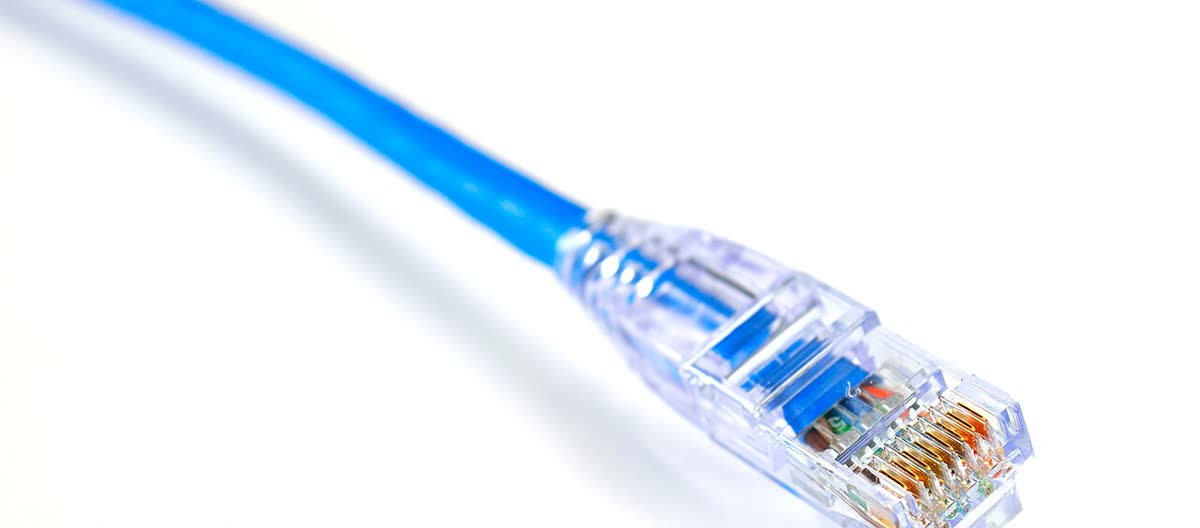
Photo: Raysonho @ Open Grid Scheduler / Grid Engine, CC0, via Wikimedia Commons.
PoE and Conductor Gauge: 24 AWG Is the Money You Cannot Save
CCTV, wireless APs, IP phones and access control readers all draw power over PoE, and the higher the PoE class the larger the current in the cable and the higher the temperature rise - the part most easily blurred in a spec sheet.
| PoE standard | Port power (PSE / powered device) | Pairs used | Cable-side points |
|---|---|---|---|
| 802.3af (Type 1) | 15.4 W / 12.95 W | 2 pairs | 24 AWG acceptable |
| 802.3at (Type 2) | 30 W / 25.5 W | 2 pairs | 23 AWG recommended; derate the bundle by the maker’s guidance |
| 802.3bt Type 3 | 60 W / 51 W | 4 pairs | 23 AWG or larger required; connectors need PoE current testing |
| 802.3bt Type 4 | 90 W / 71 W | 4 pairs | Strict bundle limits; shielding or a larger gauge preferred |
Three numbers to ask for: ① whether the gauge is 23 AWG or 24 AWG (each step down raises the temperature rise at the same current); ② how many powered cables are bundled in the same tray (bundle heat derates current capacity); ③ whether the connectors have been tested to a PoE current standard (IEC 60512-99-001/002). Putting those three into the PO is far cheaper than buying a stack of spare margin on the switch. For the switch side of PoE and power budgeting, see the PoE switch sourcing guide and 24-port PoE switch selection.
Sheath and Compliance: EU Projects Start with the CPR Class
For projects exported to Europe, cable is a construction product and must be classified under EU CPR (EN 50575) into a Euroclass (Dca / Cca / B2ca and so on) with the CE marking applied. The higher the class, the stricter the flame-retardant and low-smoke requirements, and the wider the material and price gap. Four more points to settle at the same time:
- LSZH (low smoke zero halogen): standard in comms rooms, hotel guest rooms, metros and other occupied spaces. PVC sheath is cheaper but produces toxic smoke when it burns, and many projects ban it outright.
- Shielded vs unshielded: hospitals, industrial sites and routes with heavy power interference use F/UTP or S/FTP, but the shield must be bonded continuously end to end; earthing one end only is money wasted.
- Full length and metre marks: whether the quotation is per box or per metre, whether the box really holds 305 m, and whether there is a continuous metre mark. Sample boxes must be measured on arrival.
- Firestop and tray class: fix the firestop material and the spare tray capacity before the slabs are closed, otherwise nothing can be changed on the day of the fire acceptance inspection.
Acceptance: Permanent Link vs Channel, and What the Test Report Must Show
If the field test is done to the wrong configuration, even good material cannot settle responsibility. Separate the two configurations first, then decide what to test.
| Configuration | Definition | Length limit | What it includes |
|---|---|---|---|
| Permanent link | Horizontal cable plus terminations at both ends, patch cords excluded | 90 m | Patch panel to faceplate; the cabling contractor owns it |
| Channel | Permanent link plus patch cords at both ends | 100 m | Includes user and equipment cords; the responsibility boundary must be written down |
Test point by point with a certifier-class cable tester and issue a report. The report has four things to check: ① the test configuration (permanent link or channel) and the limit standard; ② the wire map and the length; ③ whether insertion loss, near-end crosstalk (NEXT) and return loss all pass; ④ whether the number of tests matches the point schedule (a 10% sample or every point). At goods-in, run five more checks:
- Strip a length and look at the conductor colour and gauge (a 30-second lighter test for CCA);
- Weigh a sample box and measure the metre mark (full length);
- Take 10 random pieces, terminate them, and count the failure rate;
- Energise for 30 minutes and measure the temperature rise (PoE types);
- Check that the type test report, the CPR class document and the box marking all agree.
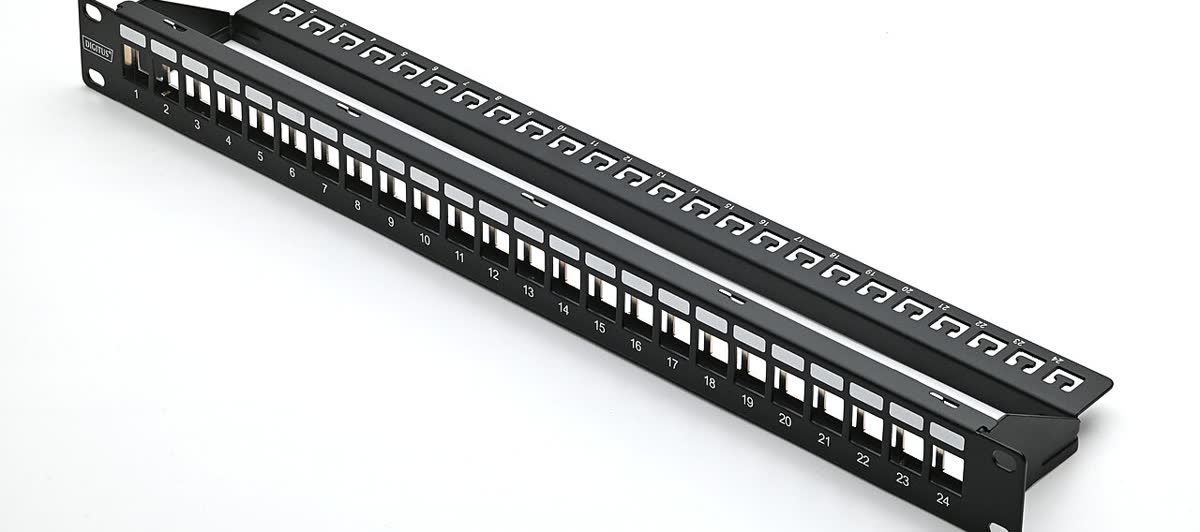
Photo: Phiarc, CC BY-SA 4.0, via Wikimedia Commons.
8 Questions to Nail Down with the Supplier
- Is the conductor solid annealed copper or copper-clad aluminium? What AWG gauge? (Get it in writing.)
- Can you provide a type test report to ANSI/TIA-568.2-D or the equivalent IEC standard?
- What is the sheath material and the CPR Euroclass? Can you issue CE/DoC?
- Is the length full? Is there a continuous metre mark in the box, and will you support opening a box for measurement?
- Are the patch panel, modules and cords made in-house or bought in? Can the whole set ship from one production batch?
- Is the fiber OM4 or OS2, and how is termination decided (fusion splice, pre-terminated MPO, field assembly)?
- Lead time and packing: how many weeks for standard specs, how many boxes fit in a container, and how is moisture protected?
- Warranty and non-conformance: how are failed samples replaced, and who carries transit damage?
The 12-Point Quotation Checklist
What is being bought (cable / modules / patch panel / cords / fiber / tray / rack) - conductor material and AWG - frequency category (Cat6/Cat6A) - shielding type - sheath material and CPR class - length and whether it is full - packing method (box or reel, metre marks) - type of test report - certification documents (CE/DoC/type test) - lead time and container loading - payment terms (deposit and balance before shipment) - warranty years and non-conformance clause. Miss any one of these and the quotations are not comparable.
Structured Cabling Sourcing: FAQ
Q1: How much more does Cat6A cost than Cat6, and is it worth it? The difference is mostly copper content and construction - Cat6A is thicker and usually shielded with a cross-web separator. If the project has to run 10GbE over the full 100 m, or the consolidation points are dense, Cat6A is the only option. For guest room internet, CCTV and IP phones, Cat6 is entirely sufficient. The decision rests on service bandwidth and the longest run, not on newer being better.
Q2: Can copper-clad aluminium (CCA) be used at all? Not in horizontal cabling. TIA-568 requires a solid copper conductor for horizontal cable; CCA has higher DC resistance, weaker mechanical strength, a higher temperature rise under PoE and a clearly higher termination failure rate. It occasionally appears in short patch cords or non-data low-voltage work, but if the quotation does not state the conductor material, treat it as a risk item.
Q3: Is shielded cable the safer choice? No. Shielding (F/UTP, S/FTP) earns its keep in high-interference environments, but the shield must be bonded continuously end to end, otherwise it becomes an antenna and the numbers get worse. UTP is enough for most offices and hotel guest rooms; the budget is better spent on solid copper and a larger conductor gauge.
Q4: Should the test report cover every point or a sample? For hotels, hospitals and financial projects, test every permanent link and hand over the raw .flw files with the as-built documents. For retrofit projects a 10% sample can work, provided it covers the longest link, the point furthest from the comms room and any route through a power riser. State the test configuration and the limit standard, and the responsibility boundary is clear.
Q5: How do we fix the termination method for the fiber backbone? For projects with many floors and dense point counts, use pre-terminated MPO cable: plug and play on site, shorter programme. For long backbones where cost matters, splicing gives lower insertion loss but needs a fusion splicer and certified technicians. Both require insertion loss and return loss testing, and both report sets must ship with the goods.
Send the BOM and Get a Comparable Quotation within 48 Hours
If you have a project list in hand - whether it is 3,000 data points in one building or the whole passive layer of a 500-room hotel ELV package - send us these items: point count and distribution, service type (1G/10G), the longest link distance, whether shielding is required, the target market and certification requirements (CE/CPR or other), and the delivery port. Within 48 hours we will return a formal comparison of 3-5 factories, line by line on conductor material, AWG, sheath class, packing and test reports, and tell you which parameters can be negotiated and which ones break the moment they are.
The structured cabling list is normally issued together with access control and intercom, public address and CCTV; it is worth checking the whole package against one ELV system cost structure so the subsystems do not buy cable twice or chase the same walls twice.
WhatsApp / phone: +86 139 2270 2227 (Guangzhou team, Monday to Saturday 09:00-19:00 GMT+8, messages answered within 12 hours including weekends) | Email: sales@cantonmade.com. To see how the whole process runs from enquiry to shipment, read how we work; for the layered design approach on hotel projects see ELV floor design for a 500-room hotel and wireless network design for a 500-room hotel.