Access control and video intercom are the easiest items to buy wrong inside an ELV package: it looks like a lock plus a screen, but it actually spans four things - credential technology, mechanical construction, fire regulation and system software. Three quotations that differ 2-3x are normal, and the gap is usually not expensive against cheap - it sits in card technology, lock type, whether it is networked, and the software licence scope.
This article does not explain “what access control is”; it covers the buying actions you can check: the three layers a door entry system splits into, how to choose among five credential technologies, why hotel locks and commercial access control are two different logics, how to set the fail mode of an electric lock, two-wire against IP intercom, the 8 questions to nail down on the quotation, and the 5 items to sample at inspection. Access control and video intercom are subsystems of hotel low-voltage system integration alongside CCTV and network - they have the most interfaces, and are the most likely to be reworked during commissioning.
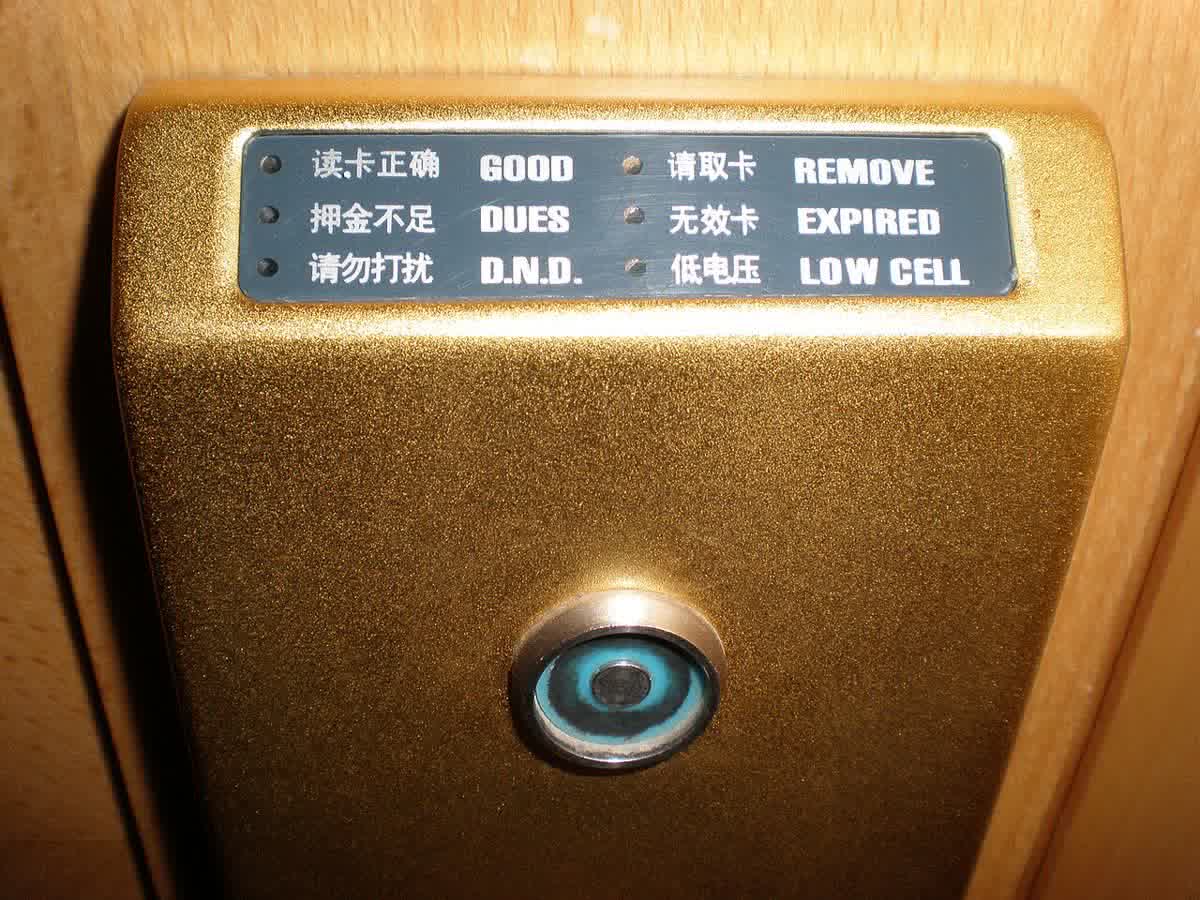
Photo: BrokenSphere, CC BY-SA 3.0, via Wikimedia Commons.
1. First, Separate the Layers: Access Control Is Not One Product
Treating “access control” as a single SKU to compare prices is the root of scope confusion. The real structure is three device layers plus an intercom layer, each supplied by a different vendor and each accepted separately.
| Layer | Typical devices | What it decides | Most common buying mistake |
|---|---|---|---|
| Control layer | Access controller, card reader, management software, card encoder | System capacity, offline operation when the network drops, communication protocol, scalability | Comparing reader unit prices only, without counting controller capacity and software licence |
| Actuation layer | Electronic strike / maglock / electric bolt / motorised lock body, lock power supply, exit button, door contact | Security level, behaviour on power loss, egress compliance | Wrong lock type, so the fire acceptance fails |
| Credential layer | ID card, IC card, CPU card, mobile key, fingerprint | Copy resistance, future upgrade cost | Using a copyable ID card as the access card |
| Intercom layer | Door station, indoor station, gateway, PoE switch ports | Cabling method, interlock with access control / lifts / PMS | Outdoor door station with no IP rating and no tamper protection |
A practical rule: fix the credential layer and the egress requirement first, then choose the actuation layer, and only then configure the control layer. Doing it the other way round (picking the reader first) will almost always come back for rework on fire interlocking or card compatibility. If all you hold is a one-line list saying “we need an access control system”, start from why a hotel ELV project needs a technical sourcing agent and break the scope down to point level before comparing prices.
2. Card Technology: The Main Reason Quotes Differ 3x
Credential technology is the least transparent of the four, and the biggest single source of price spread on the same system. The five mainstream technologies differ as follows.
| Technology | Frequency | Encryption / copy resistance | Typical read range | Where it fits |
|---|---|---|---|---|
| EM4100 / T5577 (known as ID card) | 125 kHz | No encryption, UID copyable | ≤10 cm | Internal car parks, low-security internal doors |
| Mifare Classic 1K/4K (IC card) | 13.56 MHz | Crypto1 algorithm is public and broken; UID can still be cloned | 3-5 cm | Mainstream hotel guest room locks; not for high-security points |
| Mifare DESFire EV1/EV2/EV3 | 13.56 MHz | AES-128 / 3DES, encrypted transactions, not copyable | 3-5 cm | High-security points, one-card systems (access + lifts + spend) |
| CPU card (including SM4) | 13.56 MHz | Symmetric algorithm runs inside the card; key cannot be exported | 3-5 cm | Government, finance, campus one-card systems |
| Mobile key (NFC / BLE) | 13.56 MHz / 2.4 GHz | Credential in the phone’s secure element, revocable remotely | tap 3-5 cm; BLE a few metres | Guest self check-in, staff mobile credentials |
Three buying judgements:
- A longer read range is not better. Read range is bought with antenna size and transmit power, and a longer range makes relay attacks easier (extending the reader’s field to a distance). 3-5 cm is normal for a door reader; if a reader claims “20 cm, no need to tap”, ask what anti-relay protection it offers.
- 125 kHz is not unusable, but it cannot be used at high-security points. Its UID can be copied with cheap equipment. Fine for staff attendance or a car park entry; a risk for a comms room, a finance office or a guest room.
- Whichever card a hotel lock uses ties you to it for the next decade. Changing card technology means changing every lock reader head, so choose backwards from “will we add mobile keys within five years”: DESFire upgrades smoothly, Crypto1 Classic does not.
3. Hotel Guest Room Locks vs Commercial Access Control: Two Different Logics
These two scenarios are often written into one RFQ, but their design goals are opposite - a hotel wants offline operation, bulk card issuing and PMS integration first; commercial access control wants real-time online control, central management and fire interlocking first.
| Dimension | Hotel guest room lock | Commercial access control (office / campus / apartment) |
|---|---|---|
| Networking | Mostly offline: room number and validity written to the card, verified locally by the lock | Real time: controller and server communicate continuously |
| Key accessories | Card encoder, lock management software, PMS interface, floor and common-area doors, emergency card | Access controller, software licence, fire interlock module, backup power |
| Power / network loss | Mechanical key as fallback; battery powered with early low-battery warning | Backup battery plus controller offline whitelist, auto sync on recovery |
| Scale | Hundreds to a few thousand doors | Tens to a few thousand doors |
| Acceptance focus | Unlock success rate, battery life, audit record count, PMS integration | Read success rate, release on power loss, event records not lost |
| Most common mistake | Buying locks only, without the encoder, software and PMS interface | Buying controllers only, without fire interlock, power supply and cable sizing |
Two easily missed details on hotel locks: audit record capacity (commonly a few hundred to a few thousand records, collected on site by a handheld unit; too small and you cannot trace an abnormal opening after checkout) and battery life (typically 12-18 months on 4 alkaline cells, and the low-battery warning must show in the software, or the front desk finds out before the guest does). Both should be written into the acceptance criteria. For multi-subsystem hotel projects, zone and point scope can be cross-checked against a hotel ELV design case broken down by floor - door lock and access points are usually scheduled together with CCTV and lifts.
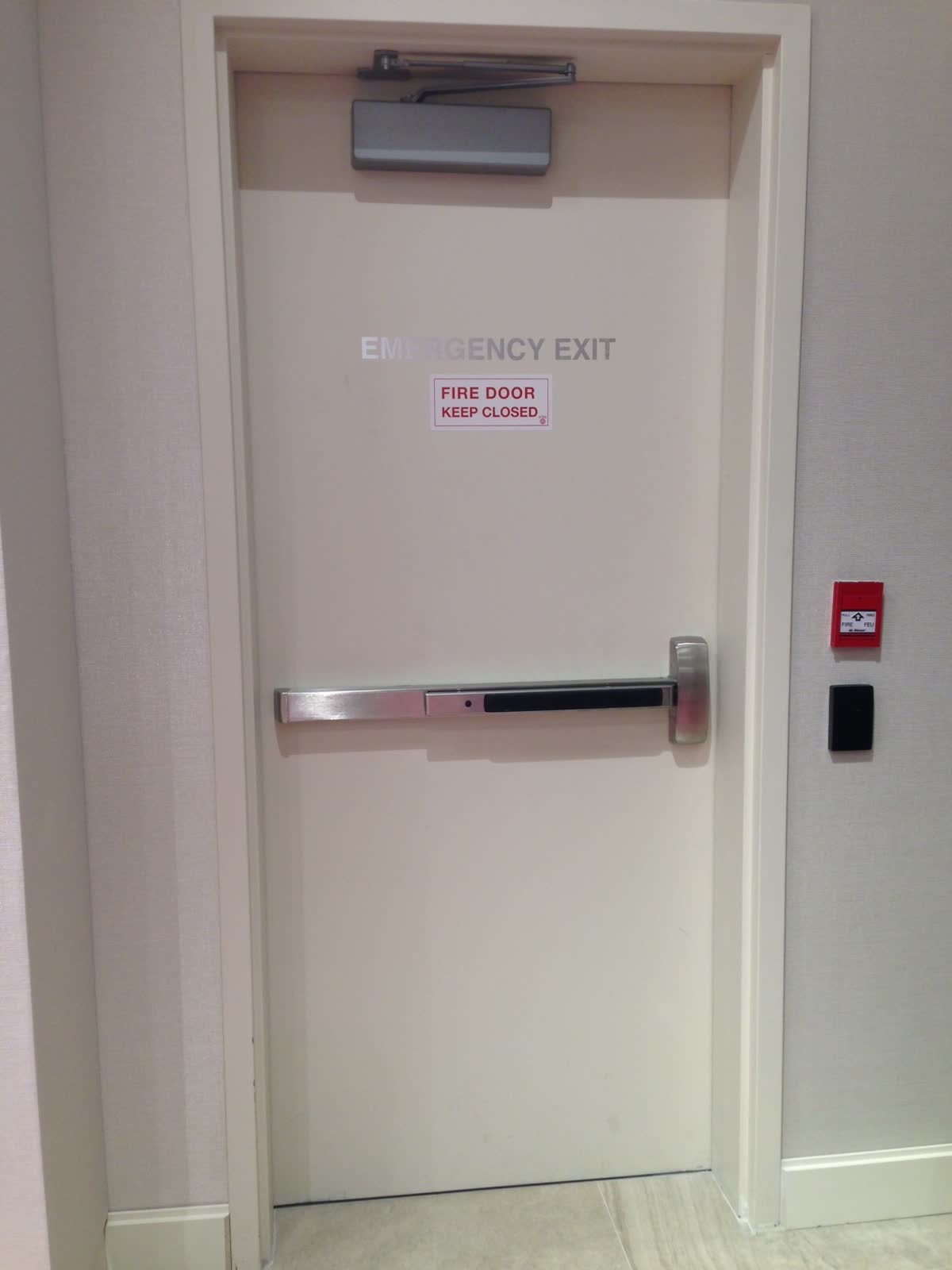
Photo: Artechvideo, CC BY-SA 4.0, via Wikimedia Commons.
4. Choosing the Electric Lock: Set the Fail Mode First, Then the Lock Type
The actuation layer is selected in the order “fix the state on power loss, then fix the mechanical form”. Reverse the order and you will tear it all out at fire acceptance.
| Lock type | Door types | Behaviour on power loss | Notes |
|---|---|---|---|
| Electronic strike (keeper) | Timber and metal doors, works with a mechanical lock body | Can be fail-safe or fail-secure | Replaces the strike on the frame, keeping mechanical key operation |
| Electromagnetic lock (maglock) | Glass doors, double doors, surface mounted | Fail-safe: opens when power is cut | Holding force chosen by rating (commonly 280 kg / 600 lb class); verify on site |
| Electric bolt | Glass doors, floor spring doors | Either, depending on the door | Needs mounting space in both the floor spring and the frame |
| Motorised lock body | Doors that must stay locked, with a high appearance requirement | Usually fail-secure | Stays locked on power loss; needs a door contact to report door state |
On an escape route you cannot look at the lock alone. The door must release automatically on a fire alarm - that is a regulatory issue, not a preference: Europe uses EN 13637 (electrically controlled locking systems on escape routes) and EN 179 / EN 1125 (mechanical escape hardware); the US goes through NFPA 101 plus UL 294 (access control equipment). Delayed egress under NFPA 101 requires an audible and visual warning before the delay. Put “the lock must release on fire alarm, with an interlock wiring scheme” into the technical requirement at RFQ stage - far cheaper than retrofitting an interlock module later.
Two installation parameters directly affect whether a price is reasonable:
- Current: a maglock typically draws 400-500 mA at 12 V, and an electric bolt draws 500-900 mA inrush. Size the lock power supply for the peak with all locks operating at once, plus battery backup - never as single-lock current multiplied by the number of doors.
- Cable gauge and distance: for 12 V DC lock power, ≥0.75 mm² is normal at 30 m; go to 1.0-1.5 mm² for longer runs or two locks operating together, or power locally. On the reader side, Wiegand needs 6-core shielded cable; OSDP runs on RS-485 twisted pair.
5. Video Intercom: Two-Wire or IP - Check First Whether There Is Cable in the Wall
The choice of intercom is fundamentally about cabling conditions, and only then about features.
| Option | Cable | Single-segment distance | Power | Suits | Limitations |
|---|---|---|---|---|---|
| Two-wire (non-IP) | One 2-core cable carrying video, audio and power | Usually ≤100 m (some brands longer) | Powered by the door station / master station | Villas, retrofits of older buildings, projects with few points | Weak expansion, limited phone-app interworking |
| IP / SIP | Cat5e / Cat6 | 100 m per segment | PoE 802.3af (15.4 W) / 802.3at (30 W) | Hotels, apartments, multi-building sites, phone-app interworking | Needs switch ports, IP planning and a PoE power budget |
| Hybrid / using existing cable | Whatever is in the building | Depends on the cable | Depends on the master station | Retrofits of existing buildings | Each point must be checked for whether the existing cable can carry video |
Points you can check: an outdoor door station must be specified at IP65/IP66 with tamper alarm; SIP follows RFC 3261 and interworks directly with an IP PBX or softswitch, which is the hard test of “can it join the existing voice system”; where the door station has its own camera, require ONVIF Profile S so the video can go into the NVR for unified storage. PoE power for the intercom points belongs in the switch budget - it is the same sum as port and power budgeting for PoE switch sourcing, and “the door stations are fitted but the switch has no ports left” is a common hotel rework.
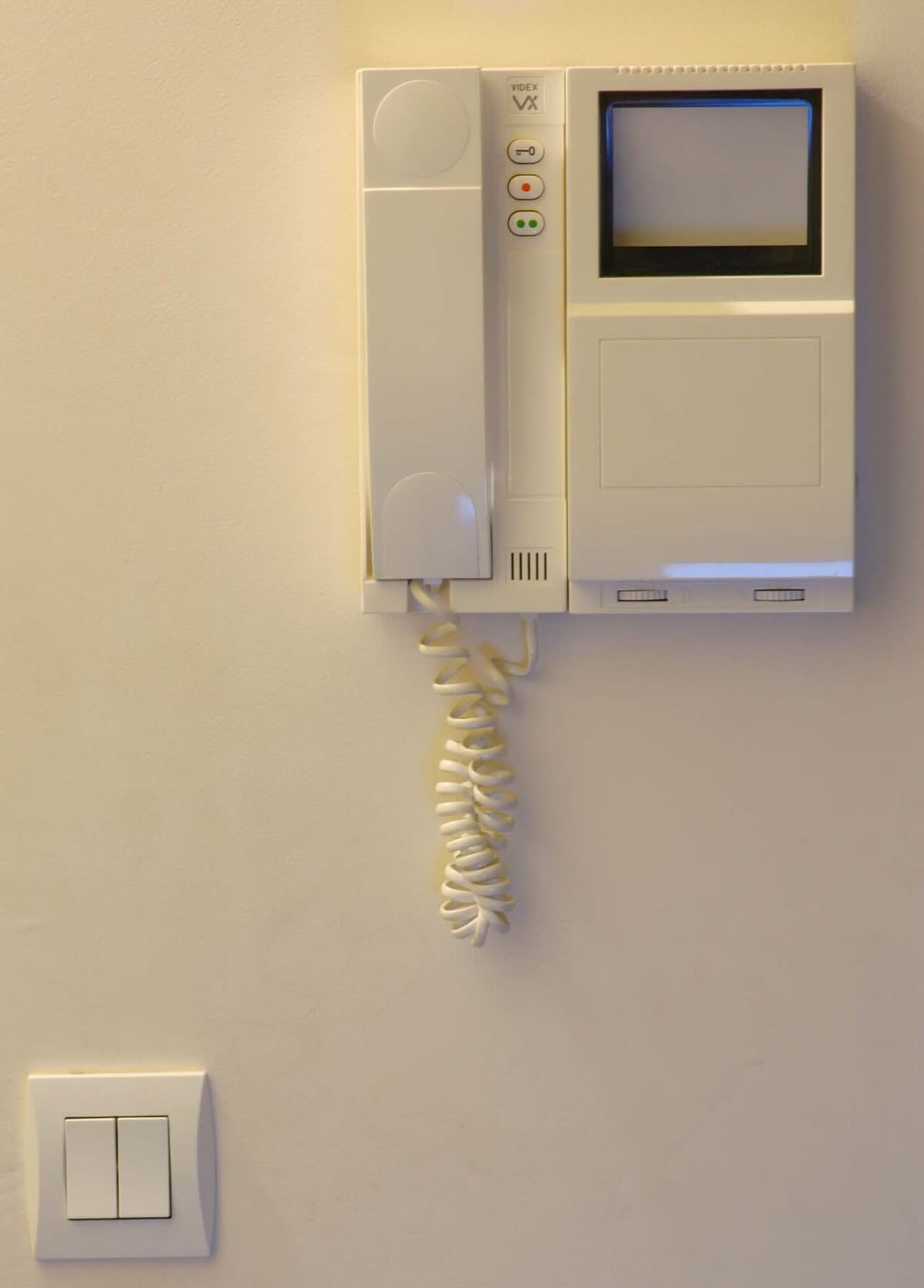
Photo: MyName (Nono365), CC BY-SA 3.0, via Wikimedia Commons.
6. What Decides the Cost: Four Variables, Not a Unit Price
There is no answer to “how much for a system”. Cost is decided by four variables, and the quotation must be aligned on all four:
- Credential technology: 125 kHz ID cards and DESFire cards are not on the same cost level; card unit price and reader price both move with it.
- Door count and lock type: door count is a linear variable (each door is one reader + lock + power supply + button); lock type and fail mode set the per-door price.
- Networked or not: networked locks and online controllers add gateways, cabling, switch ports and commissioning hours; an offline approach trades those costs for administrative labour.
- Software and licence model: per-door or per-card licensing, perpetual or annual, and whether an API / SDK is provided - this item is often blurred in quotations.
So the first question when comparing quotes is: “Does this quotation include the software licence, lock power supply, exit button, door contact, cabling consumables and commissioning?” Only after everything is aligned to one scope does price negotiation mean anything. For how each cost block weighs at ELV package level, cross-check how to budget an ELV system: access control and intercom sit in the equipment block, while interface and programming hours fall in the software and commissioning block.
7. The 8 Questions to Nail Down With Suppliers
- Are the card and chip original or compatible parts? Up to which EV generation of DESFire is supported?
- Besides Wiegand, does the reader support OSDP v2 (SIA / IEC 60839-11-5, with an AES-128 encrypted channel and remote upgrade)?
- What is the controller capacity (cards, events)? How long can it run offline when the network drops, and does it auto-sync on recovery?
- What is the door type compatibility list (timber / glass / metal / double / floor spring) and the fail mode of each lock?
- How does it release on a fire alarm? What interlock interfaces are provided (dry contact / relay / software interlock)?
- How is the software licensed (per door / per card / perpetual / annual)? Is an API / SDK provided?
- How does it interoperate with existing systems: reader Wiegand / OSDP, camera ONVIF, intercom SIP, plus lift control and PMS interfaces?
- Spares and after-sales: what is the warranty on controllers, lock bodies and power supplies, and for how many years is spare-part supply guaranteed?
Questions 2 and 5 filter out genuine engineering suppliers best. Anyone who can only answer “our readers are Wiegand” and cannot talk about OSDP is usually a trader assembling modules. For the general factory audit and capacity check process, run through the free factory audit checklist first, then do the on-site check with the complete factory audit guide.
8. Inspection and Acceptance: Sample These 5 Items
Access control and intercom faults mostly surface during commissioning, so factory inspection and site acceptance must be kept apart - factory inspection checks devices, site acceptance checks the system.
| Sample item | Method | Pass criteria |
|---|---|---|
| Read success rate | Present the same card at the same reader 100 times in a row | ≤1 failure, and no duplicate reads |
| Read range and tamper | Measure the read distance; open the housing | Read range matches the rating; opening the housing triggers the tamper alarm |
| Lock force / action | Measure the maglock with a force gauge; watch the bolt actuate and return | Measured force close to rated; no sticking |
| Lock durability and battery | Simulate 100,000 card reads; check the battery model and low-battery warning | No abnormal mechanical wear; the warning is reported |
| Offline and recovery | Disconnect the controller for 24 hours, then reconnect | Event records are not lost, auto sync on recovery |
Run a 24-72 hour powered burn-in on the batch, on the same basis as pre-shipment burn-in testing; sample to AQL, and the AQL sampling table can be used directly. After arrival, keep the inspection report and point test records following the full pre-shipment inspection process as evidence for releasing payment. Where a one-card system is involved (access + lifts + parking on one card), run one cross-subsystem commissioning before shipment rather than testing each part and shipping - for a multi-subsystem device list, see the 500-room hotel ELV sourcing case.
9. Six Common Pitfalls
- Comparing unit price without comparing scope: whether the quote includes the software licence, power supply, buttons, door contacts and cabling - the difference often exceeds the equipment price gap.
- Using a 125 kHz ID card as the access card: no encryption and a copyable UID - a back door if used on guest rooms or comms rooms.
- A reader that only supports Wiegand: one-way, unencrypted, no remote upgrade - new projects should require OSDP.
- A maglock on an escape door with no fire interlock: power loss releases it, but without fire interlock and power-loss monitoring it does not meet escape regulations.
- A hotel buying locks without the encoder, software or PMS interface: cards cannot be issued on installation day - the most common cause of a hotel project stalling.
- An outdoor door station with no IP rating or tamper protection specified: water ingress within six months, or a pried-off faceplate, and no clear responsibility even inside warranty.
Access Control & Video Intercom: FAQ
Q1: What does an access control system cost? There is no single unit price; cost is decided by four variables - credential technology, door count and lock type, networking, and software licensing. The workable approach is to list the door schedule first (door type, fail mode, networked or not for every door), price it row by row, then look at the whole. The shares in the equipment and commissioning blocks can be cross-checked in the ELV system cost breakdown.
Q2: Does a hotel lock always need a card encoder and management software? Yes. The lock is only the executing end; the card content is written by the encoder and its expiry is managed by the software, and it must integrate with the PMS so that card issuing syncs when the front desk checks a guest in. Buy locks only and you cannot issue a card on site.
Q3: Are 125 kHz access cards still usable? They can be used in low-security situations (internal car parks, non-sensitive passages), but are not recommended for guest rooms, comms rooms or finance offices, because the UID can be copied with cheap equipment. For new projects go straight to 13.56 MHz DESFire or CPU cards.
Q4: What is the difference between Wiegand and OSDP? Wiegand is an old one-way, unencrypted interface that only carries the card number; reader and controller cannot authenticate each other. OSDP (IEC 60839-11-5) is a bidirectional protocol with an encrypted channel, supporting remote upgrade, status monitoring and tamper reporting. The price difference is small; the difference in security level and day-to-day maintenance is large.
Q5: Can a maglock be used on an escape door? A maglock is fail-safe by itself (it opens on power loss), but on an escape door it must have fire interlocking: automatic release triggered by the fire alarm signal, plus power-loss monitoring. The basis is EN 13637 / EN 179 / EN 1125 in Europe and NFPA 101 plus UL 294 in the US. A maglock without interlocking will not pass escape acceptance.
Q6: Two-wire or IP for video intercom? Look first at whether there is cable in the wall. For an older building with few points, two-wire can use the existing 2-core cable, usually within 100 m per segment; for hotels, apartments, multi-building sites, or where phone-app interworking and NVR storage of the video are needed, IP / SIP is more suitable - but reserve switch ports and a PoE power budget.
Send the Door Schedule and Point List - More Useful Than Asking the Price First
The most expensive cost in access control and intercom is not the equipment, it is the rework caused by misaligned scope. Send us the door schedule, the point list or the BOQ and the first thing we do is not quote - it is to mark up, line by line, the lock type, the fail mode and whether each door is networked, together with a price range at one scope. For hotel and commercial access control plus intercom packages we return a layered quotation and an interface responsibility note within 48 hours; the full scope of supply for an ELV system is here.
WhatsApp or email both work - just send the list: contact us · how we work.