The most expensive moment in an ELV package is not the quotation — it is the day the power goes on.
The container is opened, the rack is energised, and the patch panel labels do not match the drawings; a 24-port PoE switch feeds 24 cameras and the 20th one drops the moment it is plugged in; two NVR bays sit empty because the hard disks were not counted as spares at customs. None of that is an equipment problem. It is a problem of the delivery stage never being defined. How to price the package, where its scope and boundaries sit, was covered in ELV system cost structure and the ELV / low-voltage boundary; this piece covers one thing only: the four stages between the factory and the owner’s hands — what to do at each, and what documents each one leaves behind.
1. Split “delivery” into four stages, each with a failure test
A single line saying “delivery in 45 days” guarantees nothing. What can actually go into the contract is four stages, each with its own required attendees, deliverables and failure handling:
| Stage | Who must be present | Deliverable to collect | What happens on failure |
|---|---|---|---|
| Factory integration | Factory rack-build team + our QC | In-rack wiring diagram, label schedule (Excel), packing list | Rework, then re-photograph the rack interior — “we will be careful next time” is not accepted |
| FAT (factory acceptance test) | Buyer’s representative or agent + supplier engineer | Original per-port test report, 24 h continuous recording screenshots | No complete report set, no container loading |
| Site re-test | Installation crew + ELV subcontractor | Re-test record for every port and every channel | Written notice within 48 h; after that it is treated as accepted |
| Handover | Owner’s operations team + integrator | The seven documents (below) | Final payment released against a complete handover set |
The stage most often skipped is FAT, because it falls in the window where the goods are built and the ship has not sailed — the buyer has usually paid the 30% deposit and already feels the job is done. That is precisely the only chance to find problems while fixing them is still cheap: the rack is still in the factory, where terminating one more port takes ten minutes; on site, the same port means taking down a ceiling.
2. Rack build: count the U positions before discussing an “integration fee”
Integration is not “bolting equipment onto a frame”. It is getting termination, power, cable management and labelling right in one pass. Start with capacity — a 42U rack in the ELV room of a hotel the size of 500 rooms, for example:
| Item | U | Note |
|---|---|---|
| 24-port patch panel × 4 | 4U | 96 network termination points |
| 24-port PoE switch × 3 | 3U | Uplink over fibre or stacking |
| Core / access switch × 2 | 2U | Segregated from the camera subnet |
| NVR and storage × 2 | 4U | Bay count follows channel count and retention days |
| Cable management panels / vertical managers | 3–4U | Leave cable path space front and rear |
| PDU × 2 (dual feed) | 2U | Vertical mounting saves U |
| Total used | ≈ 18–19U | About 45% of a 42U rack |
The rule: never exceed 70% occupancy, and keep at least 15% (about 6U) free for growth. Many projects have a full ELV rack in year one — not because there is too much equipment, but because cable management space was not left during integration, patch cords stack layer on layer, and the only remaining option is a new rack. Price integration in person-days: 48 terminations + 2 NVRs + labelling is normally 3–5 person-days, and the quotation has to break it into three lines — person-day rate, patch cord quantity, label quantity.
3. PoE budget: port count × per-port wattage × 1.3
This line is wrong on almost every ELV quotation: it says “24-port PoE switch” and never states a power budget.
| Standard | Type | PSE-side limit | Available at the device |
|---|---|---|---|
| IEEE 802.3af | Type 1 | 15.4 W | 13 W |
| IEEE 802.3at | Type 2 | 30 W | 25.5 W |
| IEEE 802.3bt | Type 3 | 60 W | 51 W |
| IEEE 802.3bt | Type 4 | 90 W | 71.3 W |
Worked example: 48 fixed bullet cameras at 13 W each = 624 W, plus about 60 W for the switch itself, plus a 30% margin ≈ 890 W. That means one 400 W, 24-port switch cannot carry 24 cameras — a theoretical figure of around 30 channels has to be discounted to roughly 20 in practice. Points with a pan-tilt head (PTZ) or a heater start at 25.5 W, and one PTZ equals two fixed cameras.
Two more numbers that get forgotten: keep the rack intake air at 18–27 °C (the ASHRAE recommended range), because the temperature rise inside the rack at full PoE load is clearly higher than at idle; and cameras mostly run on 12 V or 24 V, so a single 60 W Type 3 port fed directly by PoE can eat the whole switch’s spare capacity. Put “total PoE budget in W” and “per-port limit in W” on one line of the quotation, not just “PoE supported”.
4. Rack cabling and labelling: three hard numbers
| Metric | Value | Source |
|---|---|---|
| Minimum bend radius, copper cable | ≥4× cable outside diameter installed; ≥8× while pulling | ANSI/TIA-568.2-D |
| Minimum bend radius, jacketed fibre | ≥10× outside diameter | Manufacturer specification and the TIA-568 series |
| Label position | Within 300 mm of the termination at both ends, machine printed | ANSI/TIA-606-C |
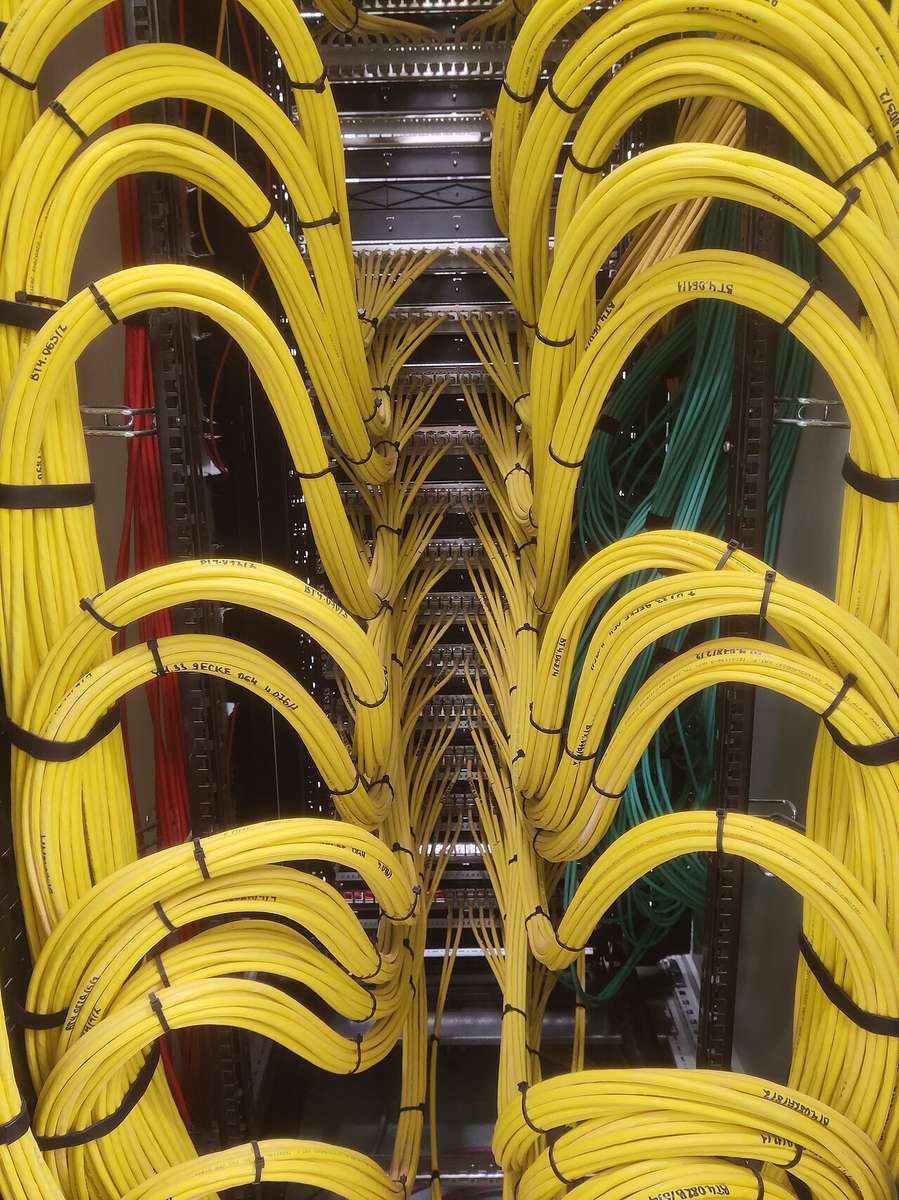
Do not invent your own labelling system. TIA-606-C gives a hierarchical identifier, for example B1-TR2-PP05-P12 (building 1 – telecom room 2 – patch panel 5 – port 12); it reads the same at both ends, so nobody has to open a drawing to know where a cable comes from and where it goes. Colour is part of the standard too: blue for horizontal cable, purple for common equipment (PBX, matrix switchers and so on), brown for the inter-building backbone. In an ELV room colours read faster than labels, because one glance tells you this is not a guest network.
The most common scene in an ELV room looks like this:
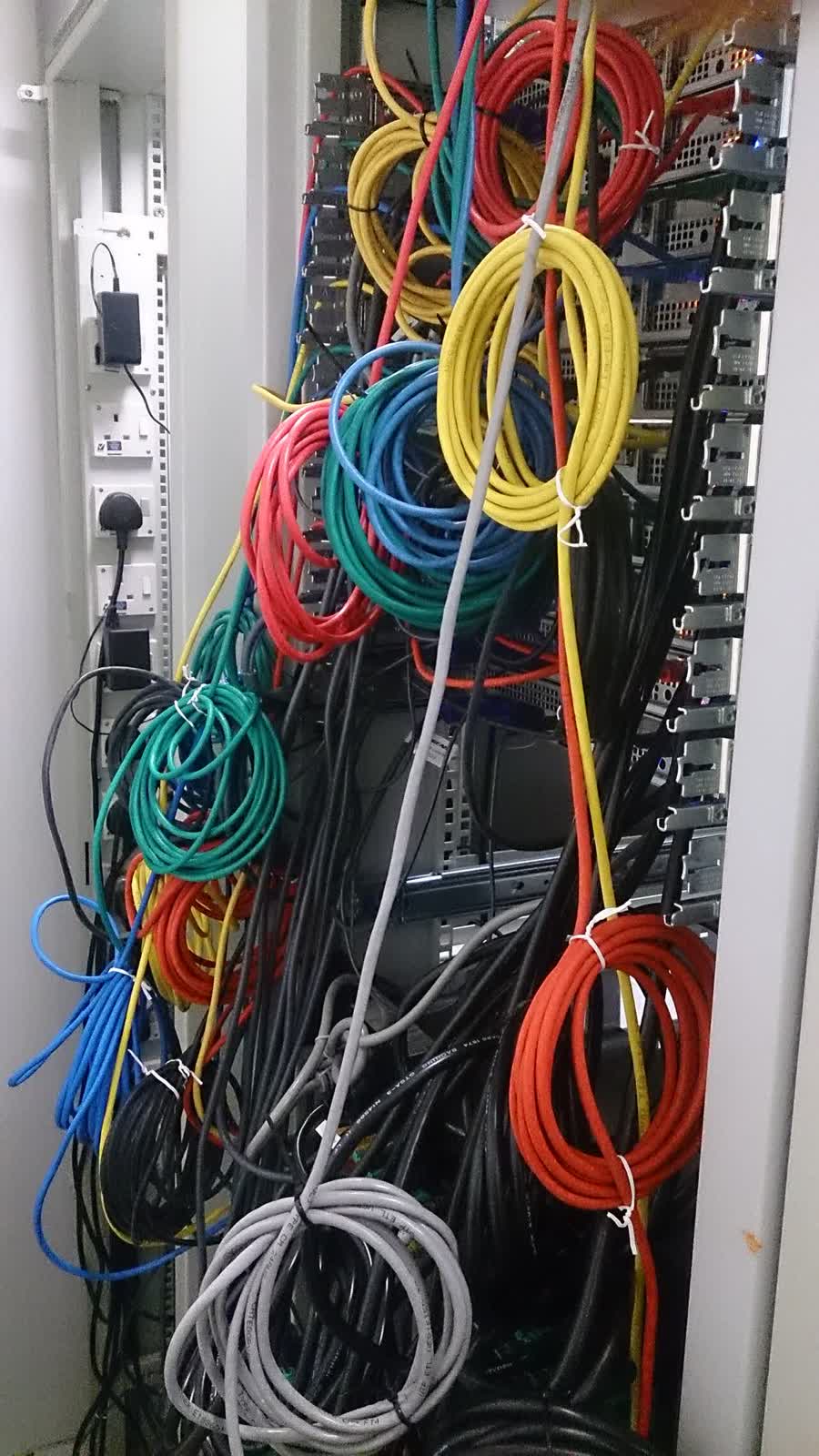
That state is not “untidy”, it is unmaintainable: every fault-finding call means pulling cables and guessing, and one wrong pull can take out a fire interlock or release a door that should stay locked. Getting bend radius and labelling right during integration is how the maintenance cost of the next three years gets paid down now.
5. Eight FAT checks you can finish on the spot
| # | Check | Pass criterion |
|---|---|---|
| 1 | Per-port permanent link test | Cat6A at 500 MHz, Cat6 at 250 MHz; report carries tester serial number and calibration date |
| 2 | Loaded PoE test | Every port connected to a real device or an equivalent load; total power within the switch budget |
| 3 | Label spot check | Random sample ≥10%, compared line by line against the label schedule; zero errors allowed |
| 4 | Firmware and configuration locked | Version numbers written into the report; no upgrading on site |
| 5 | 24 h continuous recording | Playback, export, timestamp and bitrate screenshots |
| 6 | UPS transfer | Cut mains; load does not drop, NVR does not stop recording |
| 7 | Power-cycle self recovery | After power returns, every PoE device comes back up automatically with no manual intervention |
| 8 | Packing list and spares | Patch cords 5%, power modules 2%, spare disks, keys and tools |
Checks 1 and 7 are the important ones. The link test report is the only document that proves the cable is not mis-wired and not over-length; the power-cycle test is what exposes hidden defects such as unsaved configuration or a wrong PoE power-up sequence — defects that show up on site as “a few channels only come up sometimes”, which are the hardest to find.
6. Five site re-tests, and “power connection” written into the contract
- Rack fixing and earth resistance, accepted against the code that applies where the project is built;
- Consistency between incoming labels and in-rack labels, checked line by line;
- Link re-test: 100% of critical points, a 10% sample of ordinary points;
- Camera bring-up rate across all points — one missing channel sends you back to the PoE budget and the wiring sequence;
- NTP time sync and time zone — recording time eight hours out makes the evidence worthless.
Power connection responsibilities must name a party, not say “coordinated”: who supplies the PDU, who pulls the 220 V feed, who provides the dual feed, who verifies the breaker rating. On hotel ELV systems projects these four are the interfaces with the highest rework rate — usually not a technical problem, but nobody owning them.
7. Seven handover documents: collect all of them before the final payment
- As-built drawings, including the in-rack wiring diagram and photographs;
- IP address schedule and default credential sheet (force a password change after handover);
- Original per-port test reports;
- Point schedule — floor, room, point, resolution, focal length — which maps directly onto the pixel density method;
- O&M manual with spare part models and replacement intervals;
- Training record (≥2 hours on site plus a recording);
- Spare parts list, warranty start date and response time limit.
Number 4 is the one most often missing. The point schedule is not for the buyer, it is for whoever takes over three years later: which point on which floor has to identify a face, and which only needs coverage. If that is not written down, someone has to climb a ladder and measure the distances again. For how this list lands in a real delivery, see the original structure of the 500-room hotel ELV package case.
8. Six lines that must appear as numbers on the quotation
- Integration in person-days (not an “integration fee”);
- Whether the test report includes instrument calibration, and how many copies;
- Whether labelling includes batch printing and fixing at both ends;
- Spare ratios (patch cords 5%, power 2%, disks 10% of bay count);
- Training duration and format (on site / recording);
- Warranty start date, response time limit, consumables exception.
The point of writing these six lines down is not to drive the price down; it is to turn “who does what” from a verbal promise into a clause you can withhold payment against. It is the same logic as pre-shipment inspection — what is being inspected is not the equipment, it is the evidence the process leaves behind. If you want an acceptance sheet you can send to a supplier as it is, adapt the inspection report template rather than writing a new one.
Which stage is your ELV package missing?
Send us the drawings, the point schedule and the quotation you already have, and within 48 hours we return three things: a check of your rack positions and PoE budget, a FAT checklist cut down to your system list, and a list of the handover documents you are missing. No charge, and no order required first.
WhatsApp is fastest for files, email works too. Two pieces worth reading alongside it: networking and structured cabling and CCTV camera sourcing — they decide how the cable runs and how the points are placed in this package.