China → Europe Shipping Rates
Six country-level lanes — air priority, air economy, oversized air, sea LCL and rail-truck — plus the oversized sea lane priced across 116 postcode zones and 15 weight tiers. Pick your destination to see the band that applies.
Show my rate bands* Sea LCL to Germany at the top weight band. Indicative band from the forwarder's rate card in effect 22 Sep 2026 — exact price confirmed on request.
Your Country, Your Weight Band, Your Lanes
Country-level lanes and the postcode-zone oversized lane side by side, from the current rate card.
Get the confirmed rate
Send your postcode as well and we match the oversized zone exactly. We reply with the binding rate, the sailing or flight and the transit time — usually within one working day.
Which lane takes which cargo
| Lane | Priced by | Transit | Minimum |
|---|---|---|---|
| Air priority (P) | RMB/kg by country group | 8–12 calendar days | 21 kg per shipment, 12 kg per piece, divisor 6000 |
| Air economy (C, battery) | RMB/kg by country group | 8–12 calendar days | 21 kg per shipment, 12 kg per piece |
| Air oversized (P / C) | RMB/kg by country group | 9–12 calendar days | 30 kg per shipment, divisor 7000 |
| Sea LCL | RMB/kg by country group | 40–45 days after sailing | 21 kg per shipment, 12 kg per box |
| Rail-truck | RMB/kg by country group | 22–25 days to pickup | 12 kg per piece |
| Sea oversized | RMB/kg by postcode zone and 15 weight tiers | 45–55 days | 50 kg tier, pallet max 2.4 × 2.0 × 2.2 m / 1,000 kg |
Goods we move, and goods we cannot
General cargo is the bulk of European volume: building materials, tiles and stone, sanitary ware, lighting, furniture and fittings, ELV and CCTV equipment, tools, packaging, fasteners and FBA shipments. Battery goods travel on the C lanes and oversized palletised cargo on the oversized lanes.
Not accepted at all: counterfeit or branded goods, weapons and replicas, pure batteries and power banks, mobile phones on selected lanes, pharmaceuticals, flammable, explosive or corrosive goods, unknown powders and liquids, antiques, currency and stamps, live animals and human remains, and food on general lanes.
Packaging, surcharges, liability
Packaging and pallets
- Carton lanes take cartons only; crates, wooden frames, pallets and aviation boxes travel on the oversized lanes.
- Oversized sea: pallets up to 2.4 × 2.0 × 2.2 m and 1,000 kg; wooden packing needs hinged lids and 10 cm forklift feet.
- FBA cartons: at least two labels each, “Team Lift” above 22.5 kg and “Heavy Package” above 15 kg.
- Irregular packaging can be refused or re-packed at RMB 140-200 per piece.
Surcharges on top of the band
- Non-FBA sea LCL: +RMB 1 per kg, minimum RMB 100.
- Oversized cargo: long-item and overweight surcharges by size band.
- Destination storage after 7 free days: RMB 4–6 per CBM per day.
- Peak season (mid-November to February) adds carrier peak surcharges and excludes delay compensation.
Claims and liability
- Report window: 20 days for parcels not yet picked up, 60 days from label creation while in transit, 7 days after delivery.
- Air compensation is RMB 40 per kg without a freight refund; sea is RMB 20 per kg; after hand-over to the last-mile carrier liability is capped at USD 100 per shipment.
- Fragile goods damage and partial loss are excluded, and no delay compensation applies in peak season.
Oversized sea zones for your destination
The oversized sea lane is priced per postcode zone and weight tier — 116 zones on this card, from 50 kg+ up to 2,000 kg+. Pick your destination country in the calculator and the zones for that country, with the per-kilo band in each, appear below. Zones are listed the way the forwarder writes them: 74-76 means postcode prefixes 74 to 76, and 10-25 means 10 through 25.
Where these numbers come from
Rate card: our contracted forwarder's Europe tariff in effect 22 September 2026, issued in RMB (CNY). This page publishes the band and starting rate per lane, country group and postcode zone. The full tariff behind it contains every weight-band price, which is why the binding figure is confirmed per shipment rather than published.
Account note: this site also runs an earlier Europe calculator built on the previous card (September 2026 predecessor), which publishes finer detail. Rather than replacing it, this page publishes the range version of the current card — use whichever matches the sailing you are planning, and ask us if the two appear to disagree.
What was extracted: 7 European lanes — air priority, air economy, oversized air (P and C), sea LCL, rail-truck and oversized sea — across 25 destination countries, with 4 country groups per lane, 15 oversized weight tiers, 116 oversized postcode zones mapped to 21 countries, plus packaging, prohibited-goods and claims rules.
Calculation method: per-piece chargeable weight = max(actual weight, volumetric weight at divisor 6000, or 7000 on oversized air), with a 12 kg minimum per piece; shipment chargeable weight = pieces × per-piece weight; the weight band is chosen from shipment chargeable weight and the country group sets the rate range. For oversized sea cargo the band shown is the range across the zones the card lists for that country.
Currency conversion: EUR / USD / GBP figures use indicative rates (1 RMB = 0.1285 EUR, 0.1395 USD, 0.1105 GBP) for orientation only.
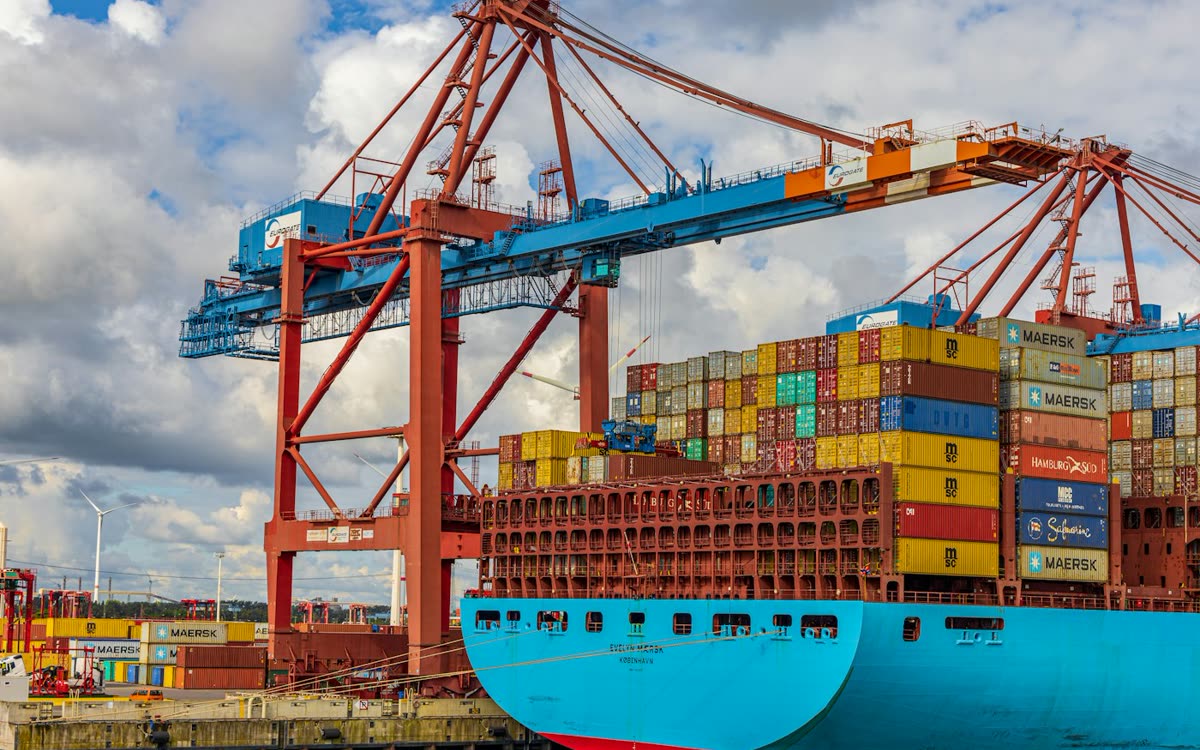
Photo credit: card image - APM Terminal Maasvlakte, Rotterdam, by Spielvogel, licensed CC BY-SA 4.0, via Wikimedia Commons.
What this is not: a quotation. Customs inspection, storage, demurrage, re-delivery, long-item and overweight surcharges and fees billed at cost are excluded unless the rate card publishes a fixed amount. Rates are valid as of 22 September 2026 and confirmed before booking.
Three Things Decide What You Pay
Germany alone is the cheapest group on every lane. France, Czechia, Poland, the Netherlands and Belgium come next; Spain, Italy and Ireland after that; and the Baltics, Greece, Romania, Portugal and the Nordics sit in the top group. The same carton can cost 15-25% more to Stockholm than to Hamburg.
Air is priced in five bands (21-45, 46-70, 71-100, 101 and 501 kg+), sea LCL in four (21-45, 46-99, 100 and 1,000 kg+), rail-truck in four, and oversized sea cargo in fifteen tiers from 50 kg to 2,000 kg+. Every step down in unit rate is real, which is why consolidating supplier orders into one shipment usually beats shipping separately.
Sea LCL is roughly a third of the air rate but takes 40-45 days; rail-truck sits between at 22-25 days; air arrives in 8-12 days. Oversized cargo adds a per-kilo premium because it consumes volumetric space on the aircraft or in the container.
More Lanes & Terms
The full-detail Europe calculator built on the earlier rate card, including per-country postcode lists.
Four DDP lanes — air priority, air economy, Matson express and Yantian sea freight — by US ZIP zone.
Air, rail-truck and palletised lanes with all 22 postcode zones and three import VAT terms.
Per-kilo rates to Gdansk, Warsaw, Lodz and Poznan, the four postcode zones and DDP vs own-VAT clearance.
Pallet specs, per-pallet delivery fees and a transit-time comparison across all four markets.
All 11 terms, the four importers actually use, and where the cost boundary sits.
Consolidation, crating, customs and door delivery on one booking.
China to Europe — Common Questions
How much does it cost to ship from China to Europe?+
On the rate card in effect 22 September 2026: sea LCL is the cheapest per kilo at about RMB 8-16.5 per kg, rail-truck is RMB 14-23 per kg, air priority is RMB 30-41 per kg, and oversized air cargo that travels as pallets or crates is RMB 40-54.5 per kg (RMB 48.5-66.5 on the battery lane). Germany is always the cheapest destination group, and the Baltics, Greece, Romania, Portugal and the Nordic countries sit in the most expensive group. Rates fall as shipments get heavier, with bands from 21 kg up to 501 kg+.
Which cities and countries does the card cover?+
Twenty-five European destinations: Austria, Belgium, Bulgaria, Croatia, Czechia, Denmark, Estonia, Finland, France, Germany, Greece, Hungary, Ireland, Italy, Latvia, Lithuania, Luxembourg, the Netherlands, Poland, Portugal, Romania, Slovakia, Slovenia, Spain and Sweden. The country lanes group destinations four ways - Germany alone, then France / Czechia / Poland / Netherlands / Belgium, then Spain / Italy / Ireland, then everyone else - and oversized sea cargo is priced country by country across 116 postcode zones.
What is the difference between the country lanes and the oversized sea lane?+
The country lanes (air, sea LCL, rail-truck) are priced per kilo for the whole country, so your exact address does not change the rate. The oversized sea lane is priced by destination postcode zone and weight tier, which is why the same pallet can cost a few RMB per kilo more to a remote zone than to a main city. It has 15 weight tiers from 50 kg+ to 2,000 kg+, and pallets up to 2.4 x 2.0 x 2.2 m and 1,000 kg.
How long does shipping from China to Europe take?+
Air priority and air economy are 8-12 calendar days to pickup, and air oversized cargo 9-12 days. Rail-truck is 22-25 days to pickup. Sea LCL is 40-45 days after sailing, and oversized sea cargo 45-55 days: it usually sails from Shanghai, Yiwu or Shenzhen into Rotterdam or a Belgium-Netherlands port, clears, and is then trucked to the destination.
What are the minimum billing rules?+
Air lanes start at 21 kg per shipment with a minimum of 12 kg per piece and a volumetric divisor of 6000. The oversized air lanes start at 30 kg per shipment with a divisor of 7000. Sea LCL starts at 21 kg per shipment with a minimum of 12 kg per box, and the oversized sea lane starts at the 50 kg tier. Bubble-split rules apply on some air lanes from 71 kg or 100 kg actual weight.
Can you ship batteries, pallets and oversized cargo to Europe?+
Yes. Built-in batteries travel on the C lanes - air economy and air oversized C - with a declaration and CE marking where the product needs it. Pallets, wooden cases and aviation boxes travel on the oversized lanes: up to 2.4 x 2.0 x 2.2 m and 1,000 kg per pallet by sea, with hinged lids and 10 cm forklift feet on wooden packing. Pure batteries, power banks, weapons, pharmaceuticals, counterfeit goods and unknown liquids are prohibited on every lane.
What happens if my cargo waits at the destination?+
Oversized sea cargo includes 7 free days of storage after clearance, then RMB 4-6 per CBM per day. Long-item and overweight surcharges apply on oversized cargo by size band, and customs inspection, demurrage and re-delivery are billed at cost. Peak season from mid-November to February adds carrier surcharges and excludes delay compensation, so plan clearance and onward delivery before the vessel arrives.
Do you deliver to Amazon FBA warehouses in Europe?+
Yes. FBA cartons need at least two labels each, "Team Lift" above 22.5 kg and "Heavy Package" above 15 kg, and pallets have to meet the warehouse height and weight rules rather than the lane limits. Non-FBA sea LCL carries a RMB 1 per kg surcharge (minimum RMB 100) on this card, so tell us at booking whether the delivery is to a warehouse, a business or a residence.
What is not included in the band?+
Customs inspection fees, storage beyond the free window, demurrage, re-delivery, long-item and overweight surcharges on oversized cargo, product-category surcharges, and anything the forwarder bills at cost. Import duty and VAT depend on the HS code and your own registrations - we clear under DDP as standard, but the amounts are confirmed per shipment rather than published as a rate.
How do I get the exact European price?+
Send the destination country and postcode, the number of boxes or pallets, the weight and dimensions, and the product. We come back with the confirmed rate for your country group or oversized zone, the sailing or flight, the transit time and any surcharge - usually within one working day, in EUR, USD or GBP. Our Guangzhou team can handle sourcing, inspection and consolidation in the same project.
Need the exact European rate?
Send the country and postcode, the cartons or pallets, the weight and the product. We come back with the confirmed rate for your country group or oversized zone, the sailing or flight and the transit time — usually within one working day.