
Polish importers and logistics companies ask the same three questions before their first order from China: what does it cost per kilo, how long does it take, and who clears customs. The answers are all on one page — and they come from a real forwarder rate card dated 9 September 2026, not from a sales estimate.
This is the working version: the rates, the zones, the chargeable-weight arithmetic, and the one number most websites will not publish — the per-cubic-metre LCL rate.
Four ways from China to Poland, side by side
| Mode | Transit | Rate (door-to-door DDP) | Best for |
|---|---|---|---|
| Sea, courier delivery | 40-45 days after vessel departure | RMB 13/kg at 21 kg → RMB 11/kg from 101 kg | 50-500 kg, cost-first |
| Sea, Poland truck | 40-45 days after vessel departure | RMB 10/kg at 51 kg → RMB 9/kg from 201 kg | Palletised cargo to Warsaw zone |
| Sea, oversize (truck) | 38-42 days after vessel departure | RMB 20.16-22.25/kg at 51 kg → RMB 10.85-11.03/kg at 2,001 kg+ | Machinery, long items, up to 2,500 kg |
| China-Europe rail | 16-18 days after train departure | RMB 20.89-22.25/kg at 51 kg → RMB 14.92-15.86/kg at 2,001 kg+ | Restocking in 3 weeks, no built-in batteries |
| Air, economy line | 8-10 working days | RMB 38.5/kg at 21 kg → RMB 36.5/kg from 101 kg | Urgent, high value, under 300 kg |
| Air, time-definite | 6-8 working days | RMB 45/kg at 21 kg → RMB 43/kg from 101 kg | Deadlines, launch dates |
| 40HQ container (DDP) | Sea transit | RMB 73,500 to Warsaw / Łódź / Poznań | Full loads, one product line |
Two things to notice. First, the rail column: it is roughly twice as fast as sea for about 30-50% more per kilo — which is why mid-weight European restocking has shifted to block trains. Second, the rate falls as the weight tier rises, in every mode. Consolidating three small shipments into one bigger one usually beats shopping around for a cheaper forwarder.
Poland is priced in four postcode zones
The destination postcode decides your rate, not just the country. On this card Poland splits into four zones:
| Zone | Postcode prefixes | Main cities |
|---|---|---|
| PLZ01 | 00-05 | Warsaw and surroundings |
| PLZ02 | 06, 09, 20-21, 25-26, 90-94, 96, 99 | Płock, Lublin area, Łódź East, Kraków, Kielce |
| PLZ03 | 07-08, 10, 15-18, 23-24, 29-31, 35-36, 39-42, 44, 47, 50-55, 60-62, 80, 85-88, 95, 97 | Gdańsk, Gdynia, Poznań, Wrocław, Katowice, Białystok |
| PLZ04 | 11-14, 19, 22, 27-28, 32-34, 37-38, 43, 45-46, 48-49, 56-59, 63-79, 81-84, 89, 98 | Olsztyn, Suwałki, Szczecin, Lublin, Rzeszów, Zielona Góra |
Truck-served sea freight additionally prices by city code: Warsaw (WAW) is zone 1 and the cheapest, with Bydgoszcz, Kielce, Lublin, Olsztyn and Siedlce in zone 2.
So “shipping to Poland” is not one price. A Gdańsk delivery sits in the same band as Poznań and Wrocław; a Szczecin delivery does not.
The per-CBM question — the honest answer
Every Polish forwarder asks it: what is your LCL rate per cubic metre to Gdańsk, and your rail rate per CBM to Warsaw?
Here is the straight answer. Per-CBM LCL and block-train space are not published rates. Carriers price them per shipment — port pair, sailing, season, whether you load full or not — and they move week to week. Any website showing a fixed “RMB X per CBM to Gdańsk” is quoting last month’s space, or hiding the surcharges that come later.
What can be quoted honestly is this:
- Per-kilo, door-to-door DDP with fixed published tiers (the table above). Everything included to your address.
- Per-CBM LCL or rail space requested from the forwarder for your exact volume and port pair, usually back within one working day, with the surcharge list attached.
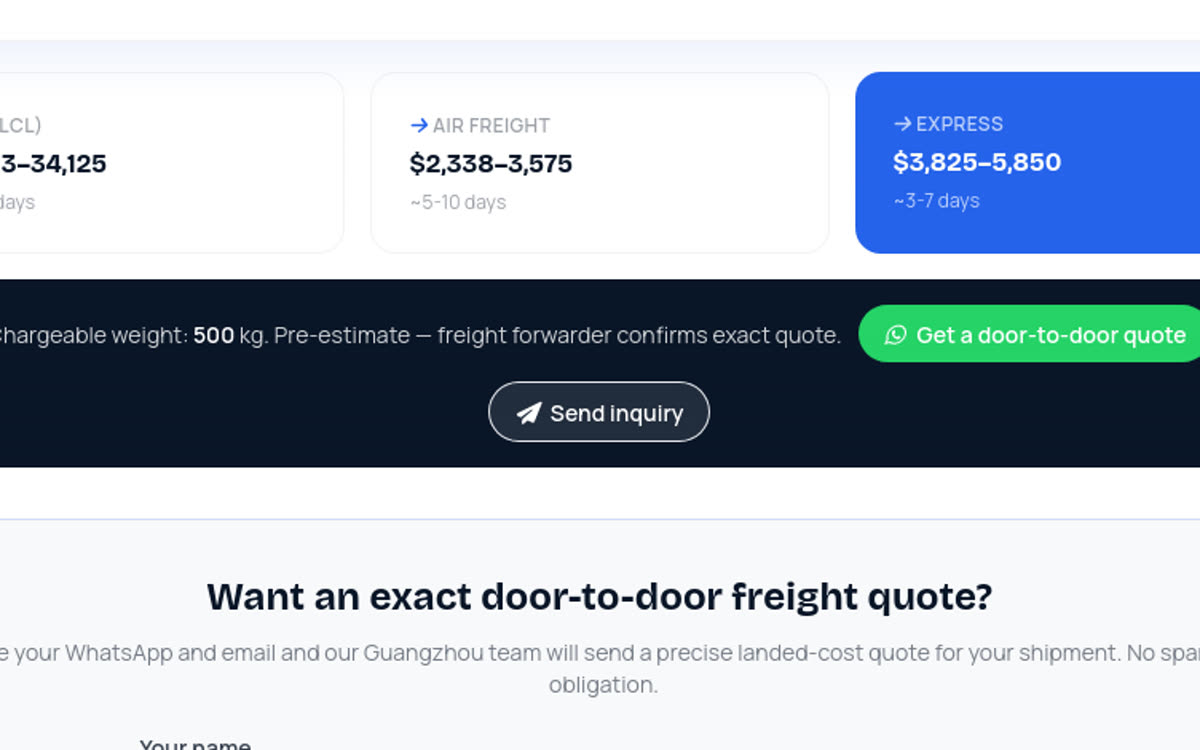
Ask for both and put them next to each other. Below roughly 15 CBM, LCL normally wins; above it, FCL or a shared container takes over — and the crossover point depends on the port pair and the season. Any quotation that does not show you the crossover is a quotation you cannot check.
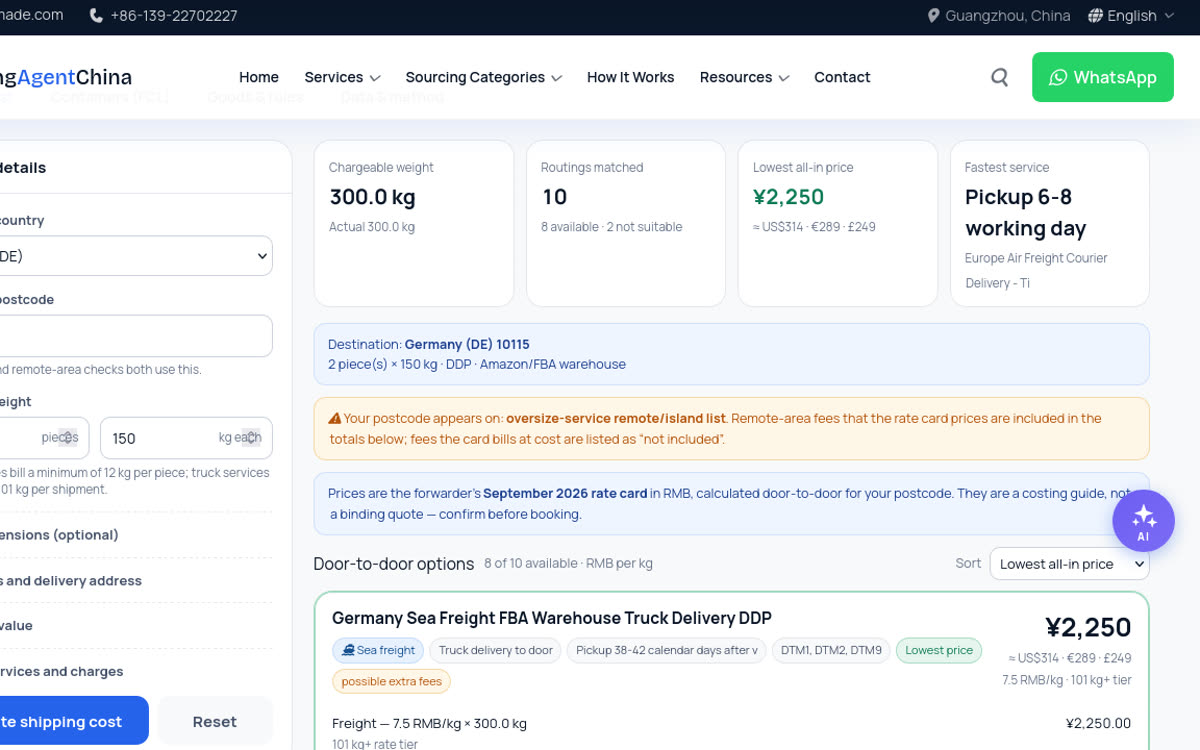
You can price the per-kilo side yourself in our China–Europe shipping calculator — it runs on the same September 2026 card, priced by postcode, weight and pallets, and explains every line it applies.
Chargeable weight: the arithmetic that decides your invoice
Freight is billed on chargeable weight, which is the greater of actual weight and volumetric weight, where volumetric weight = L × W × H in centimetres ÷ 6,000. Three rules that catch importers out:
- Minimum 12 kg per piece on courier-served services. Five 3 kg pieces are charged as 5 × 12 kg = 60 kg, not 15 kg.
- Pallet positions on Poland truck services are counted at 120 × 80 cm, worked out from the carton dimensions — and pieces between 1,200 kg and 2,000 kg take two positions.
- Bubble splitting applies on air courier lines from 12 kg at 50%: light bulky cartons get treated differently from dense ones.
Giving the forwarder real dimensions with the packing list is what prevents a surprise on the invoice. We measure and photograph the pallets at our warehouse and send the numbers before the shipment is booked.
Customs: DDP, DAP, DDU or PVA
| Term | Who clears in Poland | Duty & VAT | Notes |
|---|---|---|---|
| DDP | Our forwarder | Included in the price | Nothing invoiced to your company on arrival |
| DAP | Your consignee | Paid by consignee | Typically RMB 1-2/kg cheaper than DDP |
| DDU / own VAT | Your broker | You pay, you recover | Needs a valid VAT number; handling fee RMB 50-350 per shipment |
| PVA | Deferred through your VAT number | Deferred | For Amazon FBA sellers with VAT and EORI numbers |
If you are a logistics company with your own customs procedures, DAP or DDU keeps the entry in your name and your file — we simply hand over the commercial invoice, packing list, certificate of origin and the transport documents. If you want it fully off your desk, DDP means the price you see is the price the goods cost, delivered.
One detail worth knowing: separate export declaration. When a small Chinese factory has no export licence of its own, we file the declaration in our name — RMB 250 per shipment by sea, RMB 350 by rail, from 100 kg. Without it the goods cannot legally leave China on a valid declaration, and you lose the paperwork you need to claim import VAT properly.
Where the cost actually hides
Freight quotes are not additive by accident. The seven lines that routinely sit outside an “all-in” price:
- Customs inspection at either end, plus the container detention and demurrage it causes
- Port storage and devanning
- Palletising and repalletising
- Second delivery attempts
- Remote-area and island surcharges
- Oversize and long-item surcharges
- Insurance
Ask for these in writing before booking. Our Poland shipping page publishes the full included/excluded list, and container rates carry a 7-day validity because space and freight follow the carrier’s latest prices.
Planning a first shipment to Poland
- Fix the specification with the factory before asking for rates — quoted against different specs, rates cannot be compared.
- Decide the weight tier you can reach. Combining two suppliers’ shipments into one 500 kg consignment usually beats two 250 kg consignments.
- Pick the mode against your stock-out date, not against the cheapest line: rail lands in roughly four weeks door-to-door, sea in six to seven.
- Decide DDP or own-VAT clearance before the goods ship, because it changes the documents the factory must issue.
- Consolidate in China — checked, photographed, palletised, one waybill, one cut-off, one document set.
We handle all five: sourcing and negotiation, factory audit, pre-shipment inspection, consolidation in Guangzhou, export declaration and delivery to your address in Poland — DDP or duty-unpaid on EXW/FOB terms if your own freight department is doing the rest. Send the product details, the weight and the destination postcode, and you get both the per-kilo DDP price and the per-CBM LCL price in one reply.
👉 WhatsApp: +86 139 2270 2227 | Email: sales@cantonmade.com