A well-built equipment package still tends to end with two thin lines: 42U cabinets, quantity; PDUs, quantity. The problems appear on site. Patch panels and switches are in, but the cable managers and the UPS have nowhere to go. The switch intake sits against the closed door. The PDU has eight C13 outlets and the servers are dual-corded. The cabinet does not come apart, and it does not fit through the lift door.
A rack is the only item in the package that is sold by volume, installed by weight, and useless unless it fits the equipment around it. Its mistakes never show up in the quotation, only during installation. This covers the four things you can check before ordering: U space, load, airflow with PDU sizing, and the eight acceptance checks.
Four numbers that define 19 inches
“19-inch rack” is not a loose description; it is measurable. When the quotation and the drawing disagree, check these four:
| Item | Value | Reference | What it decides |
|---|---|---|---|
| Rack unit, 1U | 44.45 mm (1.75 in) | EIA-310-E / IEC 60297-3-100 | Every U count and cabinet height derives from it |
| Panel width | 482.6 mm (19 in) | Same | Equipment panel width, handles excluded |
| Upright clear width | 450 mm (17.72 in) | Same | Anything wider will not go in |
| Upright hole centres | 465.1 mm (18.312 in) | Same | Rails, managers and blanking panels locate on it |
Two details get missed. The holes inside one U are not evenly spaced - three positions at roughly 6.35, 22.225 and 28.575 mm - so which pair of bolts you use decides whether a device sits flush to the top or centred in its U. And the usable internal height of a 42U and a 47U cabinet is 1,866.9 mm and 2,089.2 mm, before the top cap, base frame and castors are added. Whether the drawing states internal or external height is usually the first argument after delivery.
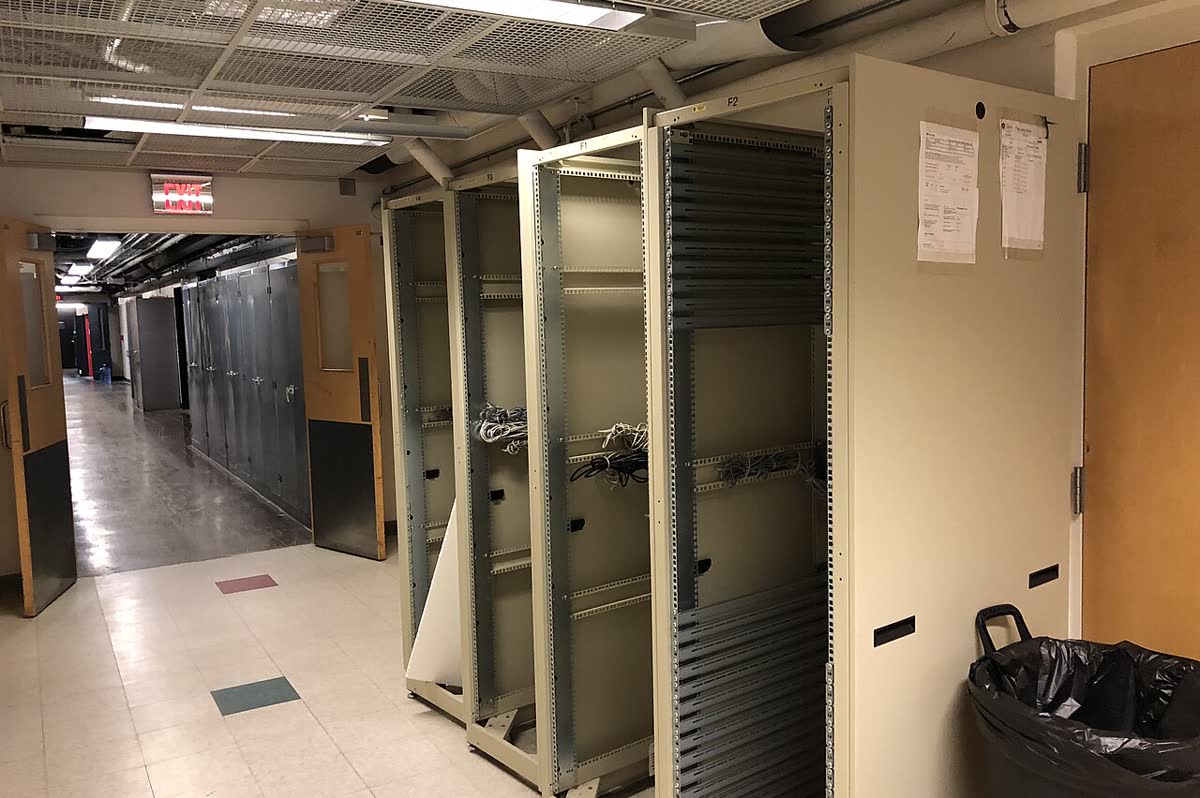
Photo: ArnoldReinhold, CC BY-SA 4.0, via Wikimedia Commons.
Count U space before choosing the cabinet
Build the U list before the cabinet. Every 1U and 2U device goes in, and so does every accessory it needs: a manager opposite each patch panel, blanking panels above and below switches, a fibre enclosure, and one slot each for the rack UPS and the PDUs.
A real count for a 500-room hotel telecom room (about 200 cameras plus the data network):
| Item | Qty | Height | Space |
|---|---|---|---|
| 48-port access switch | 8 | 1U | 8U |
| Patch panel (one per switch) | 8 | 1U | 8U |
| Horizontal cable manager | 8 | 1U | 8U |
| Fibre enclosure / splice tray | 2 | 1U | 2U |
| Core switch (pair) | 2 | 1U | 2U |
| NVR (64-channel) | 3 | 2U | 6U |
| Server (BMS / PMS) | 2 | 2U | 4U |
| Rack UPS | 1 | 3U | 3U |
| PDU (1U horizontal, dual) | 2 | 1U | 2U |
| KVM / out-of-band | 1 | 1U | 1U |
| Total | 44U |
44U does not fit into 42U. The answer is not to squeeze: either two 42U cabinets - the second one taking expansion and spares - or one 47U cabinet. Add the usual 15 percent spare (44 x 1.15 is about 50.6U) and two 42U cabinets is the configuration that still works in three years.
Write three more items into the RFQ at the same time: cabinet depth (600, 800, 1,000 or 1,200 mm, set by the deepest device plus rear cable space), door type (perforated or glass, and glass limits airflow), and whether side panels and bay joining kits are included. Depth is the most expensive error: the switch goes in, and the fibre cords behind it cannot bend.
Load is about the castor, not the total
Static load is commonly quoted at 600-1,000 kg, heavy duty up to 1,500 kg. But what a floor cannot take is usually a point, not a total.
A loaded 42U cabinet: about 110 kg of cabinet and 480 kg of equipment, 590 kg together. On four castors that is 148 kg per wheel; spread over a 600 x 1,000 mm plinth it works out to roughly 9.65 kN/m2. If the telecom room sits upstairs on a raised floor or a light slab, that number belongs with the structural engineer.
Three things you can do from the procurement side:
- Require the quotation to state static load and the rating for castor-mounted and plinth-mounted installation separately;
- Decide whether the unit arrives on castors or on levelling feet. Castors make it easy to roll into position, but they deform under long-term load - on site the cabinet should be transferred to feet or a plinth;
- In seismic zones or where the cabinet must be anchored, ask about fixing kits (top restraint, base fixing). They are options, and an option that is not quoted is an option that does not ship.
Airflow: volume, blanking panels, door open area
A cabinet is a duct, not a box. Block the front-to-rear path and heat accumulates inside, and electronics life is derated by temperature rise.
Size airflow from power. At a 10 C rise the rough rule is about 170 cubic metres per hour for every kW:
| Cabinet power | Heat | Airflow at 10 C rise |
|---|---|---|
| 3 kW | 10,236 BTU/h | about 895 m3/h |
| 5 kW | 17,061 BTU/h | about 1,491 m3/h |
| 8 kW | 27,297 BTU/h | about 2,386 m3/h |
Three procurement decisions follow. Door open area - perforated doors are typically specified above 63 percent, and glass doors really only suit low-power cabinets. Blanking panels - an open U lets hot air return to the front, so the cabinet heats itself. Cable management inside the cabinet - vertical managers use the cold-aisle space beside the uprights while horizontal managers consume U positions, and both have to be decided at order stage rather than on site.
Where the telecom room has no air conditioning, or where dust is heavy (plant rooms, basement car parks), specify a sealed cabinet with fans and filters or a heat exchanger, and state the required ingress protection. A standard IP20 cabinet in a dusty room loses its fans within months.
PDU: the inlet sets the ceiling
PDU mistakes always happen in the same order - pick outlet count first, look at inlet current later. Reverse it: total the branch load, fix the inlet, then count outlets.
| Inlet | Practical ceiling at 230 V | Where it fits |
|---|---|---|
| C14 plug (10 A) | 2,300 W | Low-power cabinets: switches, NVRs, a few devices |
| C20 plug (16 A) | 3,680 W | Standard server cabinets |
| 32 A hard-wired | 7,360 W | High-power, GPU or storage cabinets |
Dual A/B feed is the most misunderstood item. Both legs share the load in normal operation, but when one leg fails the other must carry 100 percent - so each leg is sized for the full load, not half. The table above makes the consequence plain: a 5 kW cabinet on a single 16 A C20 feed will not survive a leg failure. It needs 32 A hard-wiring, or two separate C20 feeds into the cabinet.
Count outlets as device count times cord count plus 20 percent spare: a dual-corded server takes two C13, a switch usually has one supply but should still be split across both feeds, and a UPS management port does not live on the PDU. Then decide basic, metered or switched. Metered units show per-branch current, which is how you spot an unbalanced phase or an overloaded cabinet; switched units allow per-outlet remote cycling, which matters on unmanned sites. The price step is real, but it is the only thing that tells you “this branch overloaded” when equipment reboots on its own.
How the cabinet and its power sit inside a full low-voltage package is broken down on our ELV systems page - equipment, cabinet power and cable materials are three separate cost blocks, and only separate quotations show who hid the cabinet money inside the installation fee.
Earthing: one conductor, most often skipped
The cabinet must be bonded to the equipotential earth bar, and removable parts - doors, side panels, top covers - must stay electrically continuous through short bonding jumpers. The usual specification is a bonding conductor of at least 6 mm2 and a resistance from cabinet to earth reference of 0.1 ohm or less, with terminals torqued to the manufacturer value. Under-torqued terminals are the main reason earthing is “done” but not connected.
At procurement level the checks are simple: does the quotation show an earth terminal on the PDU, an earth bar and bonding jumpers with the cabinet, and a torque note in the packing list. Skipping these saves very little and turns into a whole row of cabinets to rework at acceptance.
Welded or flat pack: can it pass the lift
Shipping form changes both freight and site labour, and the two forms price very differently:
- Welded, shipped whole: usable on arrival and the most rigid, but charged at full volume, and a 2 m cabinet frequently will not pass a goods lift, a door opening or a corridor corner in an existing building;
- Knocked down: uprights, panels, doors, top and base packed separately, typically cutting volume by more than half and allowing manual handling, at the cost of on-site assembly and a strict count of bolts, joining kits and castors.
Choose after measuring the site: goods lift clear height and width, door opening, narrowest corridor point, corner radius. This is far cheaper before the order than after delivery. For knocked-down units, add three RFQ items: assembly drawing and bolt list, a stiffness and squareness commitment after assembly, and the lead time for missing parts.
One more line belongs in the contract rather than a verbal confirmation: crating type, corner protection and foam wrapping on the uprights, because a cabinet is heavy freight and deformation is the normal failure mode.
Ten things to put in the RFQ
| # | Ask | Why it matters |
|---|---|---|
| 1 | U count and internal height (1,866.9 / 2,089.2 mm for 42U / 47U) | External height hides the top cap and castors |
| 2 | Depth, and whether 450 mm clear width takes the deepest device | Wrong depth means a new cabinet, not a site fix |
| 3 | Hole centres 465.1 mm, square or round holes | Rails and managers locate on this |
| 4 | Static load, rated separately on castors and on feet | Upstairs telecom rooms are constrained by the slab |
| 5 | Door type, open area percentage, lock or no lock | Sets the airflow ceiling |
| 6 | Blanking panels, cable managers, joining kits, side panels included? | These are the options that get missed |
| 7 | Welded or knocked down, packaging and corner protection | Decides freight and whether it enters the building |
| 8 | PDU inlet rating, outlet types and counts, single or dual feed | Power first, outlets second |
| 9 | Metered, remotely managed, and which protocol | Mandatory for unmanned sites |
| 10 | Earth bar, bonding jumpers and torque note included | Every one of these is checked at acceptance |
Eight acceptance checks
- Deformation and finish: uprights straight, door hinges aligned, paint damage within the agreed packaging terms - photograph everything.
- Measured dimensions: cabinet height and depth, upright hole centres at 465.1 mm, clear width 450 mm - with a tape, not from the label.
- Accessory count: bolts, castors, joining kits, blanking panels, managers, earth jumpers, against the packing list.
- Structure: base-to-upright welds and stiffeners matching the approved sample.
- PDU live test: every outlet energised, metered reading compared with a clamp meter, changeover between feeds without interruption.
- Earthing continuity: cabinet, doors and side panels to the earth bar, resistance recorded with a tester.
- Squareness after assembly: on knocked-down units measure verticality and diagonals, and check the doors close freely.
- Documents: packing list, assembly drawing, torque note, PDU datasheet and certification pages.
Six traps
- Writing only “42U cabinet”: no depth, no door type, no load, so the supplier quotes the cheapest configuration and the miss is yours.
- Counting devices but not accessories: patch panels, managers, blanking panels and the UPS are all left out, and 2 to 6U go missing.
- Sizing a dual feed at half load: the cabinet drops on changeover, which is a design fault, not a product fault.
- Glass doors on high-power cabinets: it overheats the moment the door closes, and the door gets replaced.
- Ignoring shipping form: the cabinet arrives and does not enter the building, and the second dismantling costs far more than the freight saving.
- Earthing only on paper: no earth bar and no jumpers on arrival, so a whole row goes back for rework.
Where this sits among the other guides
The cabinet is the least technical and most frequently omitted item of a low-voltage package: it performs no function, yet it decides whether the equipment fits, cools and keeps dual power. Device counts and cabling rules live in structured cabling sourcing and cable tray and containment; the boundary between ELV and low voltage, and where power may be taken from, is in ELV versus low voltage; UPS selection itself is in UPS power supply sourcing; whole-package delivery and handover is in ELV package delivery.
For a full package, the sub-system breakdown on our ELV systems page can be used directly as a checklist, and the free RFQ template already carries the matching columns for the U list and the RFQ items above.
Want the U list and PDU configuration calculated for your equipment list? Send the device models, quantities, cabinet depth and the site lift dimensions, and we will return a configuration note with the U table, load calculation and PDU sizing within 48 hours - contact us here.