A fire alarm system is the one part of a low-voltage package where a buying mistake touches life safety. Anyone who has delivered a hotel or hospital project knows the pattern: three factories quote the same point schedule with a spread of up to 2x, all three can send you a scanned EN 54 certificate, and the difference is not in the negotiating. It sits in four things: whether the detector type is right for each space, conventional or addressable, whose name is on the EN 54 certificate, and who writes the interlock logic and commissions it on site. It is the sub-system of hotel low-voltage system integration that is directly tied to life safety, and the only one that must pass the local fire code at acceptance, with no “install now, sort it out later” option.
This article does not explain “what a smoke detector is”. It covers the buying actions you can verify: what to buy in each of the three system segments, how to choose between conventional and addressable, how detector type follows the space, how to verify EN 54 certification, how to size points and standby battery, the 8 questions to nail down with the supplier, the 5 sampling checks at goods-in, and the 12-point quotation checklist.
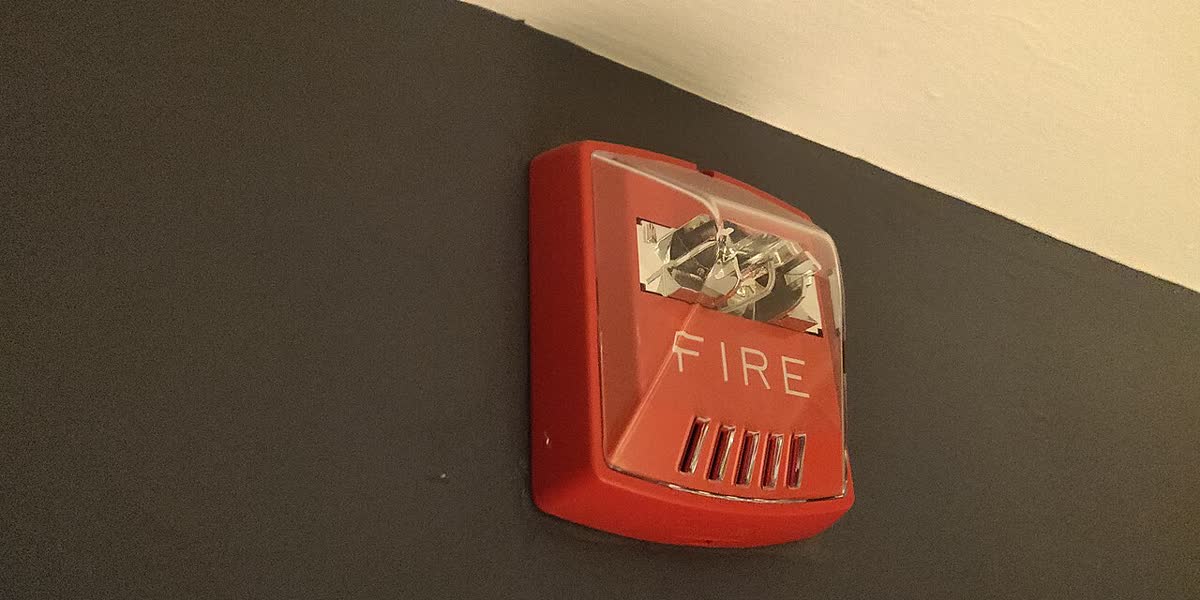
Photo: Kurtkaiser, CC0, via Wikimedia Commons.
Draw the System Boundary First: Detection, Control and Interlocks Are Three Segments
When quotations do not line up, it is usually not a pricing problem but an unclear division of labour across the three segments. Detectors, the control panel and interlock devices often come from different factories, and it is easy to leave the interfaces blank in the contract.
| Segment | Typical devices | What the purchase must fix | Interface most often left blank |
|---|---|---|---|
| Detection | Point smoke and heat detectors, multi-criteria detectors, beam detectors (EN 54-12), aspirating detection (EN 54-20), manual call points | Type, coverage radius, mounting height, IP rating | Addressing method: software addressed or DIP-switch |
| Control | Fire alarm control panel, loop cards, power supply and batteries, short-circuit isolators, input/output modules | Loop capacity and point headroom, standby duration, whether the protocol is open | Communication protocol between the panel and BMS or third-party equipment |
| Interlocks | Sounders and beacons, fire telephone and talkback, fire shutters, smoke exhaust dampers, lift homing, access control release | Who writes the interlock logic, who commissions it on site | Dry-contact or protocol interfaces to access control, lifts, smoke exhaust and public address |
A useful rule of thumb: detectors and panels are commodity products; the interlocks are where projects are won or lost. Putting all three segments on one quotation and naming who commissions each one matters far more than squeezing the detector unit price.
Conventional or Addressable: Choose by Point Count and Maintenance Capability
| Dimension | Conventional | Addressable |
|---|---|---|
| Location accuracy | Down to a loop or zone only | Down to the individual detector, with address and location text shown on the panel |
| Points per loop | Typically 2-8 zone circuits | 128-250 points per loop, depending on protocol |
| Wiring | Each zone circuit returns separately to the panel | Loop wiring, two-core, with short-circuit isolators in line |
| Expansion | Easy to add points, but adding a zone means new cable | Add a loop card to expand; upfront headroom planning matters more |
| Maintenance | Loop level, relies on manual inspection | The panel displays the faulty point directly, far faster to patrol |
| Best for | Small, single-building, budget-sensitive projects | Hotels, hospitals, malls, campuses - multi-zone buildings |
On cost structure: addressable panels and loop cards cost more, but each addressable point uses less cable and less labour; the higher the point count, the closer the two options get on cost per point. Below 200 points conventional systems are still common; for hotels and hospitals, where people sleep on site and an alarm has to resolve to a room, addressable is standard practice. For how the cost blocks are drawn in Chinese projects, see ELV package cost structure.
Detector Selection: Type Follows the Space, Not the Price
| Space | Recommended type | Why | Typical mistake |
|---|---|---|---|
| Guest rooms, corridors, offices | Point optical smoke (EN 54-7) | Responds early to smouldering fires, low cost | Using ionisation smoke: weak on smouldering fires, and it contains a radioactive source that many markets restrict |
| Kitchens, boiler rooms, steam areas | Fixed temperature or rate-of-rise heat (EN 54-5) | Avoids steam and cooking-fume false alarms | Fitting smoke detection in a kitchen; the false alarm rate climbs within months |
| Car parks, dusty areas | Heat detection or high-grade aspirating | Resists dust contamination | Ordinary smoke detectors, optical chamber contaminated within six months |
| Atriums, high warehouses | Beam detection (EN 54-12) | Point detection is not suitable in high spaces | No drift compensation after alignment, so seasonal temperature swings trigger alarms |
| Server rooms, clean rooms | Aspirating (EN 54-20 Class A/B/C) | Very early warning, discreet installation | Sampling pipe length and number of elbows out of spec, response time slows down |
| Fuel and flammable liquid areas | Point flame detector (EN 54-10) | Fast response to open flame | Heat detection only, by which time the alarm comes far too late |
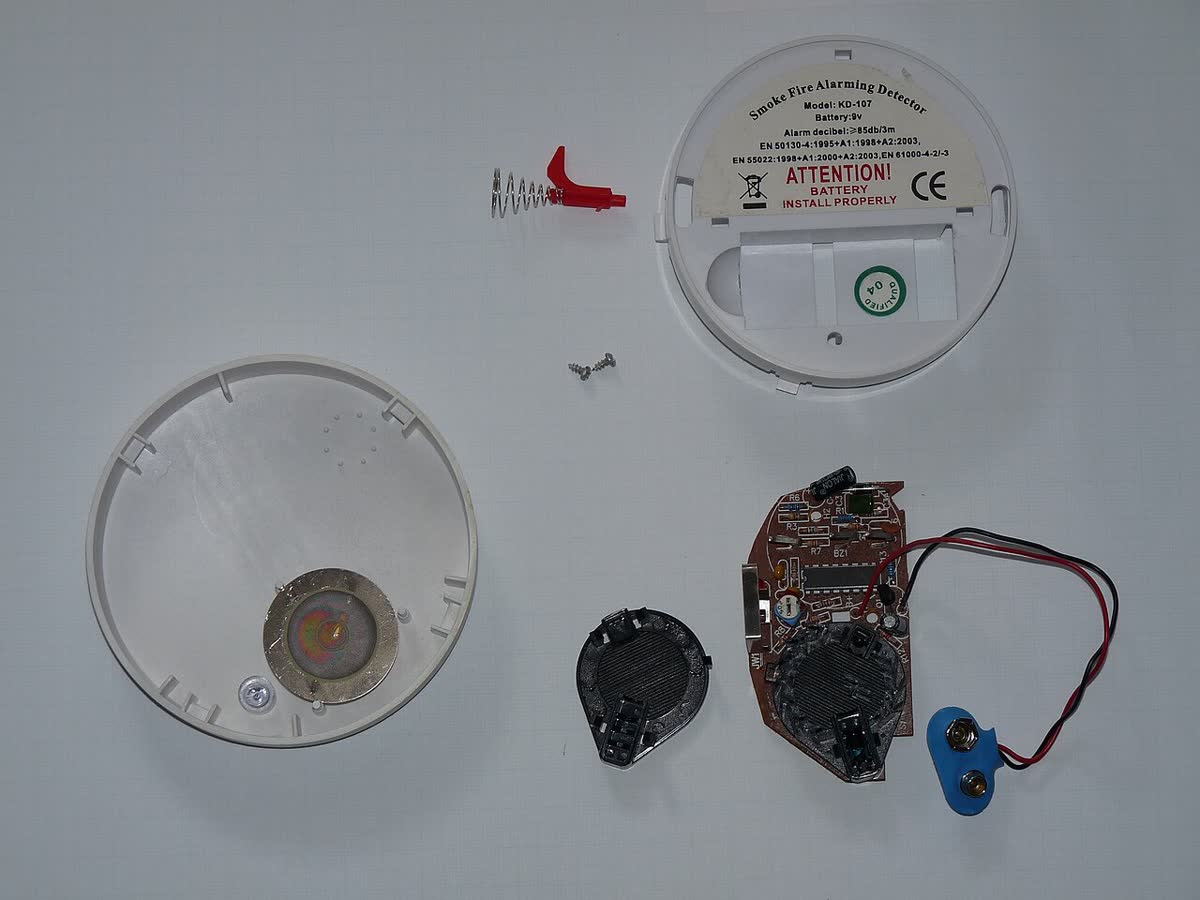
Photo: Dmitry G, CC BY-SA 3.0, via Wikimedia Commons.
EN 54 Certification: Check the Certificate Holder, the Model Range and the Issuing Body
EN 54 is a family of standards, not one certificate. The most common trap: the quotation says “compliant with EN 54”, but nobody can produce a certificate for that specific component, that specific model, held by that specific company.
| Component | Standard | What to verify |
|---|---|---|
| Control panel | EN 54-2 + EN 54-4 (power supply) | Whether the certificate holder is the factory itself; whether the declared loop capacity is inside the certified scope |
| Point smoke | EN 54-7 | Model and sensitivity class |
| Point heat | EN 54-5 | Fixed or rate-of-rise class (A1/A2/B etc.) |
| Manual call point | EN 54-11 | Reset method (key or frangible element), break-glass or resettable |
| Beam detector | EN 54-12 | Coverage distance and alignment method |
| Aspirating | EN 54-20 | Class A/B/C sensitivity |
| System compatibility | EN 54-13 | System compatibility assessment report for the whole package (the item most often missing from mixed-brand quotations) |
| Sounders and voice alarm | EN 54-3 / EN 54-23 / EN 54-16 / EN 54-24 | Voice evacuation is a separate line, see the public address sourcing guide |
| Isolators and modules | EN 54-17 / EN 54-18 | Model matching the loop protocol |
| US projects | UL 864 (panel) / UL 268 (smoke) / UL 521 (heat) | Whether the UL listing covers that exact model |
| China projects | CCCF fire product certification | Whether the certified scope matches the declared model |
Verification is straightforward: take the certificate number to the issuing body’s website (notified bodies such as VdS, LPCB/BRE, TÜV) and check the certificate holder name and the model list. A supplier who can only send a picture and no searchable number is treated as uncertified. For the usual wording on certification negotiations, see the product certification sourcing guide.
Points, Loops and Standby Battery: Do the Arithmetic Before You Talk Price
Take a 500-key hotel (excluding public areas and back-of-house):
- 500 guest rooms x 1 smoke detector = 500 points
- Corridors, lift lobbies and stairwell lobbies: about 180 points
- Manual call points: about 60 points (floor exits and escape routes)
- Input/output modules (shutters, smoke dampers, lift homing, fire pumps): about 120 points
- Sounders and beacons: about 140 points
Total: about 1,000 points. Plan with 20-30% headroom, so the panel and loop cards are configured for 1,250-1,300 points; at 128 points per loop that is 10-11 loops, plus one spare loop card. On a project with no headroom, adding three points means adding a loop card.
Standby battery follows the usual BS 5839-1 basis: 24 hours standby plus 30 minutes in alarm, sized separately on quiescent current and alarm current, then add 20% for ageing. There is a trap here that is identical to UPS work: battery capacity is quoted at the 20-hour rate, and the capacity available at the 1-hour rate is only about half, so sizing on the nameplate figure comes out short (details in the UPS sourcing guide).
On cable: loops use shielded twisted pair (commonly 2x1.5 mm², increased with loop length and point count); critical paths - panel supply, interlock modules, voice alarm - use fire-resistant cable (EN 50200 PH 30/60/90/120 or the equivalent BS 8434-2 category). Where cable shares a tray with other low-voltage services, watch separation and fire stopping; the material basis is the same as in structured cabling sourcing.
False Alarms and Maintenance: Price In the Cost of Walking Away After Handover
False alarms are the number one source of maintenance complaints on fire alarm systems, and most of them are decided at the procurement stage:
- Optical chamber contamination is the main cause. The sensitivity drift compensation required by EN 54-7 only delays the problem; it does not replace cleaning. Dust covers must be fitted during fit-out and cleaning, then removed one by one and 100% tested before handover.
- Changing the use without changing the detector type: a corridor turned into a pantry, a guest room turned into a smoking area, with the detector type left unchanged, is a common cause of false alarm complaints within six months.
- No baseline at acceptance: record each detector’s address, installation date and sensitivity setting at commissioning, so later patrols and failure-rate statistics have something to compare against; projects without a baseline end up replacing whole areas in year two.
- Cleaning cycles follow the environment: smoke detectors in ordinary guest rooms are typically cleaned every 1-2 years and replaced at 8-10 years; dusty or steamy areas need shorter intervals, decided by the sensitivity drift record.
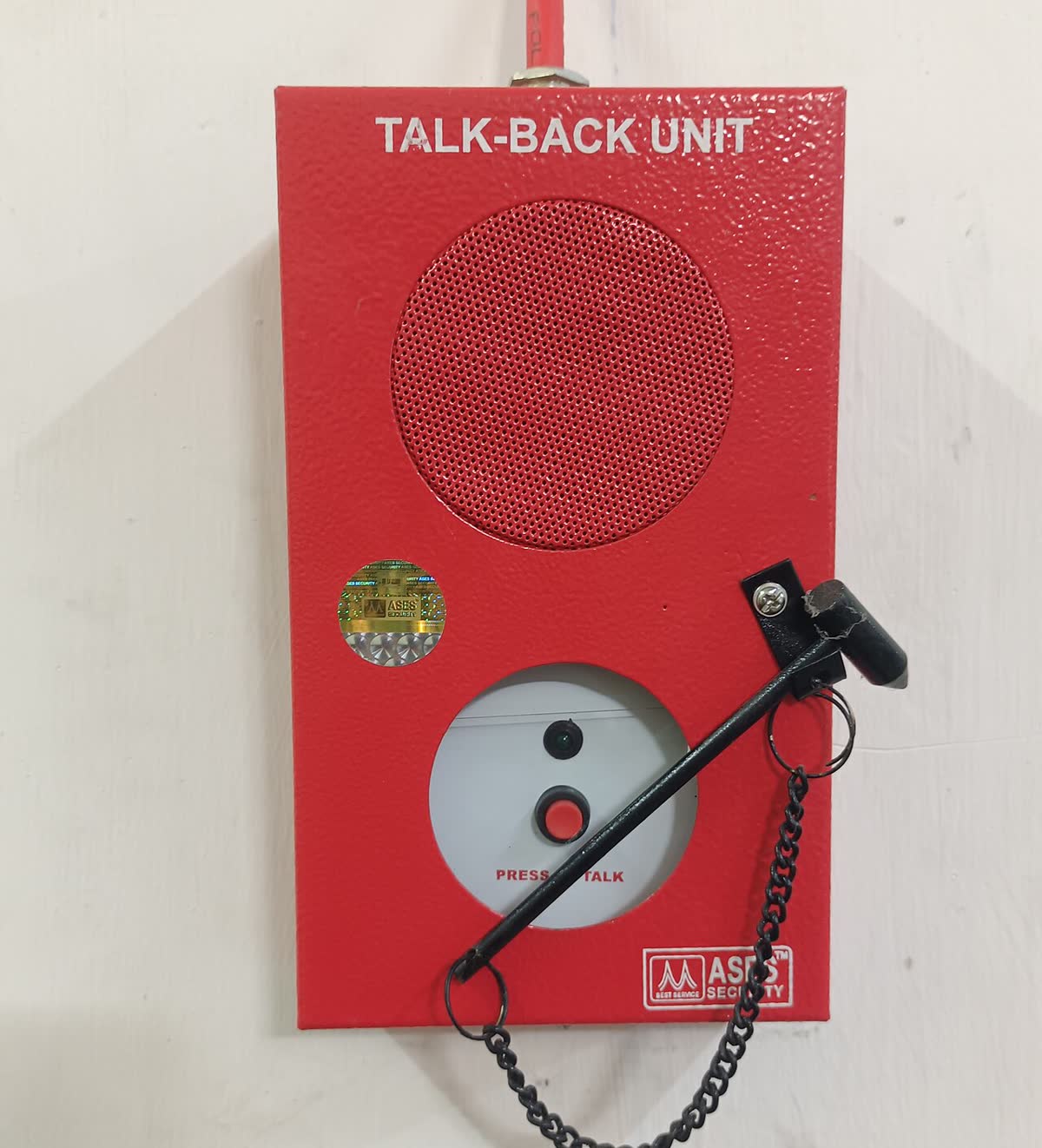
Photo: Shagil Muzhappilangad, CC BY-SA 4.0, via Wikimedia Commons.
Eight Questions to Nail Down With the Supplier
- Are the panel, detectors and loop cards made on your own line or rebranded? Is the mainboard and firmware your own design?
- Is your factory the certificate holder on the EN 54-2 / EN 54-4 certificate? Can the number be verified on the issuing body’s website?
- Is the loop protocol open or proprietary? Can third-party modules (fire telephone, BMS interface) be connected?
- Who writes the interlock logic and who commissions it? Remote or on site? How are on-site man-days priced?
- How many years of spare-part supply do you commit to for spare loop cards, detectors and batteries?
- What is the firmware update frequency and the backward-compatibility policy?
- What tests are done in the factory? Can you provide per-loop simulation test records and burn-in records?
- Which national fire acceptance standards have you delivered against? Give two verifiable local project names.
Five Sampling Checks at Goods-In; Do Not Leave Site Commissioning Blank
Goods-in sampling (sampling basis per the AQL sampling table, full process in pre-shipment inspection and the inspection checklist tool):
- Smoke or heat response test on the sampled detectors and call points
- Panel power-up self-test plus per-loop simulated load (covering 80% or more of the points)
- Battery changeover test: disconnect mains and record quiescent current and alarm current
- Register addresses and serial numbers to avoid address conflicts during on-site soft addressing
- Compare nameplates, models and certificate numbers against the order line by line
Site acceptance must test the interlocks point by point: access control electric lock release, lift homing, smoke exhaust and fire shutters, voice evacuation interface. These cross system boundaries, so interface responsibility must be written into the contract. On the failure modes of access control release (fail-safe versus fail-secure) see the access control and video intercom sourcing guide; on how points are distributed floor by floor in a hotel see low-voltage floor design for a 500-room hotel.
Twelve-Point Quotation Checklist
| # | Item | What to check |
|---|---|---|
| 1 | Detectors | Type and quantity listed separately, not one lump “detector” price |
| 2 | Panel and loop cards | Include the spare loop card, state the loop capacity |
| 3 | Power supply, batteries and standby duration | State standby hours and alarm hours |
| 4 | Short-circuit isolators and I/O modules | Quantity calculated from the point count |
| 5 | Manual call points | Reset method and mounting height |
| 6 | Sounders, beacons and voice alarm interface | Whether the public address interface is included |
| 7 | Fire telephone and talkback | Number of handsets and wiring |
| 8 | Fire-resistant cable and accessories | Whether tray, conduit and fire stopping are included |
| 9 | Programming and interlock commissioning | On-site man-days, commissioning scope |
| 10 | Drawing development and as-built | Whether the as-built point drawing is delivered |
| 11 | Spare parts kit and warranty | Spare parts list, warranty start point |
| 12 | Freight, duties and training | On-site training days, language |
The Six Most Common Traps
- Comparing detector unit prices only: the real difference sits in loop cards, power supply, programming and commissioning, and cable.
- Treating “has a CE mark” as certification: CE does not cover the model or the certificate holder; EN 54 needs a verifiable certificate number.
- Leaving no point headroom: a few extra points force an extra loop card, and later changes cost double.
- Sizing the battery on nameplate capacity: batteries are rated at the 20-hour rate; the capacity available at the 1-hour rate is about half.
- Leaving the interlock logic to the owner: the panel arrives, nobody writes the logic, nobody commissions it, and acceptance stalls.
- Using smoke detection where heat is required: in kitchens, car parks and dusty areas you get false alarms or a dead system within six months.
Frequently Asked Questions (FAQ)
1. Are a fire alarm system and an emergency PA system the same thing? No. Detection and interlocks sit in the EN 54-2 / EN 54-7 family, while voice evacuation sits in EN 54-16 / EN 54-24; the components, certificates and commissioning skills differ. But both share the same interlock logic, so they should be checked on one system schedule at procurement.
2. What is the price difference between conventional and addressable? Only the structure and the variables: the largest gap is on panels and loop cards, and conventional is cheaper at low point counts. Above 300 points, where alarms must resolve to a room, cost per point converges. Actual pricing moves with point count, loop count and commissioning scope, so we do not quote fixed unit prices.
3. EN 54 or CCCF - which one do we need? It depends on the project country: Middle East, Africa and Europe look for EN 54; China looks for CCCF; US projects look for UL 864 / 268 / 521. Export projects in third countries often require both, so confirm which regime the local fire authority accepts before buying.
4. How often do detectors need cleaning and replacement? It follows the environment: smoke detectors in ordinary guest rooms are typically cleaned every 1-2 years and replaced at 8-10 years; dusty and steamy areas need shorter intervals, decided by the sensitivity drift record and failure-rate data, not by the calendar alone.
5. Can we buy the equipment only and do the installation and commissioning ourselves? Yes. But someone must own the EN 54-13 system compatibility assessment, the interlock programming and the on-site commissioning, and that must be written into the contract; otherwise the equipment arrives and acceptance stalls because nobody is doing the interlocks.
Next Step: Send the Point Schedule and Drawings, Get a Comparable Quote in 48 Hours
Send us the point schedule, drawings or BOQ (WhatsApp or email) and within 48 hours you get a comparable quote structure: which lines are equipment, which are programming and commissioning, and which must be done locally in the project country. We work the sourcing and inspection side of this: supplier screening and audit runs through supplier audit services, goods are sampled before shipment under our quality control process, and if you want the whole low-voltage package (CCTV, access control, cabling, public address, IPTV, power) priced together, see how we work.