Public address (PA) is the part of an ELV package that looks simplest: a few speakers, one amplifier, one microphone. It is only at site commissioning that you find out why three quotations for the same list differ 2-3x - and none of the three is lying. The gap sits in four things: 100V line or IP network audio, how much headroom the amplifier leaves, how the zones are drawn, and whether the emergency broadcast needs certified devices.
This article does not explain “what public address is”; it covers the buying actions you can check: the four layers a PA system splits into, how to choose between 100V line and IP, how to size amplifier power and sound pressure, which certifications an emergency/fire voice alarm needs, how to do the bandwidth and PoE math for IP audio, the 8 questions to nail down with the supplier, 5 sampling items at inspection plus 3 at site acceptance, and the 12-point quotation checklist. Public address is a subsystem of hotel low-voltage system integration alongside CCTV, access control and network - and it is the only one that must complete its integrated testing before the fire acceptance inspection.
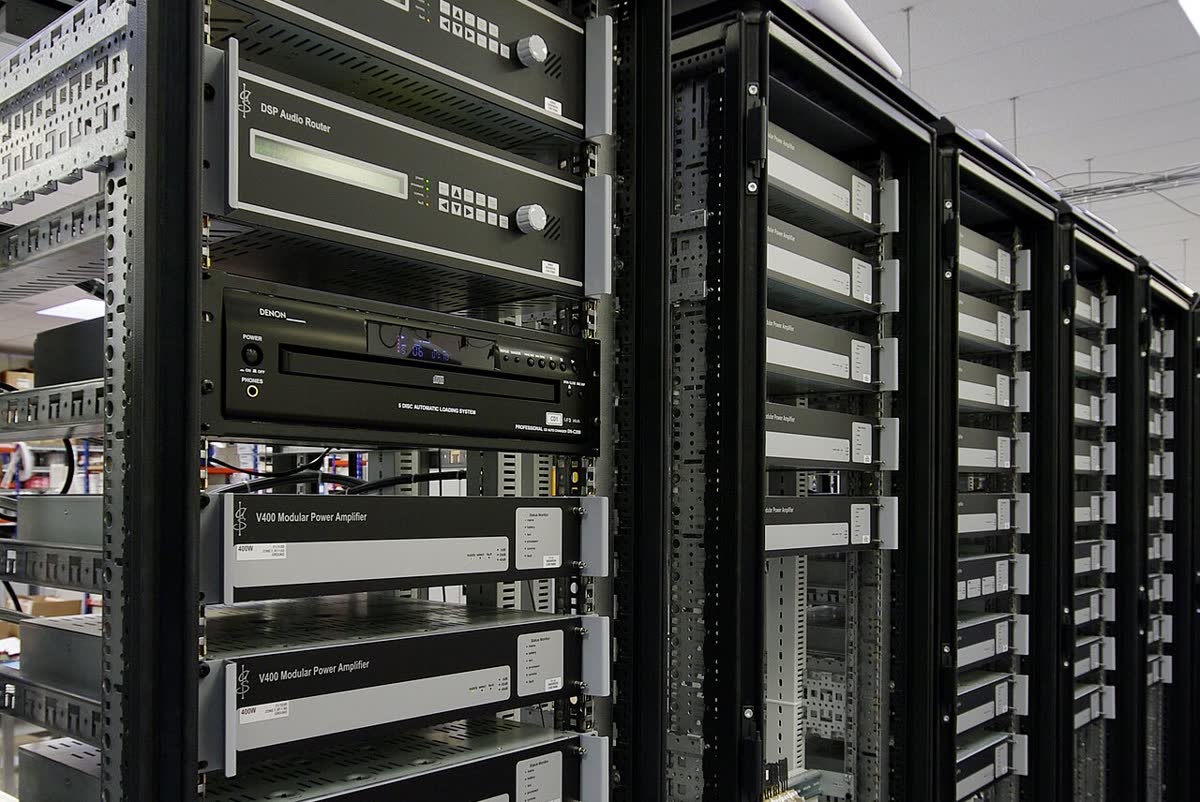
Public Address System rack 1.jpg — Photo: Misternomer, CC BY 3.0, via Wikimedia Commons.
Start Here: PA Is Four Layers plus One Fire Interface
Treating “public address” as one amplifier to compare on price is the root cause of mixed quotation scopes. The real structure is four layers plus one fire interface, and each layer often comes from a different supplier.
| Layer | Typical devices | What it decides | Most common buying mistake |
|---|---|---|---|
| Source layer | Microphones, source players, mixing console, fire voice synthesiser | Sound quality, priority, automatic announcement content | An ordinary microphone substituted for the fire emergency microphone, so nothing can force-cut during integrated testing |
| Control/amplification layer | Preamplifier, zone pager, power amplifier, IP audio host (SIP/multicast) | Power headroom, zone count, fault isolation, battery backup | Amplifier sized to full nominal speaker power with no headroom - thermal protection trips in summer |
| Transmission layer | 100V constant-voltage audio cable, Cat5e/Cat6 cable, fibre | Voltage drop, distance, interference, retrofit possibility | Thin cable still used for long runs; end-of-line sound pressure is too low and the cause cannot be found |
| Terminal layer | Ceiling speakers, column speakers, horn speakers, IP speakers, volume controllers | Coverage uniformity, sound pressure, IP rating | An indoor ceiling speaker used outdoors or in a workshop - dead within six months |
| Fire interface | Fire linkage card, dry contacts, alarm panel communication protocol | Whether fire acceptance passes, priority switching | The quotation only says “supports fire linkage” - nobody defines who supplies it or which protocol |
One practical rule: fix the zones and the emergency requirement first, then choose the architecture (100V line or IP), and only then calculate power. Done the other way round (picking speaker models first) it will almost always be reworked on zone count or fire interlocking. If your list is still just “we need a PA system”, start with why a hotel ELV project needs a technical sourcing agent and break the scope down to zone and point level before comparing price.
100V Line or IP Network Audio: Check the Cable First, Then the Zones
These are not “old versus new”, they are two engineering trade-offs. Mixed use inside one building (IP backbone, 100V line at the edge) is common too.
| Dimension | 100V line audio (analogue) | IP network audio (SIP/multicast) |
|---|---|---|
| Transmission | Dedicated audio cable, one-to-one loop | Cat5e/Cat6 Ethernet, can reuse the existing network |
| Zoning | Set by pager/amplifier channels - hard zoning | Software zoning; one speaker can belong to several logical zones |
| Point power | Speaker taps 1.5/3/6 W (ceiling), 15/30 W (horn) | Each point has its own amplifier and takes 3-12 W over PoE |
| Latency | Analogue links have essentially no latency; whole-site synchronous | Multicast latency inside one LAN is negligible; crossing subnets or going via cloud introduces it |
| Fault impact | One amplifier fault affects the whole loop | A single point fault affects only that speaker |
| Changes | Adding or moving a point means changing cable and amplifier channels | Adding a point is close to “adding a network port” |
| Old buildings | Uses the existing audio cable directly | Requires a network port and switch port at every point |
| Operation | Volume adjusted on site, no remote status | Remote monitoring of online status, volume and faults |
| Typical fit | Single hotel building, small mall, budget-sensitive projects | Multi-building campuses, industrial parks, hotels with many points |
Three rules of thumb:
- Few points, one zone, budget sensitive → 100V line. A six-floor hotel doing background music plus zoned announcements is cheapest and most stable on 100V line.
- Multiple buildings, many zones, remote management and per-point status → IP. For campuses, industrial parks and multi-property groups the difference in operating cost is far larger than the equipment price difference.
- For emergency announcements certification comes before architecture. Whether 100V or IP, if it carries fire evacuation voice alarm, the host and the speakers must hold the matching certification (see section 4).
Amplifier and SPL Budgets: Size by Total Power, Not Speaker Count
The most common buying mistake is choosing an amplifier by counting speakers: 20 ceiling speakers at 3 W taps so you buy a 60 W amplifier, and it trips on thermal protection the first hot afternoon. Two budgets must be calculated separately.
Budget one: power (100V line)
- Add up the total load first: number of speakers x tap power. 20 x 3 W = 60 W.
- Then leave headroom: total load ≤ rated amplifier power x 0.7, i.e. 30% headroom to absorb tap tolerance, cable loss and music peaks. A 60 W load needs an amplifier of at least 85 W; in practice choose 120 W or 150 W.
- Keep a spare channel per zone: for multi-zone projects plan amplifier redundancy (N+1) so any single failure can be switched to the spare - otherwise fire acceptance will ask “how do you make announcements when the audio host fails?”
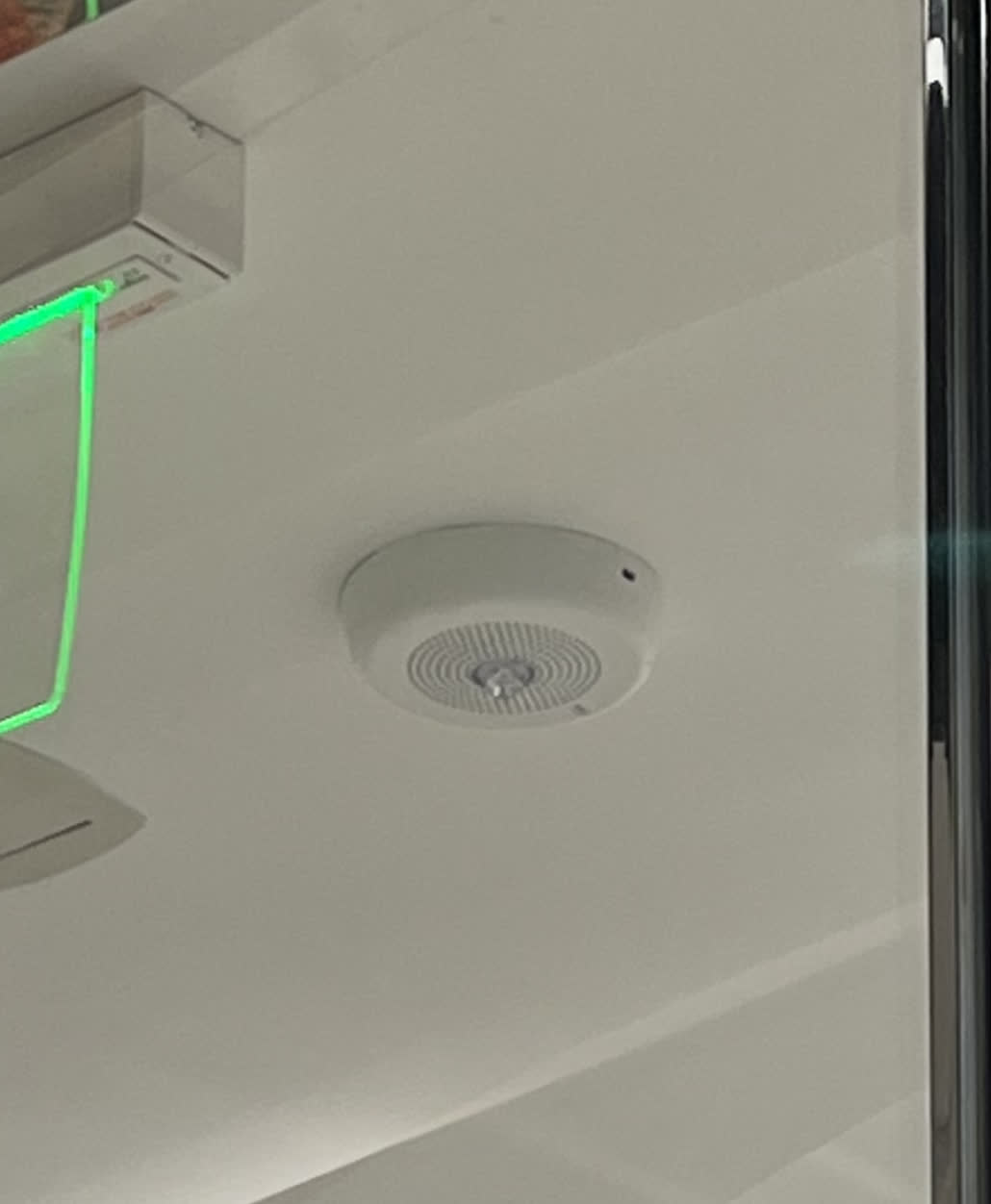
Photo: CascadeDev1361, CC BY-SA 4.0, via Wikimedia Commons.
Budget two: sound pressure
| Scenario | Typical ambient noise | Target SPL (listener position during announcement) | Typical terminal |
|---|---|---|---|
| Hotel guest-room corridors, offices | 40-55 dB(A) | 65-75 dB(A) | Ceiling speaker, 3 W tap |
| Lobby, atrium (ceiling height > 4 m) | 55-65 dB(A) | 75-85 dB(A) | Column speaker or high-power ceiling speaker, 6-10 W |
| Workshop, warehouse (machinery running) | 70-85 dB(A) | Ambient noise +15 dB | Horn speaker, 15-30 W |
| Outdoor plaza, car park | 60-75 dB(A) | Above 80 dB(A) | Weatherproof horn, IP65/IP66 |
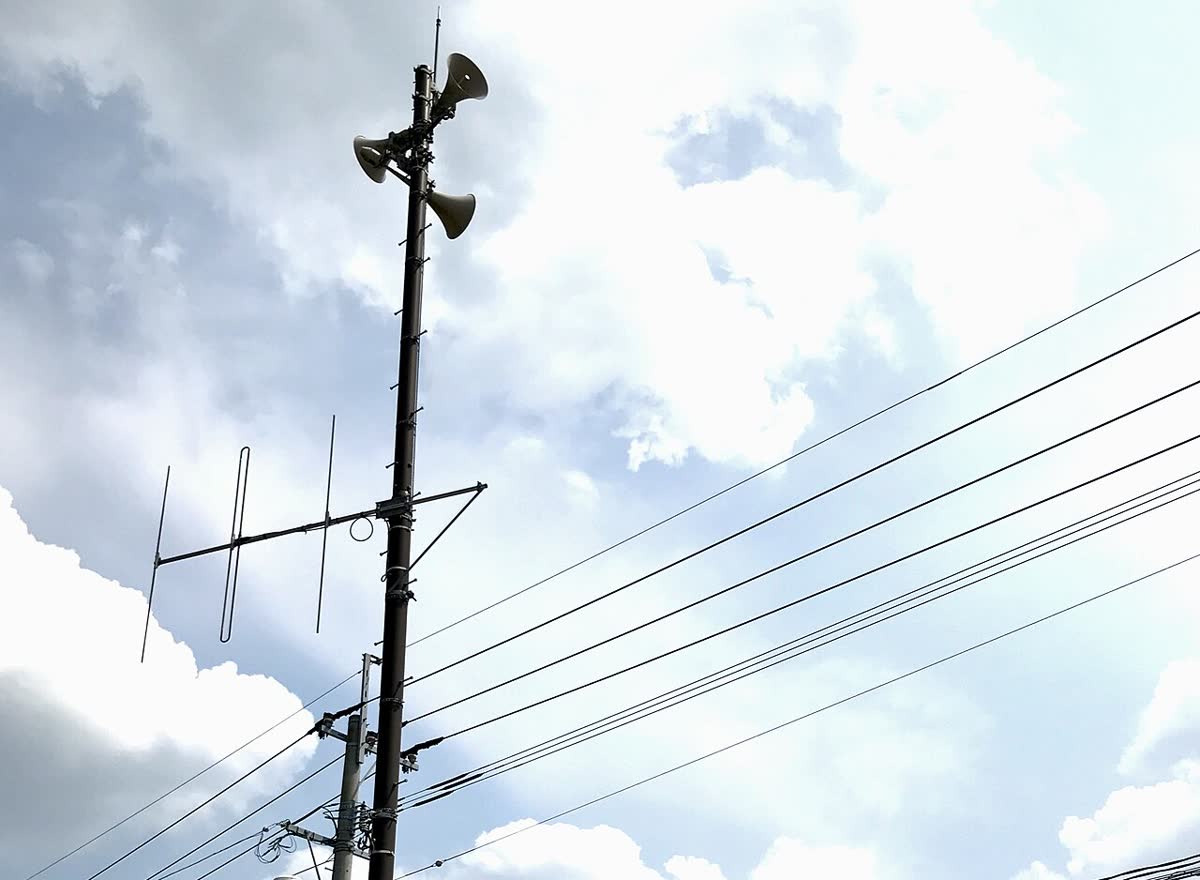
Photo: Peka, CC BY-SA 4.0, via Wikimedia Commons.
For emergency or alarm speech the reference is NFPA 72: the evacuation signal in public areas must be at least 15 dB above ambient noise and never below 75 dB(A) at 3 m from the source; EU and Middle East projects in the EN 54-16 framework require speech intelligibility of STI ≥ 0.5 (measurement method in IEC 60268-16). Write both into the acceptance standard instead of just checking that it “makes a sound”.
Budget three: cable loss (100V line)
The design rule for 100V constant-voltage transmission is no more than 10% voltage drop at the far end of the line. 1.0-1.5 mm² 2-core cable is typical; runs longer than 200-300 m or with a heavier load step up to 2.0-2.5 mm². Buyers often miss this: the speakers are installed, the amplifier is big enough, and the far end is still quiet - voltage drop is the silent killer. Half of the specification arguments about cable come from exactly here, as covered in common quotation traps.
Emergency Voice Alarm: What You Need Is Certification, Not the Words “Fire Linkage Supported”
Background music broadcasting and fire emergency voice alarm are two different products. When a buyer writes “supports fire linkage” on the RFQ, the supplier quotes the cheapest configuration that satisfies that sentence. To pass acceptance, certification and interfaces have to be written down item by item.
| Item | Applies to both 100V and IP | Notes |
|---|---|---|
| Voice alarm host | EN 54-16 (voice alarm control and indicating equipment) | Referenced directly in many EU, Middle East and African tenders; in China fire products go through CCCF certification |
| Speakers | EN 54-24 (loudspeakers for voice alarm systems) | Speakers used in emergency zones must hold this certificate; ordinary ceiling speakers cannot substitute |
| Power / battery backup | EN 54-4 (power supply equipment) | Common requirement: 24 h standby plus 30 min emergency broadcast - verify against the local code of the project |
| Backup and fault reporting | The host must report mains failure, battery failure, line open circuit and short circuit | “With battery” is not enough; specify which faults are reported |
| Fire interlocking | Dry contact plus alarm panel communication protocol, either or both | Must state who supplies the linkage card, who performs the protocol integration, who runs the interface test |
| Announcement priority | Fire > emergency microphone > business announcement > background music | Background music must be force-cuttible on site, with an operation log kept |
| Zone division | Divided by fire compartment; one amplifier must not cover the whole building | A key point in fire acceptance; it drives the number of pager channels |
US projects additionally need the UL 2572 (Mass Notification System) and UL 864 framework; Chinese projects map to GB 16806 (fire linkage control system) and GB 50116 (design code). For export projects, do not accept a “CE declaration” as certification - a CE declaration does not cover the EN 54 series; ask for the EU type examination certificate (Module B) issued by a notified body together with the factory production control file.
IP Audio Bandwidth and PoE Math: If You Have No Network, Do Not Choose IP
IP audio is cheap on equipment and expensive on the infrastructure around it. Work out these two budgets before you buy and you avoid the site incident where “nothing comes out of the speakers”.
Bandwidth: uncompressed voice (G.711) is about 64 kbps per channel, compressed streams (MP3/AAC) about 128 kbps. Broadcasting to 20 zones with one audio channel each is roughly 20 x 64 kbps ≈ 1.3 Mbps of concurrent traffic - no strain on a gigabit LAN. But note:
- Multicast with IGMP snooping must be enabled, otherwise multicast gets flooded like broadcast and the whole network stalls.
- Across subnets or between buildings, confirm whether the design uses L3 multicast or switches to multiple unicast streams; the configuration complexity and the switch requirements are different.
- If audio must not compete with the office network for bandwidth, a dedicated VLAN is the simplest answer.
PoE: each IP speaker draws 3-12 W. 60 IP speakers at an average 6 W is about 360 W; adding the switches’ own consumption and headroom, that means two 24-port PoE switches (802.3af at 15.4 W or 802.3at at 30 W per port, usually around 370 W budget per unit), plus a check of total rack power and UPS capacity. This is the same worksheet as PoE switch sourcing; for comms-room backup power see the UPS sourcing guide.
8 Questions to Nail Down with the Supplier
| # | Question | What it filters out |
|---|---|---|
| 1 | Do the emergency zones use EN 54-24 certified speakers or ordinary ceiling speakers? Can you provide the certificate numbers? | Ordinary speakers passed off as emergency units - fire acceptance fails |
| 2 | Is the voice alarm host an EN 54-16 / CCCF certified model? Notified body certificate or self-declaration? | “Supports linkage” talk against real certification |
| 3 | On what basis is the backup configured (standby hours plus broadcast minutes)? Which faults are reported? | Under-sized batteries, faults that are never reported |
| 4 | What is the total amplifier capacity, the headroom ratio over the load, and is there N+1 redundancy? | Amplifiers sized to nominal load, overheating on site |
| 5 | How many pager channels, can they map one-to-one to fire compartments, and what has to change to add a zone later? | Too few zones, forcing a second retrofit |
| 6 | What cable gauge and maximum run for the 100V loops? How is voltage drop calculated - is there a calculation sheet? | The root cause of weak sound pressure at the far end |
| 7 | IP option: multicast or unicast? Does it support IGMP snooping? How much PoE power does one speaker take? | A whole network stalling after go-live |
| 8 | Who supplies the fire linkage card, who integrates the protocol, and is integrated testing inside the quotation? | Unclear interface ownership, blame traded during commissioning |
5 Sampling Items at Inspection and 3 at Site Acceptance
Factory inspection (before shipment, per AQL sampling):
| # | Sample check | Pass criteria |
|---|---|---|
| 1 | Sound pressure and frequency response | Measure SPL at 1 m at rated power (dB); within ±3 dB of the datasheet; no audible distortion |
| 2 | Impedance and taps | Measure the 100V tap winding impedance with a multimeter; every tap matches nominal; tap wiring secure |
| 3 | Distortion and noise floor | THD ≤ 1% at rated power (1 kHz); no mains hum at idle |
| 4 | Weatherproofing and construction | For outdoor models check the stated IP rating and gaskets; for vandal-resistant models check the IK rating (IK10 = 20 joule impact) |
| 5 | Burn-in and function | 4-8 h continuous full-load burn-in without protection trip; verify zone switching, priority and fault reporting unit by unit |
Site acceptance (after installation and commissioning):
- Measure sound pressure: use a sound level meter at listener positions and check against the targets in section 3 and NFPA 72 (ambient noise +15 dB, not below 75 dB(A)).
- Test interlocking and priority: trigger the fire signal and verify that background music is force-cut, the emergency announcement plays per zone and the records are traceable.
- Battery discharge test: cut the mains, discharge to the nominal standby and broadcast durations, and verify endurance and fault reporting. The method is the same methodology as pre-shipment inspection: set the standard first, keep the evidence after.
The 12-Point Quotation Checklist
- Speakers: model, power tap, EN 54-24 (emergency zones) against standard type, quantity and zone allocation
- Amplifiers: rated power, channel count, headroom ratio, whether N+1 redundancy is included
- Pager / matrix: channel count, expandability
- Sources and microphones: whether the fire emergency microphone and the priority module are included
- Voice alarm host: certified model, certificate type, battery backup basis
- Fire linkage card and protocol integration: inside the quotation or billed separately
- Cable: specification, gauge, metres, whether tray, trunking and pulling are included
- Network part (IP option): switch port count, PoE budget, VLAN and multicast configuration
- Rack, power distribution and UPS: size, quantity, capacity and runtime
- Programming and commissioning: man-days, zone table and recording of announcement content
- Training and documentation: operation manual, zone drawings, interlocking test report, as-built drawings
- Warranty and spares: term, spare ratio for speakers and amplifiers, response time
Cost structure (the range we see on the hotel and commercial projects we handle): equipment (amplifiers, speakers, host) about 45-60%, cable and containment about 15-25%, programming and integration about 5-15%, installation and commissioning about 20-35%. Those four shares move with the zone count, how much of the system is emergency-certified and whether installation is in scope - so align the scope before comparing prices. The ELV system cost breakdown uses the same split.
Six Common Traps
- Treating “supports fire linkage” as a technical specification. It has to land on three things: certified model, protocol, named owner.
- Sizing the amplifier to the speakers’ nominal power. Without 30% headroom it is the first thing to trip on thermal protection in summer.
- Ordinary speakers in emergency zones. An EN 54-24 certified speaker looks almost identical to a standard ceiling speaker and costs noticeably more - and it shows up at acceptance.
- Choosing cable gauge by “it should be enough”. Voltage drop beyond 10% on a long loop leaves the far end too quiet to understand, and three days of troubleshooting may not find it.
- Not budgeting PoE and multicast in an IP design. After installation the switch power is short, or the whole network stalls every time there is an announcement.
- Fitting batteries without a discharge test. The nominal 30 min emergency broadcast may turn out to be 10 min on site.
Public Address Sourcing: FAQ
Q1: What does a public address system cost? There is no single unit price. Cost is decided by four things: point count and zone count, 100V line or IP, how many zones the emergency certification has to cover, and whether installation and commissioning are in scope. The workable approach is to list the zone schedule (speakers per zone, tap power, emergency or not) and price it zone by zone, then look at the whole; the cost block shares are in section 8.
Q2: For an old hotel retrofit, must we move to IP audio? No. If each zone already has audio cable and the zone count is modest, staying on 100V line is the simplest option: cheaper equipment, no link latency, low maintenance. IP only pays off when you want per-room or per-point announcements and remote status for every single speaker.
Q3: Is emergency broadcast certification mandatory? Whenever the system carries fire evacuation announcements, use certified devices per the local code (EN 54-16 plus EN 54-24 in the EU, Middle East and Africa, the UL 2572 framework in the US, CCCF plus GB 16806 in China). Pure background music does not need EN 54 certification, but choose a zone structure that leaves the interfaces for adding emergency coverage later.
Q4: How much amplifier headroom is right? In practice, total load no more than rated power x 0.7. Tap tolerance, cable loss and music peaks all consume power, so 30% is the minimum headroom; multi-zone projects add one spare amplifier for N+1 redundancy, so a single failure cannot take a zone off air.
Q5: Can IP audio share one switch with CCTV and access control? Yes, but put it on a separate VLAN and reserve power and headroom for the PoE ports. The audio multicast must have IGMP snooping enabled, otherwise flooding will drag down the whole network. The approach matches the QC discipline for CCTV networks: count ports and power first, then talk about sharing.
Q6: Which item is most often skipped at inspection? Full-load burn-in and fault reporting. Whether a speaker makes a sound and an amplifier powers up is easy to see, but whether it trips on thermal protection after 4-8 hours at full load, and whether the host reports a mains failure, can only be found on an inspection bench.
Send the Zone Schedule and Point List - More Useful Than Asking the Price First
The most expensive cost in public address is not the speakers; it is the rework caused by mis-drawn zones and misaligned certification. Send us the zone schedule, the point list or the ELV BOQ and the first thing we do is not quote - it is to mark every zone with its speaker taps, amplifier headroom, whether it is an emergency zone, and a price range at one single scope. For hotel, campus and industrial park PA plus emergency packages we return a layered quotation and an interface responsibility note within 48 hours; the full scope of supply for an ELV system is here.
WhatsApp or email both work - just send the list: contact us · how we work.