The same sentence, “hotel IPTV”, can produce three completely different quotes: one supplier quotes 600 set-top boxes, another quotes a satellite dish plus a headend rack, a third quotes a channel subscription running to tens of thousands a year. Put the three side by side and compare unit prices and the conclusion will be wrong, because they are not selling the same system.
It is also the subsystem most easily waved through at BOQ stage in hotel low-voltage system integration. The structure is topped out and the guest rooms are finished before anyone discovers the channels cannot be received, one television in one room chokes the whole building’s network, or a rights holder writes to the owner. The cost of rework is not the equipment: it is opening ceilings, re-pulling cable and redoing acceptance.
This article does not explain IPTV engineering. The interface layer — PMS integration, DRM, multilingual guest interfaces — is covered in hotel IPTV system integration. What follows is the four things a buyer has to close on site: where the content comes from, who carries the bandwidth, who signs the copyright, and how the boxes are managed.
1. Three routes are not three brands, they are three business models
| Dimension | Satellite SMATV + own headend | Carrier IPTV | OTT boxes |
|---|---|---|---|
| Where the content comes from | Your own dish, transcoded into the building LAN | Carrier loop or fibre into the building, channel packages supplied by the carrier | Public internet apps or a cloud CMS |
| Who carries the rights | The hotel (commercial subscription required) | Usually included in the carrier contract | The hotel, and this is the most overlooked |
| Network requirement | In-building multicast, headend rack, stable power | Carrier bandwidth and SLA | Public internet egress, easiest link to saturate |
| Hardware per room | Set-top box, or a commercial display with built-in hospitality DRM | Set-top box supplied by the carrier | Android box, usually consumer grade |
| Who it suits | Large resorts, campuses, regions with good satellite footprint, heavy channel demand | City hotels that do not want an in-house maintenance team | Small guesthouses, soft openings, very low room counts |
| Typical failure | Rain fade, blocked dish position, transcoder stutter, half the channel list missing | Contract lock-in, price rises, channel packages that cannot be changed | Rights complaints, saturated bandwidth, 500 boxes nobody maintains |
The buyer’s first action is not comparing prices. It is getting the owner to sign off on the second column (rights) and the third column (network). Once those two are settled, the rest is hardware.
2. Satellite SMATV with your own headend: when it is still the best value
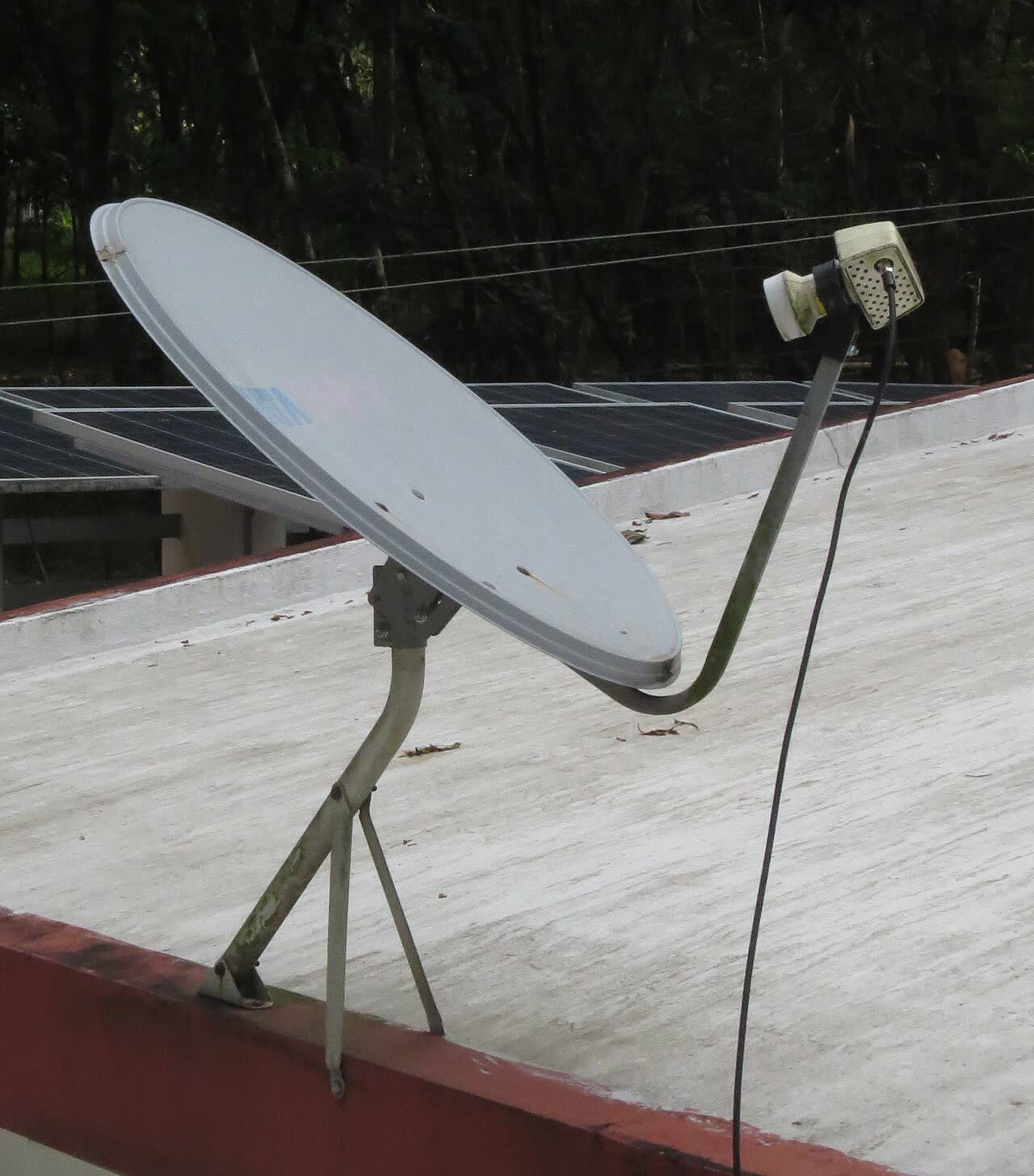
Any hotel that needs local channels, home-country channels or free-to-air satellite channels, or operates where the carrier has no credible channel package, will usually end up building its own headend. The equipment chain is fixed: dish, LNB, DiSEqC multiswitch, rack receivers or transcoders, then scrambling or direct multicast into the building network.
What actually decides success are parameters that do not show on a drawing:
- Band and dish size: Ku band receives at 0.9 to 1.2 m in dry regions, but rain fade near the equator is severe and the margin has to follow local rain intensity. C band resists rain fade well but needs a 1.8 to 3.6 m antenna, which brings roof load, wind resistance and local permits into the project.
- Polarisation and band switching: the LNB switches polarisation on 13 V or 18 V and switches high or low local oscillator on a 22 kHz tone. Leave that sentence out of the commissioning record and “half the channels are missing” after installation is almost always traced back here.
- Cable run length: a long coaxial run from dish to plant room eats the signal. Past a few tens of metres you upgrade the cable or add a line amplifier, and “close enough” is not a judgement to accept.
- Channel list table: require the supplier to list, channel by channel, the source satellite, transponder, polarisation, symbol rate and language. Without that table, adding channels later means redoing the whole installation.
3. Carrier IPTV: least hardware, most lock-in
A carrier package bundles content, bandwidth, set-top boxes and most of the rights, and the hotel barely runs anything itself. That is its real value. The price is three constraints: long contract terms, channel packages that cannot be changed freely, and no negotiating room when prices rise.
Four things have to be settled before signing: the SLA, including fault response and compensation; whether adding or removing channels is charged separately and at what rate; who owns the set-top boxes and how they depreciate; and what happens to installed equipment and cabling if the contract is not renewed. Leave those four open and the hotel has no leverage at the renewal table three years later.
4. OTT boxes: cheapest to start, easiest to break on rights and bandwidth
Consumer Android boxes have the lowest hardware cost of the three routes. The problems are all outside the hardware:
- Rights: most live and on-demand apps preloaded on these boxes carry no broadcast licence in the destination country. A hotel is a public performance venue, and the hotel is who gets pursued, not the box seller.
- Bandwidth: boxes stream unicast over the public internet, so a television switched on in a guest room competes for the outbound link. The front desk system, the OTA feed and the PMS all slow down together, and this is the most common source of complaints.
- Management: without a central platform, 500 boxes drift out of firmware sync, a channel list change means visiting 500 rooms, and every failed box costs a sellable room.
If you use OTT, take content only from a locally licensed platform, and isolate and rate-limit guest video traffic with QoS on the network side. Specify boxes that can be upgraded and locked remotely, and refuse “buy it and flash it yourself” as a delivery model.
5. Do the bandwidth maths first: multicast and unicast differ by 5x
This is the one part of the three routes that arithmetic can pin down, and the part most often manipulated on a quote. Take 500 guest rooms, 100 channels and 4 Mbps per channel:
| Item | Multicast (satellite or carrier headend) | Unicast (OTT boxes) |
|---|---|---|
| Backbone bandwidth | 100 channels x 4 Mbps = 400 Mbps (a single stream) | 500 rooms x 4 Mbps = 2,000 Mbps = 2 Gbps |
| Preconditions | IGMP snooping on access switches, PIM-SM across subnets, separate VLAN for IPTV | Public egress and the Wi-Fi side both have to survive it |
| Headroom after a codec change | HEVC at 2.5 Mbps x 100 channels is about 250 Mbps | A codec change only lowers the per-room bitrate, it is still 500 copies |
Add catch-up or time-shift and the bill grows: one channel at 4 Mbps recorded continuously for 24 hours is about 43 GB, so 100 channels is 4.3 TB a day and roughly 130 TB for 30 days of retention. Either record only part of the list (10 channels for 7 days is about 3 TB), or put the storage line in the quote at tender stage. The worst outcome is being told before acceptance that catch-up needs another server.
Multicast also depends on three network settings, and missing any one of them degrades to flooding the whole building: IGMP snooping at the access layer, PIM-SM at layer three, and a dedicated VLAN for IPTV. These sit inside the scope of structured cabling and the switches, and the plant room side can be checked point by point against the 500-room hotel ELV drawings.
6. Rights and commercial licensing: the most expensive line nobody checks
Hotel lobbies, restaurants and guest rooms are all public performance venues, and a domestic subscription cannot simply be moved into a hotel. What a buyer has to verify is not “is there a licence” but who the licensor is, how many rooms it covers, whether public areas are included, how many years it runs, and how increases are calculated.
Three practical steps:
- Put the licensor’s name and the licence number in a contract annex, not just the words “rights included”. A fake licence is harder to detect than no licence, because by the time it surfaces the supplier has closed the file.
- List public areas — lobby, restaurants, gym, meeting rooms — as a separate licence line. Many quotes only count guest rooms.
- Make the channel list and the licence scope match. A licence for 60 channels with a headend pushing 100 leaves 40 channels unlicensed.
7. Set-top boxes: specifications, central management and spares
- Hardware floor: 2 GB RAM and 8 GB storage minimum, HEVC decoding, and Widevine L1 or the equivalent DRM level if there is paid video on demand. The remote must control television volume and power (infrared learning or HDMI-CEC), otherwise guest rooms generate “two remotes” complaints.
- Quantity: room count plus public areas at 5 to 8 percent plus spares at 3 to 5 percent. For 500 rooms that is about 550 boxes; with too few spares, one failed box means one less sellable room.
- Management platform: it must push firmware in bulk, distribute channel lists, and report online rate and fault logs. A proposal that only configures boxes one at a time hands the operating cost back to the hotel.
8. The twelve-line quote check
| # | What to check | Common omission |
|---|---|---|
| 1 | Content source and channel list (per channel: satellite, transponder, language) | “100 channels” and nothing else |
| 2 | Dish diameter, band, quantity and mounting method | No diameter, no wind load |
| 3 | Headend rack: receiver and transcoder count with redundancy | No backup receiver |
| 4 | Multicast configuration and switch specification | Priced on 100 Mbps switches |
| 5 | Set-top box model, RAM and storage, DRM level | “Android box” |
| 6 | Box quantity split (rooms, public areas, spares) | Guest rooms only |
| 7 | Central management platform (licensing, per-box or per-project fee) | Platform fee listed separately and charged annually |
| 8 | Rights and commercial licensing (licensor, room count, term) | “Rights included” |
| 9 | Catch-up and time-shift included, storage in TB | Raised just before acceptance |
| 10 | PMS integration scope and cost (FIAS and similar) | Integration excluded |
| 11 | Training, spares kit, warranty term and response time | One-year warranty with no response clause |
| 12 | Interface with fire alarm and public address for emergency override | All three parties deflect to each other |
9. Eight questions to close with the supplier
- How many projects above 300 rooms have you delivered, and can you give two owners we can call?
- Can the channel list go down to transponder level, or is it only a list of channel names?
- Who is the licensor, and can you produce a copy of the licence document?
- Is the in-building distribution multicast or unicast, and who owns the switch and PIM configuration?
- Who maintains set-top box firmware, and for how many years will security patches still be available?
- Is the management platform charged per box or per project?
- Is catch-up storage local or cloud, and are capacity and retention days written into the contract?
- What is the on-site response time for a fault, and are spares held in the country or at the factory?
Acceptance looks at three things only: the power-on rate room by room, including channel switching time; multicast that does not flood, confirmed by a packet capture showing only subscribed groups; and automatic return to the home screen after a power cut. Pass all three, then discuss the retention payment.
10. Six traps
| Trap | Consequence | How to avoid it |
|---|---|---|
| Treating a domestic subscription as a commercial licence | Rights claim, forced removal | Put the licensor and room count in a contract annex |
| Quoting the dish on a “standard size” | Channels lost in the rainy season | Calculate from transponder parameters and local rainfall |
| Pricing switches at 100 Mbps | Multicast stutter, guest complaints | Check port speed and PIM capability |
| Counting set-top boxes for guest rooms only | No signal in lobby or restaurants | List public areas separately |
| Catch-up storage outside the quote | Price added before acceptance | Quote line 9 |
| No central management platform | 500 boxes maintained by hand | Put platform fee and functions into the contract |
Once the route is chosen, the remaining work is folding it into the whole building’s low-voltage package: channels and rights, bandwidth and VLANs, boxes and spares, acceptance and retention. Each of the four needs an owner. If you want a comparable quote structure built around your room-type schedule and channel demand, send the drawings and requirements over and we will reply within 48 hours.
Related reading: Hotel IPTV system integration: PMS, DRM and multilingual interfaces · Cost structure of a 500-room hotel ELV system · Hotel guest room smart control · Hotel network and Wi-Fi design