“China factory audit” sounds like a formality until it saves you from a bad supplier. A 30-minute check of a business license costs almost nothing. A container of defective goods costs tens of thousands.
The gap between those two outcomes is exactly what an on-site factory audit fills. This guide explains what a professional China factory audit actually checks, how long it takes, what the report contains, and how to read the red flags — so you can verify any supplier before a single dollar moves.
What Is a China Factory Audit?
A factory audit is an on-site verification of a supplier’s legal status, production capability, and quality systems — performed by a person physically standing in the factory, not by email.
It answers three questions you cannot answer from abroad:
- Does this factory legally exist? — Is the business registered, in the name claimed, at the address claimed?
- Can this factory actually make your product? — Real equipment, real production lines, real capacity for your order size?
- Is this factory capable of consistent quality? — Certifications, QC staff, testing equipment, and documented processes?
An audit is different from a product inspection. A pre-shipment inspection checks the goods after production. A factory audit checks the factory itself before you commit. Both matter — they protect different stages of the same order.
What does a professional factory audit check?
The cost of an audit is small compared to the cost of the failure it prevents. A typical import order runs from $5,000 to $50,000. A bad supplier can burn the entire order value through:
- Deposit loss — you pay 30% upfront, the “factory” disappears or stalls
- Trading company markup — middlemen re-invoicing your product at 15-40% above factory price while you believe you’re buying direct
- Quality failure — goods that don’t meet spec, caught only after shipment
- Delay penalties — capacity that was never there, missed sales seasons
A 1-2 day audit, costing a fraction of any of those outcomes, is the cheapest insurance in the entire import process.
What do you get in the audit report?
A serious audit is systematic, not a quick walk around. Based on the standard we run for clients at Cantonmade, here’s the full checklist:
1. Business License & Legal Registration
The auditor verifies the factory’s business license against Chinese government databases, confirming:
- Company name matches the one you’re dealing with
- Registration address matches the physical location
- Legal representative is who they say they are
- Business scope actually covers your product category (a common trap: a “steel fence factory” whose license says “household goods trading”)
2. Physical Site & Production Capacity
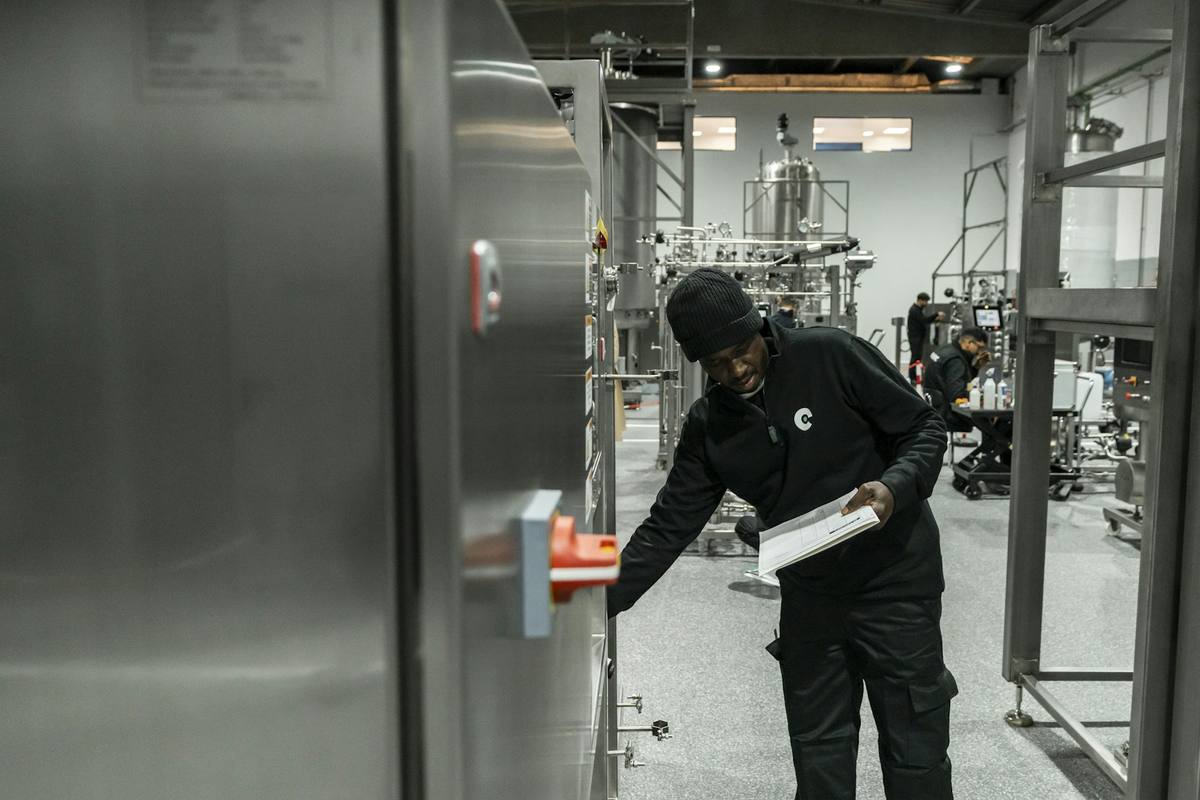
The auditor walks the production floor and counts what’s actually there:
- Factory area in square meters
- Number of machines, assembly lines, and workstations
- Warehouse space and inventory
- Workforce size — how many workers on the floor, not on paper
- Estimated monthly output — can they genuinely handle your order volume without delaying other customers?
3. Equipment & Line Verification
Beyond counting machines, the auditor checks whether equipment matches what’s needed for your product. Injection molding, CNC machining, SMT lines, welding stations — each product category needs specific capability. A factory that outsources your product to an unknown third party can’t show you the line that makes it.
4. Certification Verification
Paper certificates are easy to fake, so a professional audit verifies:
- ISO 9001 (quality management), ISO 14001 (environmental)
- Product-specific marks: CE, FCC, FDA, UL, BSCI, SEDEX depending on your market
- Expiry dates and issuing bodies — expired certificates are one of the most common dodge tactics
- Whether the certificate genuinely covers the production lines used for your order
5. Quality Control Systems
The auditor assesses whether QC is a real process or a slogan:
- How many dedicated QC inspectors, at what stages (incoming, in-process, final)?
- Testing equipment present and functional?
- Documented procedures — inspection records from recent production runs?
- Attitude toward third-party inspection: factories confident in their process welcome it
6. Export Experience & Client References
- Major clients and export markets — who have they actually shipped to?
- Existing customers in your country or region (same compliance and logistics context)
- Export documentation capability — does anyone on site understand FOB, Incoterms, and export paperwork?

What You Get: The Audit Report
A professional audit doesn’t end with a verbal “looks fine.” You receive a written report within 2-3 business days of the visit containing:
| Section | What’s Included |
|---|---|
| Identity | Factory name, address, GPS coordinates |
| Legal | Business license & registration documents |
| Scale | Factory size (sqm), employee count |
| Production | Equipment list, production line count |
| Capacity | Monthly production capacity estimate |
| Market | Major clients & export markets |
| Compliance | Certification copies with validity check |
| Evidence | On-site photos & video walkthrough |
The photos matter most — they’re proof the factory is real, taken the day of the visit. No stock images, no retakes.
Red Flags: What Auditors Find in the Field
Some signals only appear on the ground. Our auditors routinely see:
- Registered address ≠ factory address — the license says one city, the factory is in another, with no branch registration
- “Factory” that is an office — a showroom with samples but zero production equipment
- Rented-in demonstration — the real line belongs to another company and was “borrowed” for the visit
- Staged workforce — workers brought in for the tour (a trick more common than you’d think)
- Certificates that don’t match — valid-looking ISO documents that list a different company name or expired dates
- No QC records — the inspection process is claimed but no written records from recent batches exist
- Reluctance to show the floor — “it’s not clean today,” “we’re between shifts,” any excuse that keeps you out of production
None of these are visible in a WhatsApp message or a video call. All of them are visible in person.
How Long Does a Factory Audit Take?
A standard on-site audit takes 1-2 days including travel. The auditor visits the factory, runs the checks above, and documents everything with photos. The written report is delivered within 2-3 business days after the visit.
For a first order from an unknown supplier, that timeline is nothing compared to the 30-60 day production cycle you’re about to commit to.
What Does a China Factory Audit Cost?
Audit fees vary with travel distance, factory size, and product complexity. A useful way to think about it: the audit costs a small fraction of your deposit, and a far smaller fraction of what one failed shipment costs. When you work with a sourcing agent on a commission basis (typically 5-8% of factory price), factory verification is part of the package — you see every factory invoice directly, and the audit protects your deposit from day one. Ask any agency for their audit fee in writing before you commit.
When Should You Audit a Factory?
Audit when the stakes justify it — which is most orders, and definitely these situations:
- First order from a new supplier — the highest-risk purchase you’ll make
- Before paying a deposit — the audit is your last chance to walk away for free
- When the quote is suspiciously low — cheap prices often mean a trader, not a factory
- When switching suppliers — even a factory you “know” changes management and equipment
- For branded or certified products — CE/FDA-marked goods require verified production
If you’ve already found a factory on Alibaba or at a trade show, that’s fine — many clients ask us to audit factories they found themselves. An independent on-site audit gives you an unbiased assessment either way.
Can You Audit a Factory Yourself?
You can do parts of it remotely: check the license photo, ask for certifications, request a live video call walking the production floor. That’s the 10 questions approach, and it’s worth doing as a first filter.
But remote checks have limits: video calls can be staged, documents can be doctored, and the person on camera may not be the factory owner. The verification that actually holds up is in person — checking GPS coordinates against the license, walking the line, seeing the equipment running. That’s why our 15-step sourcing process includes on-site supplier verification before any contract is signed.
Supplier audit vs factory audit vs social compliance audit: which one do you need?
“Supplier audit” and “factory audit” are used interchangeably online, but they answer different questions, and a buyer who orders the wrong one pays for a visit that proves nothing about the risk they actually carry. The five formats below are the ones we are asked for; each column names the published standard you can hold the auditor to.
| Format | Question it answers | What is physically checked | Published standard to reference | When buyers run it |
|---|---|---|---|---|
| Supplier verification (document-based) | Is this company real, licensed and solvent? | Business licence against the national enterprise credit system, the 18-character Unified Social Credit Code, registered business scope, legal representative, litigation and enforcement records | China’s National Enterprise Credit Information Publicity System (gsxt.gov.cn) | Before any deposit moves, on every new supplier |
| Factory audit (on-site, quality and technical) | Can this factory actually make my product, at my volume, consistently? | Site, machinery, line count, shift pattern, capacity, in-house QC, calibration, batch records | ISO 9001:2015 for the quality system; ISO 19011 as the audit-method guideline | First order from a new factory; new product or new process |
| Social compliance audit | Are wages, hours and working conditions acceptable to my customer? | Contracts, payroll and time records, overtime, safety equipment, dormitories | SMETA (Sedex) four-pillar methodology; amfori BSCI; SA8000 | When a retailer or brand requires it before onboarding |
| Environmental audit | Are permits, emissions and waste handling in order? | Permits, wastewater and solid-waste handling, air emissions, chemical storage | ISO 14001:2015 | Chemical, paint, plating, printing or finishing processes |
| Supply-chain security audit | Is the cargo and the site protected against tampering and theft? | Site access control, container sealing, cargo handling, personnel procedures | C-TPAT | US-bound cargo and retailer compliance programmes |
No single format covers all five well, and that is the point. Document-based verification dominates the legal and financial layer, because those facts live in government databases rather than on a factory floor. An on-site audit dominates capacity and physical quality control. A social audit dominates labour records. Pick by the failure you cannot afford, not by the cheapest line on the quote.
What a supplier audit has to produce to be conclusive
Any auditor can hand you a signed report. What makes the report usable is that each claim carries evidence you can verify yourself afterwards:
| Check | Evidence to demand | How you verify it independently |
|---|---|---|
| Registered name and number | Business licence showing the 18-character Unified Social Credit Code | Look the code up on gsxt.gov.cn |
| Manufacturing scope | The registered business scope line, in Chinese | Read the scope: “production / manufacturing” versus “sales, wholesale, import-export” only |
| Legal representative | Licence name set against the person who signs your contract and the account holder on the proforma invoice | Licence plus the bank details on the PI must match |
| Site | GPS coordinates and photos taken on the day of the visit | Match the photos and coordinates against the licence address |
| Capacity | Line count, machine list, shift pattern, recent monthly output | Ask for output records from the last three months, not a capacity claim |
| Quality system | Incoming-inspection log, one non-conformance report with its corrective action, current calibration records | Request those three documents by name and read the dates |
Two of those checks catch most of the fakes we see: a licence whose scope says trading rather than manufacturing, and a deposit request to a personal bank account. Both are decided on paper, before an auditor ever boards a train — which is why we run the document layer first and the on-site visit second, and why the free factory audit checklist is a reasonable first filter. Once production starts, the audit question changes: the pre-shipment inspection guide covers the AQL sampling that checks the goods rather than the factory.
FAQ
How long does a factory audit take?
A standard on-site audit takes 1-2 days including travel. The audit report with photos, documents, and our assessment is delivered within 2-3 business days after the visit.
Can you audit a factory I’ve already found?
Yes. Many clients come to us with a factory they found on Alibaba or at a trade show. We run the full independent on-site audit — license, production lines, capacity, certifications — and give you an honest go/no-go recommendation.
What happens if the factory fails the audit?
We flag every red flag clearly in the report and recommend against proceeding. If issues are fixable (missing documents, minor equipment gaps), the report explains exactly what the factory must correct. If not, we help you find alternative verified suppliers from our network — your deposit is never at risk because problems are caught before you commit.
Is a factory audit the same as a product inspection?
No. A factory audit verifies the factory itself (license, capacity, certifications, QC systems) before you order. A pre-shipment inspection verifies the finished goods against your spec after production. Most importers need both — the audit to choose the right supplier, the inspection to confirm the right goods.
What’s the difference between an audit and a “factory visit” arranged by the supplier?
A supplier-arranged visit shows you what they want you to see. An independent audit is unannounced or semi-announced, follows a fixed checklist, and reports to you — not to the factory. The independence is the entire point.
What is the bottom line on factory audits?
A China factory audit is the difference between buying from a verified manufacturer and buying from whoever answers the phone. For the cost of a few hundred dollars against an order of thousands, it answers the only question that really matters before you pay: is this factory real, capable, and reliable?
We perform these audits weekly for clients who can’t be in China — verifying factories across the Pearl River Delta and beyond, with every invoice shown directly from the factory. We’ve shipped for importers in Tanzania, Nigeria, Saudi Arabia and the Philippines.
Have a factory to verify, or a product to source? Send us the factory name or Alibaba link and we’ll conduct an independent on-site audit — or read our factory audit service overview to see exactly what’s checked. New to China sourcing? Start with our complete sourcing guide.
Related: auditing a CCTV and PTZ camera factory — the same audit logic applied to a security-camera supplier.
📥 Free tool: download our China Factory Audit Checklist (Excel) — 84 checks across nine sections, with an automatic audit score, the evidence log and the red flags, ready to walk a plant with.