
Answer first: UK import VAT can be settled three ways on a shipment from China. Clear the goods on your own VAT number and reclaim the VAT later; use VAT deferred so the import VAT is declared on your VAT return instead of being paid at the border; or buy duty paid under DDP with the duty and VAT already inside the freight price. Clearance on the first two is RMB 200 per shipment.
Same cartons, same flight, three different cash-flow and compliance outcomes. Which one fits depends on whether you are VAT registered in the UK and whether you can actually reclaim import VAT, not on which per-kilo number looks smallest.
Most quotes UK buyers receive from China offer one of the three, take it or leave it. Our card is priced for all three, so we can put them side by side.
What are the three UK import VAT routes?
Own VAT (self-clearing). The declaration is made using your UK VAT number and your EORI number. The import VAT is recorded against your business and you reclaim it on your VAT return as input tax under the normal rules. We prepare the customs file and clear the goods; you supply the numbers. Clearance fee RMB 200 per shipment, no product-category surcharge on the rate.
VAT deferred (postponed VAT accounting). Still declared under your VAT number, but the VAT is accounted for on your VAT return rather than paid in cash at import. Nothing leaves your account at the border. Also RMB 200 per shipment.
Duty paid (DDP including VAT). We are the importer of record and we pay the duty and the import VAT, as set out in DDP shipping from China. The goods arrive cleared and delivered and you do nothing at customs. The price reflects it: a higher freight band plus a product-category surcharge.
| Own VAT | VAT deferred (PVA) | Duty paid (DDP incl. VAT) | |
|---|---|---|---|
| Importer of record | You | You | Us |
| Numbers you need | VAT number + EORI | VAT number + EORI | None |
| When VAT is paid | At import, reclaimed later | Never paid in cash; declared and reclaimed on one return | By us, inside the freight price |
| Our clearance fee | RMB 200 per shipment | RMB 200 per shipment | None, but a product-category surcharge applies |
| Freight band, air freight P | 36–50 RMB/kg | 36–50 RMB/kg | 38–53 RMB/kg |
| Who recovers the VAT | You, if entitled to deduct | You, if entitled to deduct | Nobody on your side |
What does each route cost on our China to UK lanes?
Our contracted UK card, in effect 22 September 2026, prices the three options separately. The gaps look small and behave large, because the duty paid band already contains tax you may not recover.
| Service | Own VAT | VAT deferred | Duty paid incl. VAT | Transit |
|---|---|---|---|---|
| Air freight P (mainland China departures) | 36–50 RMB/kg | 36–50 RMB/kg | 38–53 RMB/kg | 5–7 working days after clearance at LHR |
| Air freight C (Hong Kong / Korea departures) | 41–59 RMB/kg | 41–59 RMB/kg | 44–62 RMB/kg | 5–7 working days after clearance at LHR |
| Rail + truck | 13–19 RMB/kg | 13–19 RMB/kg | 13–19 RMB/kg plus surcharge | 25–30 days after loading |
| Oversize / pallet line | Air 9–12 days plus 2–3 days after clearance; sea 40–45 days. Head-haul 41 RMB/kg air or 7.5 RMB/kg sea, delivery 630–1,200 RMB per pallet | Same three options | Same three options | Pallet max 100 × 120 × 200 cm, 800 kg |
Every figure is an indicative band, not a bookable rate. Minimums are 5 kg per shipment and 12 kg per carton, and volumetric weight uses a divisor of 6000, so light bulky cargo prices on size.
How does each route change your cash flow?
Own VAT and deferred look nearly identical on a quote and behave very differently in your accounts.
Own VAT means the import VAT is funded when the goods enter the UK and recovered on your next return. For slow-selling stock, that is a working-capital loan to HMRC: cash out at the border, back a cycle later.
VAT deferred removes that float. Nothing is paid at import. The postponed amount appears on your postponed import VAT statement, you enter it on your VAT return as VAT due and as input tax, and the two sides net off when you are entitled to a full deduction. For goods that sit in a warehouse before selling, this is usually the cleanest route available.
Duty paid asks nothing of you at the border, because we already paid. But the VAT inside that price is not your input tax: the declaration is not in your name and the amount never appears on your postponed VAT statement, so you cannot reclaim it. For a VAT registered business importing to resell that is a permanent cost; for a buyer with no VAT registration it costs nothing extra.
What numbers does each route require?
Own VAT and deferred need the same things, before the declaration is filed rather than after.
| Requirement | Own VAT | VAT deferred | Duty paid |
|---|---|---|---|
| UK VAT registration number | Yes | Yes, entered on the declaration | No |
| GB EORI number | Yes | Yes | No |
| Written instruction to the declarant | Yes | Yes, and it cannot be changed once submitted | Not applicable |
| Customs broker | Yours, or ours under your authorisation | Same | Ours |
| Record supporting the VAT return | Import VAT paid and reclaimed | Postponed import VAT statement | None for you |
| Legal responsibility for the entry | You | You | Us |
Two points buyers get wrong. A broker can clear under your VAT number with your written authorisation, so you file nothing yourself, but the declaration stays your legal responsibility. And the deferred instruction must reach the declarant in writing before submission, because the choice cannot be changed afterwards. Miss it and the VAT reverts to payment at import.
What is the difference between DAP and DDP in the UK?
Under DAP (Delivered at Place) we pay the freight and deliver to the agreed place, but import clearance, duty and VAT are yours. That is what the own VAT and deferred quotes on our card are: DAP deliveries cleared under your registration.
Under DDP (Delivered Duty Paid) we carry the full chain including clearance, duty and import VAT, and deliver to the named place. It is the only one of the three that asks nothing of you at the border, and the DDP vs DAP comparison walks through who carries the risk on each leg.
DDU is the term buyers still use for “duty unpaid”, and it no longer exists. It was retired in Incoterms 2010 and replaced by DAP, one of the eleven rules in Incoterms 2020 explained. If a supplier quotes DDU today, read it as DAP and confirm who clears the goods, because that clause decides whose number the VAT lands on.
Which route should you choose?
- VAT registered and importing to resell: VAT deferred — same RMB 200 clearance, lower band than duty paid, no cash out. Keep own VAT only if you already clear that way.
- Not VAT registered, or buying for personal use: duty paid. Deferral is not available to you, and VAT paid at import on your own account is money you cannot recover.
- Selling into a marketplace or FBA warehouse: deferred. Select the Amazon or FBA address in the China–Europe shipping cost calculator and it prices the UK postcode groups.
- Need one fixed landed cost per unit: duty paid. Treat the higher band as the price of certainty, not a tax you can reclaim.
One rule covers all of it: the own VAT band looks cheaper until you ask who recovers the VAT. Air freight P is 36–50 RMB/kg own VAT against 38–53 RMB/kg duty paid, roughly 2 to 3 apart. If you can deduct, the lower band plus RMB 200 clearance wins. If you cannot, that premium buys you the whole VAT, and duty paid is cheaper by a wide margin.
What are the common misconceptions about UK import VAT?
1. “Declare it low and nobody will notice.” Under-declaring is a false declaration, not a discount. HMRC can reassess the duty and VAT and add penalties, and the record attaches to your EORI number, not the seller’s. We quote duty paid on the real invoice value.
2. “Postponed VAT accounting means no VAT.” Deferral is timing. You still account for the import VAT on your return, and if you are not entitled to deduct, the deferred amount becomes a real cost, just collected later.
3. “Deferred means there is nothing to do.” You must give the declarant written instructions before the declaration, your VAT number must be on it, and you must retrieve the postponed import VAT statement to complete the return. Lighter paperwork, not none.
4. “Duty paid means the VAT is mine to reclaim.” It is not, because the entry is not in your name. Buyers who assume otherwise find out a quarter later.
5. “The cheapest per-kilo rate is the cheapest shipment.” Only if you can deduct import VAT. That condition flips the choice between the two bands, which is why we ask about VAT registration before quoting.
FAQ
Is VAT deferred the same as not paying import VAT at all? No. Deferred means postponed, not cancelled: the VAT is declared and reclaimed on the same return, so the cash never leaves your account. It changes when the VAT is settled, not whether you owe it.
What do I need before my first own VAT or deferred shipment? A UK VAT number, a GB EORI number, a broker, and a written instruction to the declarant that you want import VAT accounted for on your VAT return. The declaration stays your legal responsibility.
Do I need an EORI or VAT number if I ship duty paid? No. We are the importer of record, so you need a delivery address and a contact. The trade-off: the import VAT inside the freight price is not your input tax, so a VAT registered buyer cannot reclaim it.
How much is UK import VAT and duty? It depends on the HS code and the product, so no single rate exists. We do not publish or estimate rates; the figure is confirmed per shipment against the commodity code and invoice value.
Does the duty paid rate treat every product the same? No. Duty paid means we pay duty and VAT for you, so a product-category surcharge applies according to what you import, confirmed per shipment.
Why is the duty paid price per kilo higher? Because we fund the duty and the import VAT at the border and carry that risk. On the air lanes it sits about RMB 2 to 3 per kilo above the own VAT band.
Related Guides
- Shipping from China: sea vs air vs express and Incoterms — the mode-by-mode background behind these UK bands.
- China to Europe rail freight planning — why the rail lane at 13–19 RMB/kg is the slow, cheap option for UK stock.
- Landed cost calculator — put freight, duty and VAT into one per-unit figure before you set a price.
- Our shipping and customs service — how we run booking, export declaration, UK clearance and delivery as one file.
Send us the product description, carton count, dimensions and weights, the destination postcode, and whether you hold a VAT number and EORI, and we will price own VAT, deferred and duty paid on the same goods, so you can see the cash-flow difference next to the price difference. Every figure here comes from our contracted forwarder’s UK card in effect 22 September 2026 and is indicative only; rates and transit times are confirmed at booking. If your goods also move to the United States, price those lanes in the China–USA shipping cost calculator, and for the quote-by-quote discipline behind these numbers see how to compare China quotes line by line.
Contact us or message WhatsApp +86 139 2270 2227, Monday to Saturday, 09:00–19:00 GMT+8. We answer within 12 hours with the three routes priced against each other.
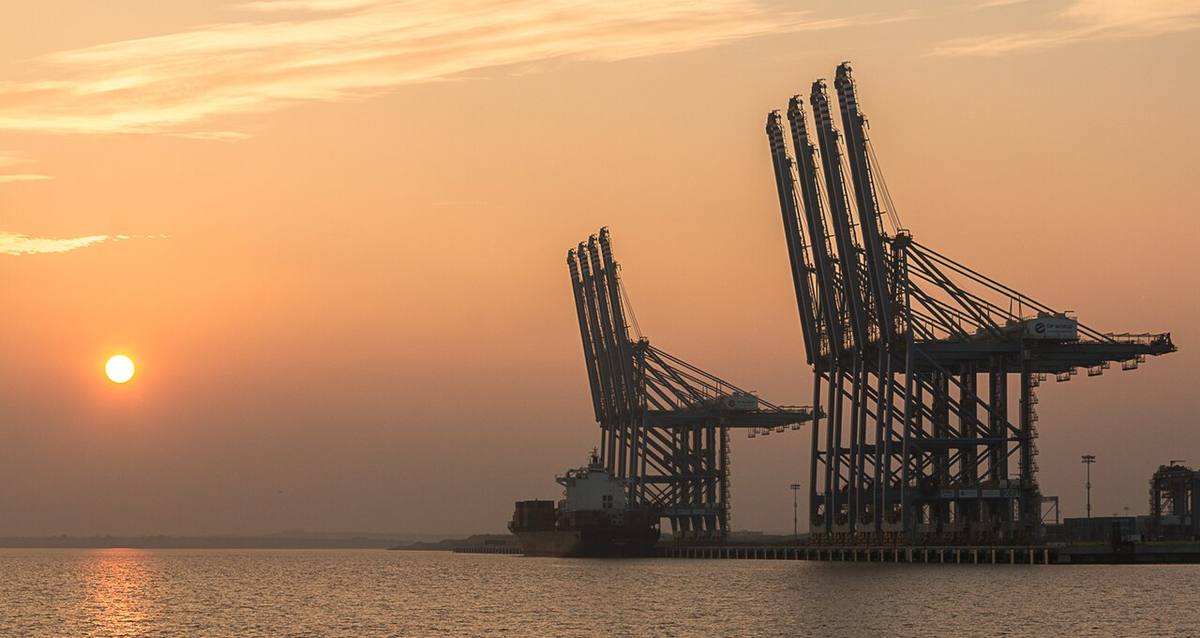
Photo credits: cover - London Gateway container terminal at sunset by Christine Matthews, licensed CC BY-SA 2.0, via Wikimedia Commons.