Most overseas buyers file Suzhou under one line: “that garden city near Shanghai.”
That is a sourcing mistake with a measurable cost. Suzhou is the second-largest industrial city in China by above-scale output, and its four belts - electronics and precision engineering, contract electronics and displays, textiles and elevator components, German-invested machinery - sit within an hour of each other. You can audit a connector plant in the morning, watch an injection-moulding trial after lunch and inspect a knitted-garment line before the evening train back to Shanghai.
This article covers five things: whether Suzhou is worth the trip (public 2025 numbers), where the four belts actually are, why inspection here is documentation-led rather than market-led, how export runs from Taicang Port and Suzhou’s rail link, and agency fee ranges plus a verification checklist.
Start With Six Numbers: Is Suzhou Worth the Trip?
| # | Fact | Figure | Source |
|---|---|---|---|
| 1 | GDP (2025) | RMB 2,769.51 billion (CNY 2,769.51 bn), +5.4% at constant prices; secondary industry RMB 1,284.44 bn (+5.6%), tertiary industry RMB 1,464.18 bn (+5.2%) | Suzhou Municipal Bureau of Statistics / NBS Suzhou Survey Team, 2025 Suzhou Economic Performance, released 2026-02-02 |
| 2 | Above-scale industrial output (2025) | RMB 4,896.64 billion, +3.9%; above-scale industrial value added +7.6%; electronics +5.1% and equipment manufacturing +4.2% together contributed 75.8% of the output growth; hi-tech industries are 56.2% of above-scale industrial output | 2025 Statistical Communiqué of Suzhou, Suzhou Municipal Bureau of Statistics, 2026-04-30 |
| 3 | Foreign trade (2025) | RMB 2,811.93 billion, +7.4% — a record high; exports RMB 1,760.87 bn (+7.6%), imports RMB 1,051.05 bn (+7.1%) | Same communiqué; customs data via Suzhou Bureau of Commerce, 2026-01-23 |
| 4 | Export mix (2025) | Machinery and electrical products RMB 1,393.01 bn (+8.1%), 79.1% of exports; hi-tech product exports RMB 870.08 bn (+8.0%), 49.4% of exports; integrated-circuit imports RMB 437.95 bn (+18.6%), 41.7% of all imports | Same communiqué |
| 5 | Kunshan (2025) | GDP RMB 561.53 billion (+5.8%); above-scale industrial output RMB 1,302.79 bn; output included 16.37 million computer units, 72.17 million mobile phones and 102 million LCD panels; one RMB 100-billion-plus IT cluster and 11 RMB 10-billion-plus clusters | 2025 Statistical Communiqué of Kunshan, Kunshan Municipal People’s Government |
| 6 | Taicang and its port (2025) | 560+ German-invested companies - about 10% of China’s German manufacturing firms, including 60-plus hidden champions and six of Germany’s top-ten machine-tool makers; Taicang Port handled 8.736 million TEU (+5%) and 299 million tonnes (+3.4%), and exported 900,000 vehicles | Taicang 2025 statistical communiqué and government work report; Xinhua, 2026-02-26 |
Read three of these together:
- The city sells documentation, not price. Machinery and electrical products are 79.1% of exports and hi-tech products 49.4%, and integrated circuits alone account for 41.7% of everything Suzhou imports. A belt this deeply embedded in tier-1 supply chains runs on drawings, spec sheets and test reports: the factories expect to be asked for them, which is good news for a buyer who brings a specification and bad news for one who brings a photo.
- Growth is real but it is not coming from cheap labour. Above-scale industrial value added rose 7.6% while total output rose 3.9% - capacity is going into higher-value work, and integrated-circuit wafer, industrial-control-instrument and industrial-robot output grew 13.6%, 33.0% and 20.6% respectively. If your product is a commodity where the last 3% of unit price decides the order, Suzhou is usually the wrong belt. If it is a component that has to pass a test, it is often the right one.
- The trade is diversified. Exports grew faster than imports, trade with Belt-and-Road countries rose 17.3% to 45.0% of the city’s total, and cross-border e-commerce trade grew 92.1% in a year. Factories here are used to overseas buyers, foreign paperwork and third-party inspection, and many of them are already audited by European or American customers.
The Four Belts - and the Rest of the City
Suzhou is not a market city like Yiwu or a single-cluster city like Zhongshan. It is a prefecture with a core city plus four county-level cities, each of which owns a different industry. Knowing which one owns your product is what decides the price, the MOQ and the shipping leg.
| Belt | Focus | Typical export products | Sourcing notes |
|---|---|---|---|
| Suzhou Industrial Park / SIP | Electronics, precision engineering, medical devices, semiconductors | Connectors and harnesses, sensors, PCBA, power supplies, precision metal and plastic parts, medical equipment | The China-Singapore flagship park, founded 1994. In the first half of 2025 its GDP reached RMB 193.04 bn and its trade RMB 378.1 bn - close to 30% of the whole city. Documentation and supplier systems are as good as any belt in China, and prices reflect it |
| Kunshan | Contract electronics, notebooks, displays, phones, tooling | Notebook and tablet assembly, LCD panels and modules, phone accessories, injection-moulded and die-cast parts, tooling | The city’s IT cluster passed RMB 1 trillion in combined output and its two leading industries crossed that line together. Suppliers are moving from “notebook chains” to handset and auto-electronics chains, so ask where your product sits in that shift |
| Wujiang | Textiles and apparel; elevators and escalators | Woven and knitted fabric, home textiles, garment OEM, elevator and escalator components, doors and control panels | Wujiang’s 2025 GDP was RMB 276.287 billion (+5.7%), and Shengze is one of the largest silk and synthetic-fabric trading towns in China. Fabric is bought on lab-dip and GSM, elevator parts on drawings - two very different inspection disciplines under one district government |
| Taicang | German-invested machinery, auto parts, new energy, logistics | Precision machinery and machine-tool components, automotive parts, new-energy drive components, moulded and machined parts | Over 560 German-invested firms, and local content for new-energy drive systems is reported at around 70% within a few kilometres. This is the belt for engineers: expect DIN-standard documentation, tight tolerances and quote comparisons that live or die on tolerance class |
| Changshu / Zhangjiagang / Xiangcheng / Suzhou New District | Metallurgy, knitwear, furniture, electronics and PV | Steel and metallurgical machinery (Zhangjiagang), knitwear and down apparel (Changshu), furniture (Xiangcheng Likou trade area), electronics, auto parts and solar (Suzhou New District) | Suzhou New District’s 2025 GDP was RMB 197.67 bn with hi-tech industries at 60.6% of above-scale output and 40 Fortune Global 500 firms invested in 62 local projects - a useful second source for electronics when SIP lead times stretch |
Why the Suzhou Playbook Differs From Guangzhou
Buyers who already source in the Pearl River Delta often arrive with the wrong reflexes. Three differences decide whether a Suzhou order goes smoothly:
- Quotations assume a drawing, not a photo. A Guzhen lighting supplier will quote from a product picture. A Suzhou electronics or machinery plant will ask for the drawing, the material, the tolerance class, the annual volume and the test standard before it commits to a price. Send those five things first and you get comparable quotes; send a photo and you get a wide range that you cannot compare.
- The certification conversation starts at sampling, not at shipping. Because so much of the output is already exported to the EU and North America, factories here hold CE, RoHS, REACH, UL or IEC reports for many of the parts they make - but “we have the certificate” is worth nothing until you have seen the report, the issuing laboratory and the model number it covers. We ask for the document at the sampling stage, so a compliance problem surfaces before tooling is cut rather than after the container is sealed.
- The MOQ is a tooling decision. In consumer belts, MOQ is usually a factory policy. In Suzhou, injection moulds, die-cast dies and custom connectors mean MOQ is downstream of a one-off tooling cost. That changes the negotiation: instead of arguing about quantity, you agree who owns the tool, whether it is transferable, and how a second year of production is priced.
Inspection: What Actually Decides Accept or Reject Here
The AQL 2.5 sampling plan per ISO 2859-1 still applies to volume production, and a sample table is enough to plan it. What decides the outcome in Suzhou is usually one level below that:
| Product | What we check before release | What buyers most often forget |
|---|---|---|
| Electronics and PCBA | Incoming component verification, solder-joint inspection, functional test, ageing or burn-in, firmware version, ESD and packaging | That the approved sample and the mass-production firmware are the same version |
| Displays and modules | Pixel and uniformity checks, brightness and colour binning, touch function, drop and vibration packing test | That panel grade (A/A-, “industrial”) is written into the specification - the price gap between grades is real |
| Fabric and garments | Lab-dip against the approved standard, GSM and shrinkage, colour fastness, stitch and measurement tolerance, needle and metal detection | That the approved lab-dip is stored against a batch number, not against a memory |
| Machinery and machined parts | First-article measurement against the drawing, material certificates, heat treatment, load or run-in test, marking and packing | That witness points are agreed before production starts, not requested the week of shipment |
| Elevator and door components | Dimensional and fit checks, control-panel function, load and cycle testing, safety documentation | That the component matches the install standard used on site, not just the drawing |
Two practical notes. First, in a belt where 41.7% of imports are integrated circuits, counterfeit or re-marked components are a live risk for electronics buyers: we verify the traceability route of critical ICs, not just the final test result. Second, Suzhou projects are frequently multi-factory - structure from one plant, electrics from another, soft goods from a third - so consolidation and one set of export documents usually matter as much as the inspection itself.
Export and Logistics: Taicang Port, Shanghai and the Rail Option
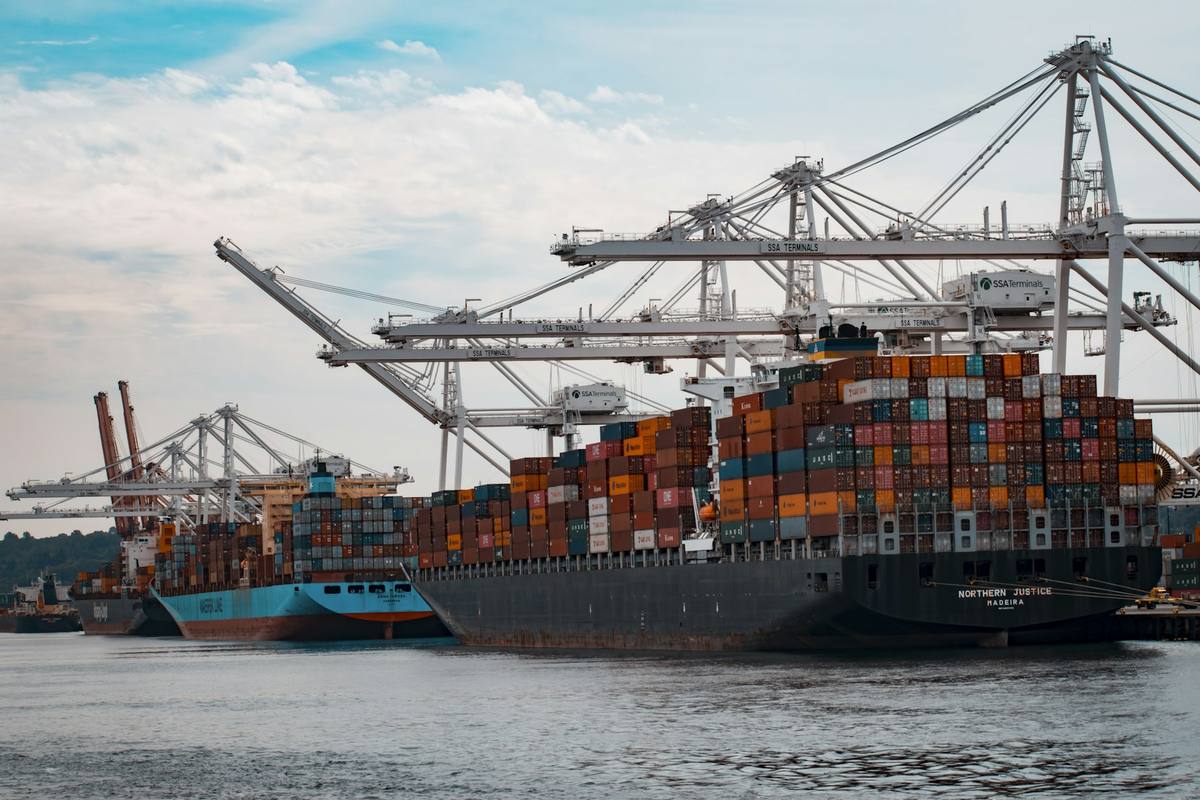
- Taicang Port, inside Suzhou’s own prefecture, handled 8.736 million TEU and 299 million tonnes in 2025 and has direct sailings on the main Asia-Europe and transpacific services. For machinery and heavy components it removes the truck leg to Shanghai that adds cost and handling risk.
- Shanghai is about 100 km away and adds sailing frequency when Taicang’s schedule does not fit; Yangshan, Ningbo-Zhoushan and the rail option are all reachable in the same week. Suzhou also has a working air-cargo front station linked to Shanghai airports for urgent samples and light high-value freight.
- Suzhou Port as a whole moved 613 million tonnes and 10.215 million TEU in 2025 (+5.7% on containers), and the city is one of the Yangtze Delta origins for China-Europe block trains - useful when your buyer wants goods in Central Europe rather than at a seaport.
- Consolidation is the norm. City-wide foreign trade reached RMB 2.81 trillion with cross-border e-commerce up 92.1% and 67 overseas warehouses operated by Suzhou companies, so the warehouse and re-labelling infrastructure for mixed orders already exists. We consolidate multi-factory orders at one point, cut the container count and issue a single bill of lading.
Fee Ranges: Ask for a Written Fee Schedule First
The published scale we work to, confirmed in writing before we start: 5%-8% of the factory invoice price for standard projects, 3%-5% for very large volume orders and 8%-10% for complex or highly technical projects. You see the actual factory invoice, so the commission is visible and there is no markup on the factory price, no listing fee and no retainer to start. Freight is billed at our contracted forwarder cost and inspections or lab tests at the price we are charged.
Typical add-ons in the Jiangsu belt: factory audit around RMB 1,500-3,500 per site, pre-shipment inspection around RMB 700-2,000 per order or RMB 900-1,999 per man-day, with ITP witness attendance, mechanical testing and third-party lab work quoted separately. Be wary of commissions below 3% or “zero commission” - in a belt this capital-intensive it comes back through tooling fees, unit price or freight.
Six things to verify before you send a deposit:
- Legal entity and production address - the business licence, the legal representative and the actual plant address, matched against what the website claims. In Jiangsu, plenty of trading companies present themselves as manufacturers.
- The factory’s own equipment list - for a customs product, the machine that makes it; for electronics, the test equipment, not just the assembly line.
- Who signs the inspection report - an internal quality clerk or an independent inspector you can talk to.
- Ownership of tooling - who holds the mould, and whether it transfers if you move the order.
- Certificate documents, per model - the report, the issuing lab and the covered model numbers, not a logo on a website.
- A written fee schedule - what the commission includes, and whether travel, audit and testing are inside or outside it.
The Three Most Common Pitfalls
Quoting from a photo. Without a drawing, tolerance or test standard, three Suzhou quotes are three different products. Level the specification first, then compare price.
Treating “German-managed supply chain” as a certificate. Taicang’s German-invested factories and their Chinese suppliers are two different things. A local supplier that sits inside a German customer’s chain is a good sign - it is not evidence about your order.
Inspecting at the end. In electronics and machinery, the expensive defects are designed in at sampling and tooling. An AQL check at pre-shipment catches quantity and workmanship; it cannot fix a wrong tolerance class or a firmware mismatch. Agree witness points and first-article approval before mass production.
FAQ
Q1: What does a Suzhou sourcing agent cost? A commission on the factory invoice, typically 5%-8% for standard projects, 3%-5% at very large volumes and 8%-10% for complex or highly technical work, with factory audits around RMB 1,500-3,500 per site and pre-shipment inspections around RMB 700-2,000 per order or RMB 900-1,999 per man-day. Ask for the fee schedule in writing and expect to see the factory invoice.
Q2: What can I source from Suzhou that I cannot get in Guangdong? Precision: industrial connectors, harnesses, sensors, medical-device parts, machine-tool components, elevator and escalator components, technical fabrics and contract electronics at tier-1 quality levels. Suzhou’s above-scale industrial output reached RMB 4,896.64 billion in 2025 with electronics and equipment manufacturing driving 75.8% of its growth. For consumer goods and lighting, the Pearl River Delta usually wins on price and assortment.
Q3: How do I inspect electronics from Kunshan or SIP? Not with an AQL count alone. We combine AQL 2.5 per ISO 2859-1 for workmanship with functional test, ageing or burn-in, firmware-version checks and component traceability on critical ICs, and we store the approved sample with its batch number so the pre-shipment check compares production against that sample rather than against a memory.
Q4: Can you run a project that spans several factories in different cities? Yes - that is the normal shape of a fit-out, medical or industrial order in the Yangtze Delta. We split the bill of quantities across plants in different belts, verify each supplier against the same specification, inspect every batch before loading and consolidate into one shipment out of Taicang or Shanghai. Start from a drawing set or a BOQ and we will tell you which lines Suzhou can hold and which belong in another province.
Q5: How does shipping work out of Suzhou? Taicang Port handles container, bulk and roll-on/roll-off cargo directly from Suzhou - 8.736 million TEU and 299 million tonnes in 2025 - Shanghai adds sailing frequency about 100 km away, and Suzhou is one of the Yangtze Delta origins for China-Europe block trains. We quote FOB Taicang or Shanghai, CIF and door-to-door, and compare forwarder rates on every shipment. Sea transit to Europe and North America is normally three to five weeks port to port; exact schedules and cut-offs are quoted against your booking.
Next Step: Send Us Your Suzhou Sourcing Requirement
Send the drawing or specification + target quantity + destination market, and within 48 hours you get a written plan:
- Belt positioning - whether your product belongs in SIP, Kunshan, Wujiang, Taicang or the Changshu / Zhangjiagang side of the city, down to the park;
- Like-for-like quotes - three to five factories on the same specification, with tax treatment and Incoterms levelled before you compare;
- Inspection plan - the checks that matter for your category, who signs the report, and where witness points sit;
- Export route - Taicang or Shanghai, container type, and consolidation with your other suppliers.
Suzhou city desk: the Suzhou sourcing agent page carries the SIP / Kunshan / Wujiang / Taicang cluster map, the Taicang Port and China-Europe rail options, and the direct WhatsApp line for this city.
For related reading, start with the Guangzhou sourcing agent guide for the Pearl River Delta alternative, our Nanjing sourcing agent guide for the neighbouring Jiangsu industrial base, Xiamen and Dalian for the Fujian and northern belts. Practical tools: the AQL sampling table, the pre-shipment inspection guide, the freight cost calculator and the China procurement agent guide. Service pages: product sourcing, supplier audit, quality control, private label and OEM, warehousing and consolidation and shipping.
Tell us your category and quantity by WhatsApp (+86 139 2270 2227) or email (sales@cantonmade.com), and we will reply within 48 hours.