You have a product idea, or you want to slap your own brand on an existing business, so you start searching for “Chinese contract factories.” The more you search, the more confused you get: someone talks about OEM, someone else says ODM, and a third brings up “private label” and “own brand.” Quotes range from a few thousand units to hundreds of thousands. Business cards from factories pile up in your WeChat, and you can’t tell who’s a real factory and who’s a middleman.
We know this state too well. In 10 years of sourcing and purchasing agency work, almost every client doing wholesale for the first time starts with “I can’t tell these terms apart.” This piece goes deep on OEM / ODM / private-label manufacturing: the difference between the three concepts, how to pick a factory that actually matches your product, how the tooling fee gets split, what the private-label MOQ is, how to keep your design from being copied, and how to avoid the most common contract-manufacturing traps. By the end you’ll know exactly how many gates stand between a design file and a finished product with your brand on it.
How do OEM, ODM, and private label compare in one table?
A lot of people stumble because they use these three terms interchangeably. They represent completely different levels of collaboration and risk:
| Model | Who Does the Design | Who Covers Tooling/Development | Typical Scenario | Your Cost & Risk |
|---|---|---|---|---|
| OEM (contract manufacturing) | You provide design drawings | Factory builds to your drawings; you usually pay the tooling fee | You have a mature design and just want a factory to make it | High investment, high risk, but the product is yours |
| ODM (private label) | Factory provides the design | Factory has an existing ready-made product; you only print your trademark on it | You want to launch your own brand fast without designing from scratch | Low investment, fast to market, but it’s a shared design with lots of competitors |
| Private label (custom on stock model) | You change the logo/color/packaging on a factory’s existing product | Mostly no new tooling, just surface-level customization | TaoBao/Amazon/wholesalers sell under their own brand | Lowest investment, but almost no design barrier |
Easy way to remember: OEM is “your design, factory’s hands”; ODM is “factory’s product, your brand.” Whether you choose OEM or ODM comes down to whether you have your own design and whether you’re willing to invest in development. Most “dropship and private-label” projects on the market are really ODM — the factory product is ready-made and you just swap the label, which is exactly why the entry barrier is so low.
The first step to telling them apart is to take what you want to make and ask yourself this question against the table: Is my differentiation in the “design” or in the “brand”? If you can’t answer, don’t rush into contract manufacturing yet.
How do you pick a factory that actually fits?
A good factory isn’t the biggest one and isn’t the cheapest one — it’s the one that fits your product. These five steps will filter out eight out of ten traps:
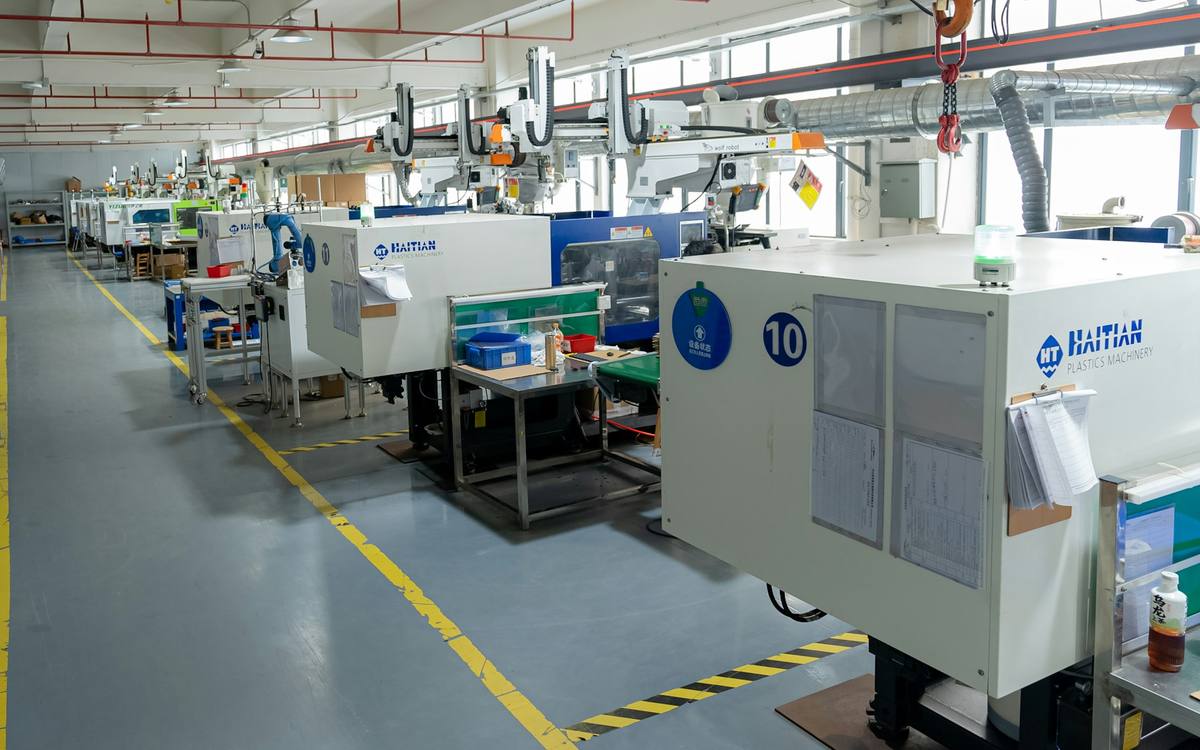
- Vet the factory before you talk price. Don’t judge credentials by the ISO certificates on the wall. Look at: capacity (how much can it actually ship per month), the production line (is the equipment set up for your category), and whether it has its own tooling room and QC line. A “factory” with no QC line is really just an assembly point.
- Ask outright: “Are you really a factory?” One line gives it away: ask “Do you buy raw material yourselves or do you subcontract it out?” A real factory can explain the raw material, the components, and each process; a trading company can’t answer the details. Then ask for a timestamped photo of the shop floor taken today — most fake factories can’t produce one.
- Look at how many orders they’ve done for a similar product. Ask to see recent (not three-year-old) pre-production samples or shipment photos for a comparable product. A factory with no case history in your category means your design is new to them too, and the risk lands on you.
- Start with a small trial order. For your first order, run the whole path from approved sample to minimum quantity. Don’t jump straight to a few hundred units of bulk production. What a trial order exposes (workmanship, tolerances, lead times) is more real than any verbal promise.
- Confirm you’re not the guinea pig. Ask the factory “has this mold ever been run before?” A brand-new mold + a brand-new factory + your first contract-manufacturing order = three unknowns stacked, which dumps all the development risk onto you.
How is the manufacturing cost calculated, including tooling fees?
In a manufacturing quote, the item most often overlooked and most often argued over is the tooling/mold fee. It’s not as easy to understand as a unit price, but it directly determines how much you invest:
| Cost Item | Description | Typical Amount (varies by product) |
|---|---|---|
| Tooling/development fee | Injection molds, hardware dies, stamping dies, silk-screen frames — a one-time investment | From a few thousand to hundreds of thousands RMB (injection molds are usually a few thousand to tens of thousands) |
| Sampling fee | First sample after tooling, or a pre-production sample | Usually a few hundred to a few thousand RMB; higher for large/complex parts |
| Bulk unit price | Material + labor + manufacturing overhead | Quoted separately by the factory per order before shipment |
| Non-standard extras | Certification testing (CE/FCC/UL), special packaging | Needs separate confirmation; usually not in the unit price |
The tooling fee is the heart of every manufacturing negotiation. Remember one rule: whether the tooling fee can be spread into your bulk unit price depends on whether you have follow-up orders. When a factory says “free tooling,” the catch is almost always “you have to order at least X units” or “the mold belongs to the factory and you can only come back to us.” Conversely, if you pay the tooling fee, the mold is your asset — you’re free to change factories and add orders.
The right order for negotiating manufacturing fees: first nail down how much the tooling costs, who owns the mold, and when it’s free or partially refunded, then negotiate the bulk unit price. Don’t open with just “how much per unit” — that leaves the development cost, the thing you most need to settle, hidden for later.
What is the real private-label MOQ?
“What’s the private-label MOQ?” is the single most-asked question in manufacturing inquiries. There’s no universal answer, but by category you can get industry reference ranges (all typical ranges — every factory differs):
| Category | Private-Label MOQ (typical) | Notes |
|---|---|---|
| Electronics (chargers, data cables, small appliances) | 500–1,000 units | Shared tooling is ready; mostly just logo changes; relatively low barrier |
| Apparel/textiles | 200–500 pieces/style | Constrained by fabric minimums; color splits and size splits multiply the requirement |
| Plastic injection parts (own mold) | 1,000–5,000 units | Tooling fee is the bulk of cost; negotiating the mold is the key to lowering MOQ |
| Packaging/printed goods (boxes, labels) | 1,000–5,000 units | Printing plate fee + minimum paper-material order |
| Custom manuals/catalogs | 3,000 units and up | High fixed cost of print typesetting and layout |
Two practical reminders:
- Many factories will agree to a 100–200-unit trial order for your first order — provided you’re willing to bear the tooling/sampling cost, or the product is a ready-made ODM shared-tooling model. If you want to test the market, start with a trial order and scale once it’s proven.
- Ask whether “MOQ 5,000” means 5,000 per SKU. A common private-label trap is to blur “per-SKU MOQ” with “total-order MOQ.” If you order 5 colors and the MOQ is per SKU, that’s actually 25,000 units — always clarify the basis before you talk.
Which contract clause protects your design IP?
The biggest hidden cost in OEM/ODM isn’t money — it’s your design getting copied. In Chinese factories, the reality of “small factories copying big ones, poaching designers, and leaking drawings” does exist. Protection isn’t about luck, it’s about process:
- Sign an NNN agreement before development (Non-Use / Non-Disclosure / Non-Circumvention). What’s actually put in front of the factory is a two-party or three-party confidentiality agreement, not a “don’t worry” in WeChat.
- Hand over drawings in stages, not all at once. Wherever you can withhold core technical details, do so. Let them know “how to make it” but not “exactly how everything is made.”
- Register the IP where it matters. If you’re selling long-term, file a design patent or trademark in China — the cost is low, but domestically it deters your factory and externally it blocks copycats. We can also connect you with Guangzhou lawyers who handle cross-border IP.
- Be wary of unusual enthusiasm from a “cheap factory.” A tooling fee well below market rate, plus a full-chest guarantee they’ll never leak — take it with a grain of salt. Behind the low price, you often find they never intended to keep their word.
What does a complete manufacturing order look like end to end?
Here’s the full chain. Match yourself to it and you’ll know where you are and who to contact next:
Concept discussion → sampling (approved sample / pre-production sample) → iterate until the sample is right → tooling/development investment → bulk production → inspection at each stage → shipping + loading supervision → logistics → arrival at port
The two steps most people “skip” are keeping the approved sample after sampling and inspecting before bulk shipment. A lot of manufacturing failures aren’t because the factory can’t do the job — it’s because those two steps got missed: ① no approved sample kept, so the bulk deviates from the sample; ② no bulk inspection, so the workmanship problem is found only after the goods reach overseas. Especially with your own brand, your name is on it — a problem costs you your reputation, not just this shipment.
Frequently Asked Questions
Q: I’m doing my own brand for the first time. Should I choose OEM or ODM?
It depends on your goal. To launch fast and test a few SKUs, use ODM (factory’s ready-made product + your logo) — low investment and fast to market. To build long-term with your own design barrier, use OEM — more up-front tooling and development cost, but the product is yours. Most brands do it this way: test the market with ODM, and once it works, move to OEM for differentiation.
Q: Is the tooling fee refundable?
Two cases. ① Once the order hits the agreed volume, the factory spreads the tooling fee into the unit price or refunds it — write this clause into the contract before you negotiate. ② The tooling fee is a one-time charge and the mold belongs to you — no refund, but the mold is a fixed asset on your books, so changing factories or adding orders doesn’t put you at their mercy. Never accept “free tooling” without clarifying the conditions — it’s usually tied to future purchasing.
Q: How long does it take from sampling to bulk production?
Sampling usually takes 1–3 weeks; tooling takes two weeks to a month depending on complexity; bulk production typically runs 1–2 months depending on quantity and category. So for a brand-new manufacturing project, budget 2–3 months from concept to your first bulk shipment, and that’s a safe estimate. Rushing the lead time compromises quality — build the timeline into your manufacturing discussions, don’t just stare at the unit price.
Q: Is inspection for contract manufacturing the same as for regular purchasing?
In essence yes, but for your own brand it needs to be stricter. Regular purchasing checks “is this batch acceptable?” Contract manufacturing also checks “does the bulk match the approved sample? Has workmanship been cut anywhere? Is my brand mark printed correctly?” I’d recommend at least a Pre-Production Inspection (PPI) plus a Pre-Shipment Inspection (PSI), with in-line inspection added for critical processes (injection molding, plating, printing). For branded goods, inspection isn’t a cost — it’s insurance.
Q: How do I stop the factory from taking my design and selling it to competitors?
Three actions stacked together: ① sign the NNN before development; ② deliver drawings in stages and don’t hand over core technology; ③ register a design patent or trademark in China to create legal leverage. Add a professional third party to monitor contract and IP enforcement, and you’re far better covered than trying to watch it remotely yourself.
In a Nutshell
OEM/ODM manufacturing isn’t “find a factory to make your goods” — it’s “handing your design and your reputation to a stranger to hold in trust.” Pick the right people, settle the tooling fee and mold ownership, keep the approved sample, inspect the bulk, and protect your design — get those five things right and manufacturing can grow your business; miss any one of them and it can turn into a very expensive lesson.
If you’re getting ready to manufacture or private-label in China, send us your product images, target market, and expected volume. We’ll help you: ① shortlist factories that fit your category ② negotiate transparent tooling fees and mold ownership ③ oversee sampling, inspection, and IP protection end to end. Reach us on WhatsApp at the bottom of the page (+86 139-22702227) or send your materials through the contact page — we’ll get you a written manufacturing proposal within 48 hours. No sales talk.
Related: the sample process, from RFQ to approved gold sample covers the step between the tooling decision and the bulk order.